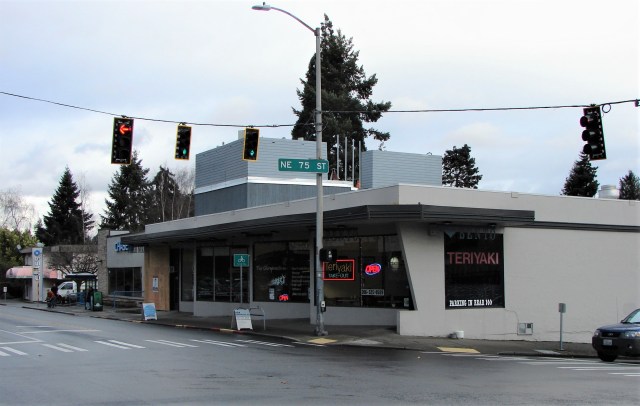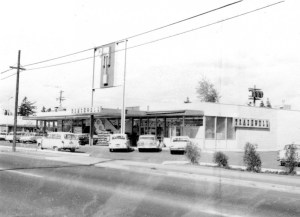
Dairy Queen in Wedgwood

The first Dairy Queen store opened in Illinois in 1940 with immediate success.  The menu started out with ice cream and sundaes but soon expanded to malts, milkshakes, and banana splits.  The company began to register its trademark products and in 1958 the Brazier logo on a DQ indicated that the store had their patented new cooking device using charcoal or electric to grill food.  DQ rapidly expanded its Brazier menu to serve burgers, fries, hot dogs and fried chicken.  In the era of post-World-War-Two population growth and the rise of the fast-food industry, Dairy Queen was very, very successful.

Copyright notice:  text and photos on this article are protected under a Creative Commons Copyright.  Do not copy without permission.

Continue reading

Posted in apartments, businesses, Shearwater | Tagged , , , , , | 5 Comments

The Wedgwood Safeway

The intersection of 35th Ave NE and NE 75th Street had no buildings at any of the four corners until after 1946.

7500 35th Ave NE.January 2020

The square outline of the Ida’s Inn tavern, which closed in 1948, can be seen above the roof of the building at 7500 35th Ave NE, with its storefront system built in 1950.  Photo by Valarie, January 2020.

The only building near to the corner of 75th & 35th was Ida’s Inn at 7500 35th Ave NE, which began as a small grocery store in 1926 and was converted to a tavern after Prohibition ended in 1934.  Ida’s Inn closed in 1948 but the building still exists.  Its square outline can be seen above the rooftop of the stores built in front of it in 1950.

In the period of 1945 to 1950 after the end of World War Two, Wedgwood really began to grow in population and bigger grocery stores started to come in at that time.  In 1946 the Safeway Corporation started planning to build at their present site on the southeast corner of the intersection of 75th & 35th.  In that process they had to apply for the zoning to be changed from residential to commercial.

Copyright notice:  text and photos in this article are protected under a Creative Commons Copyright.  Do not copy without permission.

Continue reading

Posted in businesses, grocery stores, Neighborhood features | Tagged , , , | 8 Comments

Avian Friday: How to Attract Birds

Valarie says:  Our Northeast Seattle Bird Guy, Joe Sweeney, tells how putting peanut butter on your camera is a sure-fire way to attract birds!

Joe Sweeney's avatarShort & Tweet Bird Reports

IMG_2580

This week’s photo, taken March 30, 2013 in Magnuson Park in Seattle, WA, features my first SAVANNAH SPARROW of the year.

When I’m out walking the trails and looking for birds, my best strategy for drawing them in is to get out some food. No, not food for the birds – food for me. Murphy’s Law states, “When you can’t hold your camera or binoculars because your hands are full with food, that’s when the good birds will appear.”

Saturday, I’m standing in Magnuson Park with my binoculars and camera slung around my neck. It’s a gloriously beautiful spring morning, yet there’s not a bird in sight. So I decide to eat some breakfast. I pull out a peanut butter and jam sandwich and take a few bites, and then a few more. When I’m halfway done with my sandwich, I notice a sparrow-like bird flitting from bush to bush…

View original post 159 more words

Posted in Nature and wildlife | Tagged , | Leave a comment

Street-grade: ups and downs in Wedgwood

The Big Green House at 7321 35th Ave NE has a retaining wall around it, showing that the street level has been cut down.

The Big Green House at 7321 35th Ave NE was built in about 1910.  It had a retaining wall around it, showing that the street level has been lowered in the section in front of the house.  The house was demolished in 2015.

Wedgwood’s main commercial corridor is along 35th Ave NE which was first declared an arterial in 1934.  Some improvements were made at that time, including some widening and some road-grading to level out the surface and make it more passable for car travel.  More major street improvement efforts came in the 1950s after all of Wedgwood finally came into the Seattle City Limits.

We can still see the results of road-grading on 35th Ave NE in the “ups and downs” of the streets and houses.  Some of the evidences of road-grading in Wedgwood are places where there are retaining walls such as along NE 75th Street next to Safeway, and houses which are either high above or below the level of arterial streets.  The area around the intersection of 35th Ave NE with NE 75th Street has the most examples of ups-and-downs in Wedgwood.

Continue reading

Posted in 7321 35th Ave NE, 7528 35th Ave NE, Big Green House, Houses, streets | Tagged , , , | 3 Comments

The House in the Road

Before NE 80th Street was put through, an old house was

Before NE 80th Street was put through, an old house was “in the road” at the corner of 31st Ave NE.  This photo shows what the corner looked like as of the year 2013, looking eastward on NE 80th Street.  In 2018 this house was torn down and a new house was built, completed 2019.

The years 1945 to 1955, from the end of World War Two until the Wedgwood neighborhood came completely into the city limits of Seattle, were years of rapid change.  The population of Seattle had swelled with war workers in the 1940s, creating a housing shortage.  After the end of the war in 1945 there was even more of an increase in housing demand, as soldiers returned from war, married and sought to establish homes.

In the 1950s in Wedgwood there was a frenzy of housebuilding with the associated completion of streets, but in some places in Wedgwood the once-rural roads could not easily be put through.  For more than three years, from 1953 to 1956, a Wedgwood homeowner fought back when the City of Seattle informed him that his house was “in the road” and would have to be moved out of the way.

Continue reading

Posted in Controversies, Houses, Plat names, streets | Tagged , , , , , | 2 Comments

Avian Friday: Watchable Wildlife

Great Blue Heron WA Dept of Fish and Wildlife

Photo of Great Blue Heron courtesy of the Washington Dept of Fish & Wildlife.

It’s Spring, and the Great Blue Herons are in their communal nesting sites called rookeries, large nests often built out over waterways.  Through the Watchable Wildlife resources, you can observe birds in real time on the WildWatchCams.  HeronWatch is just one of the choices — watch nature as it happens!  More updates are on the Facebook page of the Washington Dept. of Fish & Wildlife, including more photos of birds and information on animal activities in the Spring season.

Posted in Nature and wildlife | Tagged , | Leave a comment

Hamburgers in Wedgwood

Wedgwood of the 1950s was a still-developing neighborhood with a lot of house construction in progress.  Although Albert Balch’s original group of Wedgwood houses was finished (from NE 80th to 85th Streets on the west side of 35th Ave NE) work was still ongoing on the east side of 35th Ave NE in other plats such as Wedgwood Park.  Later in the 1950s Balch began building houses farther west of 35th Ave NE, including property sold to him by the Picardos, from 28th to 30th Avenues NE.

Tradewell-old-QFC-1962

The Tradewell Grocery Store as pictured in 1962, was built in 1959 and is the present site of QFC at 8400 35th Ave NE. Photo courtesy of Seattle Municipal Archives image 76718.

In the 1950s the commercial district of Wedgwood was not finished yet, either.  There were some small cafes, delis and convenience stores but no sit-down restaurants and no hamburger drive-ins.  Many new stores were going in, including Tradewell at the present site of QFC, 8400 35th Ave NE.  This big piece of property from the corner of NE 82nd to 85th had never had any buildings on it during the long-time ownership of the Fulton family.

After Balch acquired the property in October 1942 he used the site for storage and parking of his construction equipment and materials until such time as he had another place to put everything.  Tradewell then leased the property and built a new store which opened in 1959.  The other buildings on the site, including the Wedgwood Broiler, Homestreet Bank and others, were not built until much later.

In the 1950s as Wedgwood grew as a neighborhood, there was not any planning of what kinds of businesses would be put in.  At first, the neighborhood seemed to be mostly characterized by gas stations.

Continue reading

Posted in Balch, businesses, community club (old), Controversies | Tagged , , , | 8 Comments

Names in the Neighborhood: from Pontiac to Wedgwood

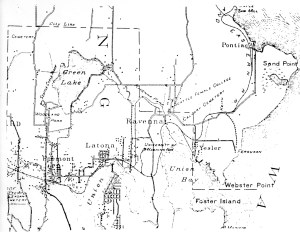
McKee’s Correct Road Map of Seattle and Vicinity, 1894, shows the railroad line. Courtesy of the Seattle Room, Seattle Public Library. The snaking line of the SLS&E Railroad is shown through the communities of Fremont, Latona (Wallingford), Ravenna, Yesler (Laurelhurst) and north past Sand Point. Block dots indicate population clusters. Calvary Cemetery, established 1889, is a point of reference at the corner of NE 55th Street and 35th Ave NE.

In 1887 the Seattle, Lake Shore & Eastern Railroad was up and running, a line now followed by the Burke-Gilman Trail.  The railroad paralleled streetcar lines from downtown Seattle as far as Fremont which was a major transportation hub for people to continue on to residential districts like Green Lake.

The SLS&E Railroad was mainly for industrial use, so it travelled eastward to the sawmill village of Yesler (Laurelhurst) and then north along the shore of Lake Washington past various freight stops.

The ultimate goal of the railroad was the coal fields near Gilman (Issaquah) east of Seattle, as well as carrying loads of bricks and lumber from the stops along the way.  With the coming of the railroad and the ability to send and receive goods to and from downtown Seattle, businesses, mail stops and villages sprang up along the route of the SLS&E.

Passenger cars could also be attached, and early Seattleites enjoyed traveling out to Snoqualmie Falls.

Copyright notice:  text and photos on this article are protected under a Creative Commons Copyright.  Do not copy without permission.

Continue reading

Posted in Maple Creek ravine, name of the neighborhood, Plat names | Tagged , , | Leave a comment

Names in the Neighborhood: from Decatur to Thornton Creek

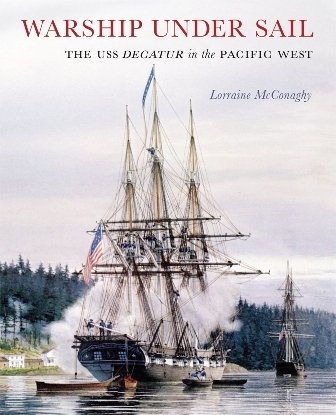
Seattle historian Dr. Lorraine McConaghy wrote this book about the USS Decatur, the ship that saved Seattle.

Seattle historian Dr. Lorraine McConaghy wrote this book about the USS Decatur, the ship that saved Seattle.

Author’s note: This article is about the name of a school in the Wedgwood neighborhood.  If you are looking for an outline of the history of the Thornton Creek watershed and The Confluence at Meadowbrook, go here.

The US Navy sloop-of-war Decatur became known as “the ship that saved Seattle” on January 26, 1856.  At dawn that day Seattle’s less-than-two-hundred white settlers huddled in a blockhouse at the present site of First & Cherry Streets while gunfire came from unseen attackers behind the tree line along Third Avenue.  Seattle had been in existence only a little more than four years and the dense forest had been cut back only that far.

In 1855-56 the rapid, forceful, unfair process of treaty-making with Indian tribes resulted in turmoil which was later called the Puget Sound Indian War. Tension and fear increased when word came of killings in the White River Valley (Auburn.)  Those who had escaped fled to Seattle for protection.  In preparation for a possible attack, Seattle’s settlers built two defensive structures called blockhouses, and these were collectively named Fort Decatur in honor of the ship. Continue reading

Posted in name of the neighborhood, Neighborhood features, Plat names, School histories, Shearwater | Tagged , , , , , , | 5 Comments

The Thornton Creek Confluence at Meadowbrook Pond

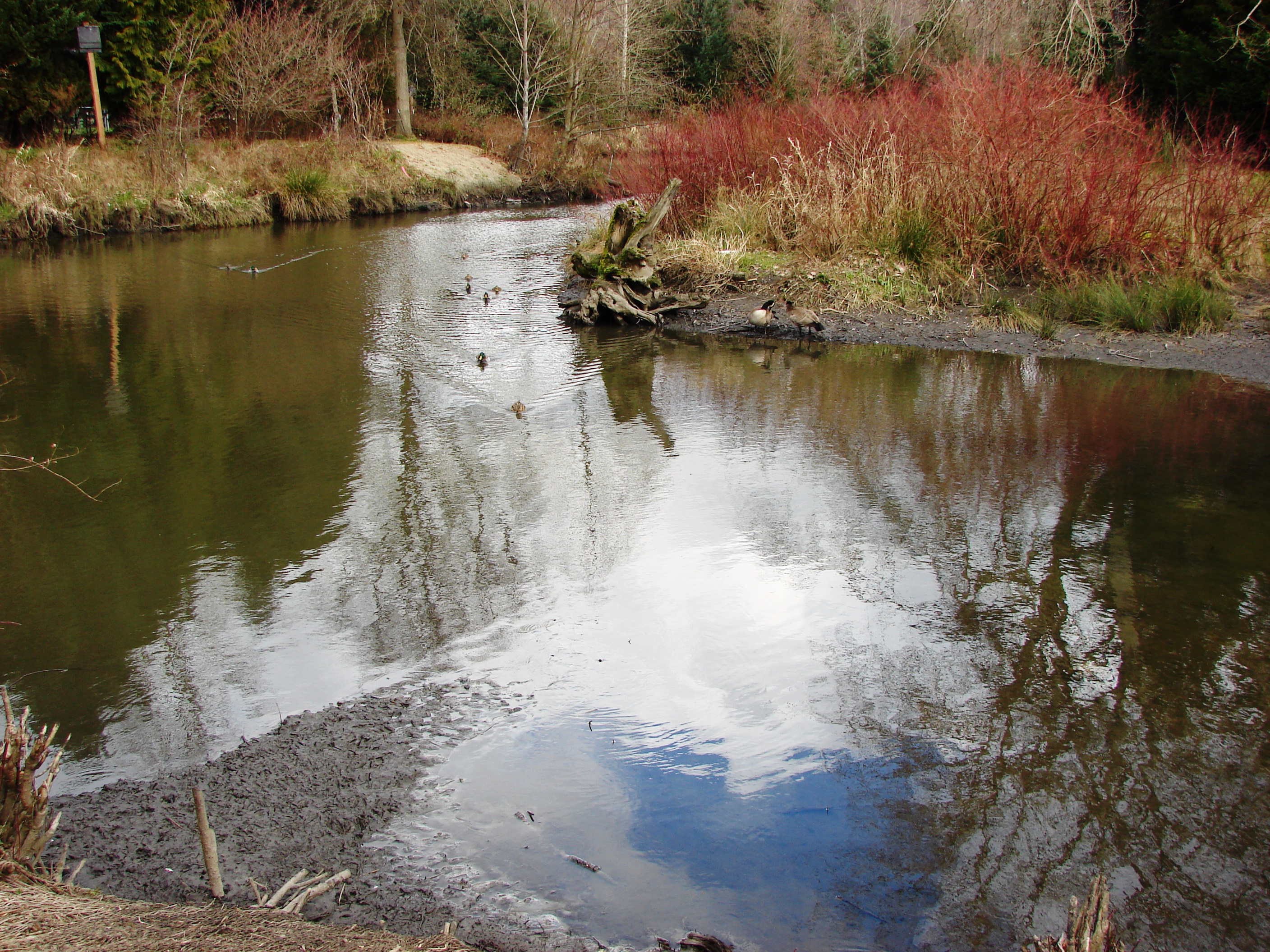
Meadowbrook Pond is located on the east side of 35th Ave NE at NE 107th Street.

Meadowbrook Pond is located on the east side of 35th Ave NE at NE 107th Street.

The Thornton Creek Watershed is a system of big and small streams which drain the region of northeast Seattle, with the final outflow into Lake Washington at Matthews Beach, at about NE 93rd Street.

The watershed has two main branches, one originating near Ronald Bog Park (at NE 175th Street & Meridian Ave North) and the other from a wetland near North Seattle Community College (100th & Meridian.)

At this writing, no documentation has been discovered, as to the source of the name “Thornton Creek.”  If it was an honorary name, Thornton Creek might have been named for John Thornton, an early resident of Washington Territory who served in the territorial legislature.   John Thornton lived in the Port Townsend area.

The two branches of Thornton Creek are called the North Fork and South Fork, and they combine at Meadowbrook Pond on the east side of 35th Ave NE at NE 107th Street.  The area is called The Confluence because the two Thornton Creek branches join here.  The Meadowbrook Pond, first developed by Seattle Public Utilities at The Confluence in 1996-1998, has become a successful site for collecting, slowing and filtering the water before its final flow into Lake Washington.

Continue reading

Posted in Meadowbrook neighborhood, Thornton Creek | Tagged , , , , , | Leave a comment