Albert Balch, Part Five: Spreading Wedgwoods Everywhere

In November 1888 two young men, employees of the Post-Intelligencer newspaper in Seattle, quit their jobs and went into real estate. They didn’t have any formal training in such work but their knowledge of the city and their belief in its potential led them to launch out into the buying and selling of land. Just six months later, Seattle’s Great Fire of June 6, 1889, caused an explosion in the value of real estate and in the potential for expanding and developing new areas of the city for industry and for housing. Samuel Crawford and Charles T. Conover were on their way, and became one of the best-known and trusted names in real estate and development in Seattle.

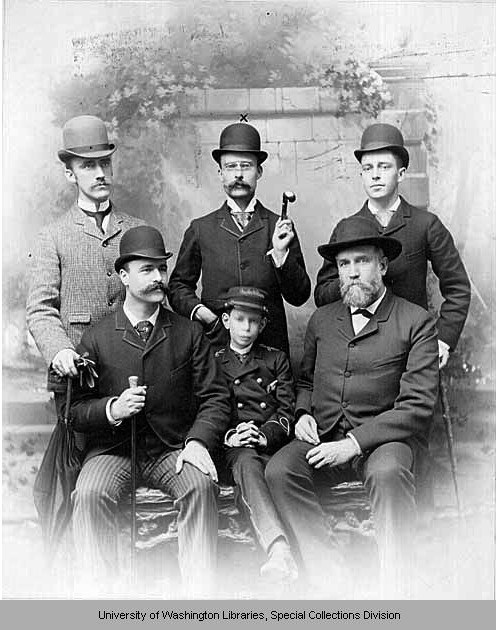
Crawford and Conover 1890 UW Special Collections

Real estate office of Samuel Crawford (seated at left) and Charles T. Conover (standing, center) in 1890. Walter Hamley, age 12 (seated, at center) worked as a messenger boy. Photo courtesy of University of Washington Special Collections, PH Coll 503.8.

The remarkable story of Crawford & Conover had parallels forty-seven years later in 1935, when Albert Balch and Ralph Jones left radio work to go into real estate. Like Crawford & Conover in the 1880s, in the 1930s Balch and Jones were bold and optimistic that they could overcome a “down” economic climate.

Incredibly, when Balch and Jones first started out in the 1930s, the real estate firm of Crawford & Conover was still operating.  Samuel Crawford had died in 1916.  Charles T. Conover began the process of retiring from business at age 74 in 1936.  Conover lived to be a very old man, dying in 1961 just two days before his 99th birthday. Albert Balch was one of the honorary pallbearers at the funeral of C.T. Conover.

Continue reading

Posted in Balch, name of the neighborhood, Plat names | Tagged , , , , | Leave a comment

Albert Balch, Part Four: A New Development in Wedgwood

Albert Balch 1903-1976

In the year 1940 Albert Balch was 37 years old and he was at a turning point both personally and professionally.  He had been married seven years and his family had expanded to four children.  His father and mother had died in 1932 and 1939 respectively, so by 1940 Albert Balch had become the “elder generation” with his own children to care for.  Although he and his business partner Ralph Jones had been successful in the View Ridge development in northeast Seattle and they had been able to build their own homes there, Balch wanted to do more.  As Balch thought about what he would do next, he saw that just north of View Ridge there were large areas of undeveloped land.  A plan formed in his mind to “build a city” on the model of colonial America.

Continue reading

Posted in Architecture, Balch | Tagged , , , , | Leave a comment

Albert Balch, Part Three: Learning Real Estate in View Ridge

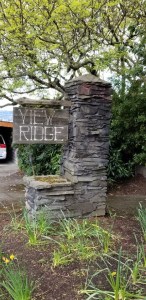
View Ridge marker on NE 65th Street installed by the community club in 1958.

As of January 1936 Albert Balch and Ralph Jones were on their way: they had started a new real estate development called View Ridge and had been able to get some buyers.  Although Balch & Jones had experience in advertising and communications (newspapers and radio) neither had training or experience in real estate and construction.

The two men boldly launched out on an incredible adventure, especially considering the dark days of the 1930s economy called the Great Depression.  It was audacious for the men to quit their jobs and go into real estate full-time under the risky conditions of the economy.  We may wonder whether they told their wives what they were going to do!  Balch & Jones fearlessly set out to jump-start the Seattle real estate market which was at a standstill in the 1930s.

Continue reading

Posted in Balch, Houses, Plat names | Tagged , , | Leave a comment

Albert Balch, Part Two: Finding a Career in the 1930s

Albert Balch, developer of the View Ridge and Wedgwood neighborhoods of northeast Seattle, did not start out to work in real estate.  As many college grads do, at first Balch struggled to find a suitable career.

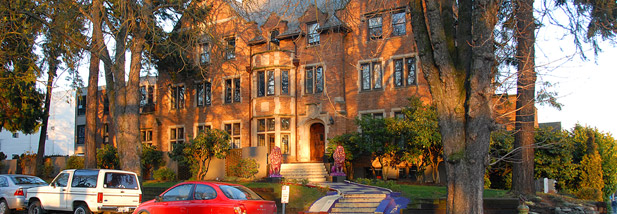
The Sigma Alpha Epsilon fraternity building in Seattle was built in 1925.

The Sigma Alpha Epsilon fraternity building in Seattle was built in 1925, at the northeast corner of 17th Ave NE and NE 45th Street.

Albert Balch graduated from the University of Washington in Seattle in 1926, and for the next two years he was employed by the national organization of the fraternity he had belonged to, Sigma Alpha Epsilon.

In his job as travelling secretary Balch reviewed organizational records and the functioning of the fraternities, whose mission statement was to “turn promising young men into true gentlemen.”  Judging from the activities of Balch and his fraternity brothers after graduation, it appears that having been in Sigma Alpha Epsilon gave the men social advantages as the men went on to respectable careers and civic involvement.  In the period after his graduation Balch was many times noted in the Seattle newspapers as active in groups, such as UW alumni, the Municipal League, and business associations.

Continue reading

Posted in Balch | Tagged , , , , , | Leave a comment

Albert Balch, Part One: Early Life

This series of articles will outline the life of Albert Balch, the developer who, beginning in 1941, built the Wedgwood houses which gave their name to the neighborhood in northeast Seattle.

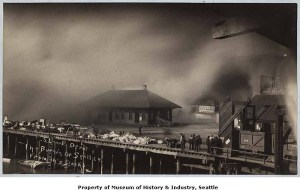
Great Seattle Fire of June 6 1889 waterfront photo.MOHAI Seattle Historical Society photo SHS708A

On June 6, 1889, the Seattle waterfront was enveloped in smoke from fire.  Photo courtesy of MOHAI SHS708A

Balch’s father Albert S. Balch Sr. was from a Michigan farm home, and as a young man in his twenties he went to seek his fortune out West.  Balch Sr. arrived in Washington Territory before statehood and first lived in the Bellingham area of Whatcom County.

An anecdotal family story is that Albert Balch Sr. travelled by boat in Puget Sound from Bellingham to Seattle, because he wanted to have a look at the city and decide whether to settle there.  But it was the day of Seattle’s Great Fire, June 6, 1889, and there was too much smoke drifting over the waterfront to see what the town looked like.  The boat could not dock at Seattle, and Balch Sr. went back to live in Whatcom County.

Continue reading

Posted in Balch | Tagged , , , , | 2 Comments

Working for Mr. Balch

The developer of the Wedgwood neighborhood, Albert Balch, was born in Gem, Idaho, finished high school in Blaine, Washington, and graduated from the University of Washington in Seattle.  In 1934 Balch was thirty years old, married and about to become a father, and his natural ambition and drive caused him to want to improve his status for himself and his family.

Entrance to the “original Wedgwood” on the west side of 35th Ave NE at NE 81st Street.

In the early 1930s Balch was working as a salesman of radio advertising for Fisher Communications.  He had steady employment during the insecure times of the 1930s, yet Balch’s boldness caused him to look for more and better opportunities.  Along with co-worker Ralph Jones, the two men quit their jobs at Fisher Communications because they thought they could do better in real estate.  They dared to take a big risk in the face of the “down” economic times of the Great Depression of the 1930s.

Balch & Jones succeeded in developing and selling house lots in View Ridge, centered along NE 70th Street east of 35th Avenue NE.  After five years’ experience Balch was ready to do even more, so in 1941 he launched out on his own to build what became the Wedgwood development.  The first plat which became the original group of Wedgwood houses was on the west side of 35th Avenue NE from NE 80th to 85th Streets.

As Balch acquired more land and built more sections of Wedgwood houses, in 1949 he established an office at 8050 35th Ave NE, which remained his home base for the rest of his career.  The 8050 building was Balch’s personal office and some of the “back-office” functions such as accounting.  Balch acquired the brand name Crawford & Conover for the real estate sales arm of his business, and the building next door at 8044 35th Ave NE was their office.  The other buildings in the row of offices were built by Balch to provide medical and dental services for the Wedgwood neighborhood.
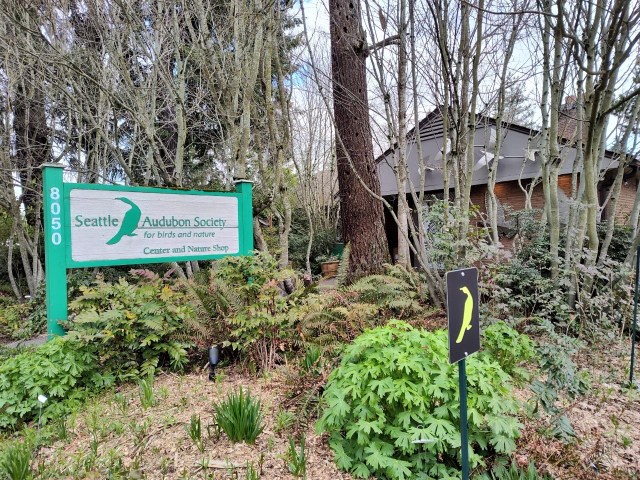
Balch’s original office at 8050 35th Ave NE later was occupied by the Seattle Audubon Society. Photo by Valarie.

Continue reading

Posted in Balch, name of the neighborhood | Tagged , , , | Leave a comment

Dairy Queen in Wedgwood

The first Dairy Queen store opened in Illinois in 1940 with immediate success.  The menu started out with ice cream and sundaes but soon expanded to malts, milkshakes, and banana splits.  The company began to register its trademark products and in 1958 the Brazier logo on a DQ indicated that the store had their patented new cooking device using charcoal or electric to grill food.  DQ rapidly expanded its Brazier menu to serve burgers, fries, hot dogs and fried chicken.  In the era of post-World-War-Two population growth and the rise of the fast-food industry, Dairy Queen was very, very successful.

Copyright notice:  text and photos on this article are protected under a Creative Commons Copyright.  Do not copy without permission.

Continue reading

Posted in apartments, businesses, Shearwater | Tagged , , , , , | 5 Comments

The Wedgwood Safeway

The intersection of 35th Ave NE and NE 75th Street had no buildings at any of the four corners until after 1946.

7500 35th Ave NE.January 2020

The square outline of the Ida’s Inn tavern, which closed in 1948, can be seen above the roof of the building at 7500 35th Ave NE, with its storefront system built in 1950.  Photo by Valarie, January 2020.

The only building near to the corner of 75th & 35th was Ida’s Inn at 7500 35th Ave NE, which began as a small grocery store in 1926 and was converted to a tavern after Prohibition ended in 1934.  Ida’s Inn closed in 1948 but the building still exists.  Its square outline can be seen above the rooftop of the stores built in front of it in 1950.

In the period of 1945 to 1950 after the end of World War Two, Wedgwood really began to grow in population and bigger grocery stores started to come in at that time.  In 1946 the Safeway Corporation started planning to build at their present site on the southeast corner of the intersection of 75th & 35th.  In that process they had to apply for the zoning to be changed from residential to commercial.

Copyright notice:  text and photos in this article are protected under a Creative Commons Copyright.  Do not copy without permission.

Continue reading

Posted in businesses, grocery stores, Neighborhood features | Tagged , , , | 8 Comments

Avian Friday: How to Attract Birds

Valarie says:  Our Northeast Seattle Bird Guy, Joe Sweeney, tells how putting peanut butter on your camera is a sure-fire way to attract birds!

Joe Sweeney's avatarShort & Tweet Bird Reports

IMG_2580

This week’s photo, taken March 30, 2013 in Magnuson Park in Seattle, WA, features my first SAVANNAH SPARROW of the year.

When I’m out walking the trails and looking for birds, my best strategy for drawing them in is to get out some food. No, not food for the birds – food for me. Murphy’s Law states, “When you can’t hold your camera or binoculars because your hands are full with food, that’s when the good birds will appear.”

Saturday, I’m standing in Magnuson Park with my binoculars and camera slung around my neck. It’s a gloriously beautiful spring morning, yet there’s not a bird in sight. So I decide to eat some breakfast. I pull out a peanut butter and jam sandwich and take a few bites, and then a few more. When I’m halfway done with my sandwich, I notice a sparrow-like bird flitting from bush to bush…

View original post 159 more words

Posted in Nature and wildlife | Tagged , | Leave a comment

Street-grade: ups and downs in Wedgwood

The Big Green House at 7321 35th Ave NE has a retaining wall around it, showing that the street level has been cut down.

The Big Green House at 7321 35th Ave NE was built in about 1910.  It had a retaining wall around it, showing that the street level has been lowered in the section in front of the house.  The house was demolished in 2015.

Wedgwood’s main commercial corridor is along 35th Ave NE which was first declared an arterial in 1934.  Some improvements were made at that time, including some widening and some road-grading to level out the surface and make it more passable for car travel.  More major street improvement efforts came in the 1950s after all of Wedgwood finally came into the Seattle City Limits.

We can still see the results of road-grading on 35th Ave NE in the “ups and downs” of the streets and houses.  Some of the evidences of road-grading in Wedgwood are places where there are retaining walls such as along NE 75th Street next to Safeway, and houses which are either high above or below the level of arterial streets.  The area around the intersection of 35th Ave NE with NE 75th Street has the most examples of ups-and-downs in Wedgwood.

Continue reading

Posted in 7321 35th Ave NE, 7528 35th Ave NE, Big Green House, Houses, streets | Tagged , , , | 3 Comments