Names in the Neighborhood: from Decatur to Thornton Creek

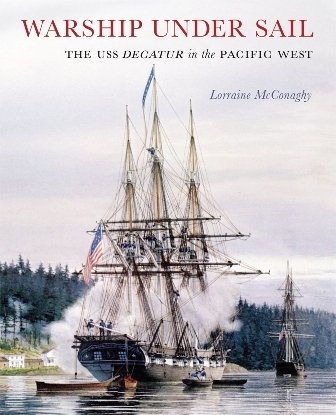
Seattle historian Dr. Lorraine McConaghy wrote this book about the USS Decatur, the ship that saved Seattle.

Seattle historian Dr. Lorraine McConaghy wrote this book about the USS Decatur, the ship that saved Seattle.

Author’s note: This article is about the name of a school in the Wedgwood neighborhood.  If you are looking for an outline of the history of the Thornton Creek watershed and The Confluence at Meadowbrook, go here.

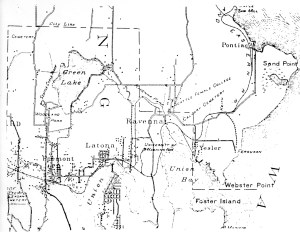
The US Navy sloop-of-war Decatur became known as “the ship that saved Seattle” on January 26, 1856.  At dawn that day Seattle’s less-than-two-hundred white settlers huddled in a blockhouse at the present site of First & Cherry Streets while gunfire came from unseen attackers behind the tree line along Third Avenue.  Seattle had been in existence only a little more than four years and the dense forest had been cut back only that far.

In 1855-56 the rapid, forceful, unfair process of treaty-making with Indian tribes resulted in turmoil which was later called the Puget Sound Indian War. Tension and fear increased when word came of killings in the White River Valley (Auburn.)  Those who had escaped fled to Seattle for protection.  In preparation for a possible attack, Seattle’s settlers built two defensive structures called blockhouses, and these were collectively named Fort Decatur in honor of the ship. Continue reading

Posted in name of the neighborhood, Neighborhood features, Plat names, School histories, Shearwater | Tagged , , , , , , | 5 Comments

The Thornton Creek Confluence at Meadowbrook Pond

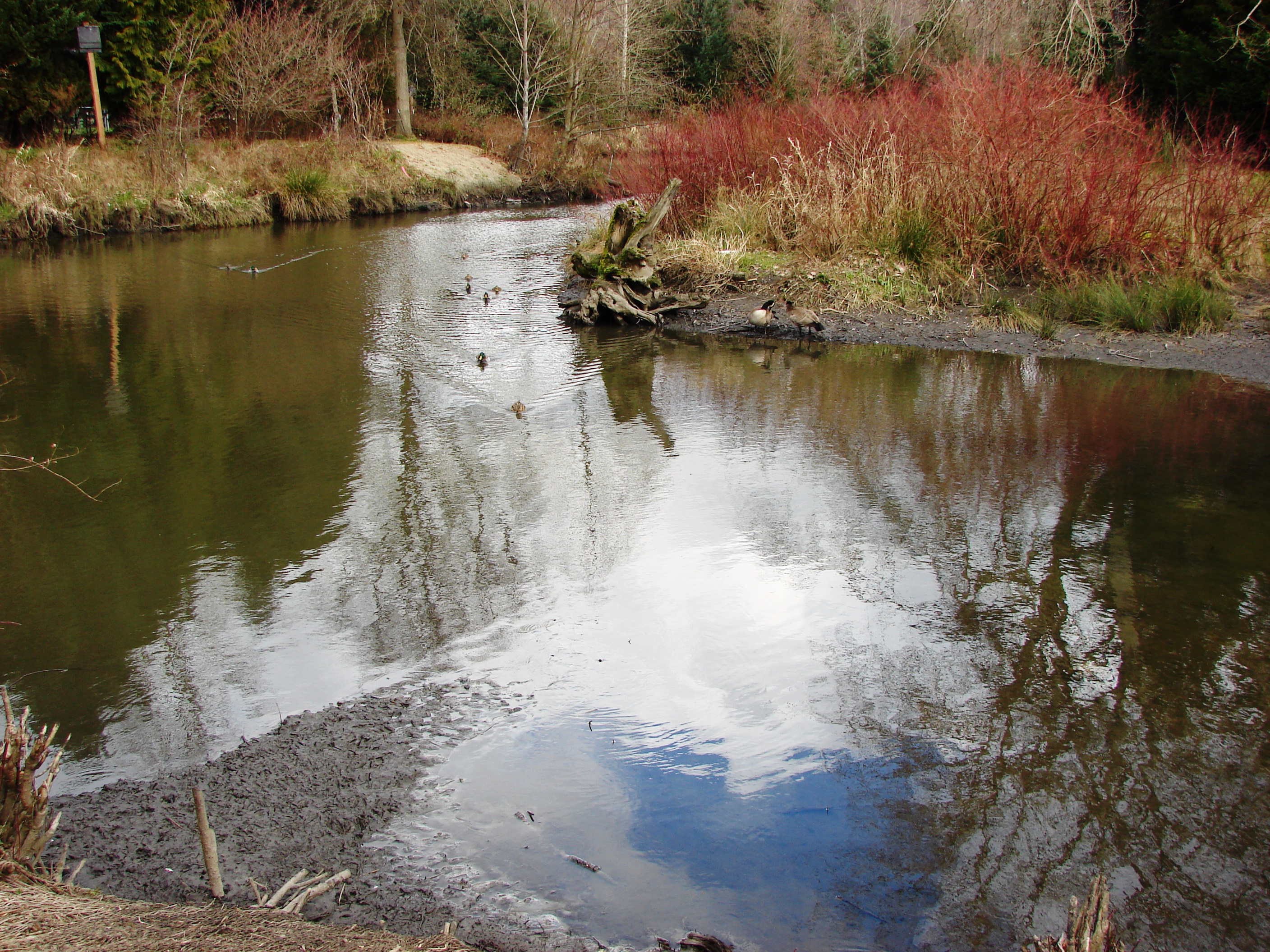
Meadowbrook Pond is located on the east side of 35th Ave NE at NE 107th Street.

Meadowbrook Pond is located on the east side of 35th Ave NE at NE 107th Street.

The Thornton Creek Watershed is a system of big and small streams which drain the region of northeast Seattle, with the final outflow into Lake Washington at Matthews Beach, at about NE 93rd Street.

The watershed has two main branches, one originating near Ronald Bog Park (at NE 175th Street & Meridian Ave North) and the other from a wetland near North Seattle Community College (100th & Meridian.)

At this writing, no documentation has been discovered, as to the source of the name “Thornton Creek.”  If it was an honorary name, Thornton Creek might have been named for John Thornton, an early resident of Washington Territory who served in the territorial legislature.   John Thornton lived in the Port Townsend area.

The two branches of Thornton Creek are called the North Fork and South Fork, and they combine at Meadowbrook Pond on the east side of 35th Ave NE at NE 107th Street.  The area is called The Confluence because the two Thornton Creek branches join here.  The Meadowbrook Pond, first developed by Seattle Public Utilities at The Confluence in 1996-1998, has become a successful site for collecting, slowing and filtering the water before its final flow into Lake Washington.

Continue reading

Posted in Meadowbrook neighborhood, Thornton Creek | Tagged , , , , , | Leave a comment

John Thornton of Early Washington Territory

In the Meadowbrook neighborhood of northeast Seattle, the North and South Forks of the Thornton Creek system come to a convergence point on 35th Ave NE at NE 107th Street.  Since the 1990s intensive work has gone into this site, including the creation of Meadowbrook Pond to collect and filter the water before its final outflow into Lake Washington at Matthews Beach.

The Thornton Creek system with its many tributaries has always been integral to life in Meadowbrook.  Meadowbrook’s earliest settlers took land claims where they would have access to creek water for irrigating crops, and where they would be able to dig wells to obtain fresh drinking water.

In the days of farming in Meadowbrook, different segments and tributaries of the creek were known by the name of the closest resident.  By the 1890s the first land claimants, the Beckers, had sold some of their land but they still lived near what is now Lake City Way at NE 107th Street.  The creek flowed past Beckers’ into the valley of the Fischer farm at the present site of the fields of Nathan Hale High School.

The Nishitani family with their plant nursery at 98th & Ravenna named their tributary Willow Creek for the tree on its banks.  Farther to the east of 35th Ave NE, the converged main stream was known as Matthews since John Matthews owned land from NE 95th Street over to his home on the shore of Lake Washington.

Meadowbrook Pond mossy rocks

Thornton Creek

In the 1990s activists such as Brian Bodenbach, one of the founders of the community group Thornton Creek Alliance, began to bring attention to the health of the creek as a wake-up call about pollution, flooding, and the need to promote clean water for the health of people, plants and animals.

Also in the 1990s government departments such as Seattle Engineering and Seattle Public Utilities worked to create Meadowbrook Pond, first created in 1998, and began to take an overall-view of the entire creek system along its eighteen-mile length.

At that time in the 1990s, the name Thornton Creek began to be better known, but why was this name chosen for the watershed system?  Who was Thornton?  To date, we have not found any evidence of who Thornton Creek was named for.

This blog article will tell about the life of John Thornton, an early settler in Washington Territory.  Even though he never lived in the Seattle area, I speculate that the watershed system might have been an honorary name, because John Thornton served in the early legislature of Washington Territory.

Continue reading

Posted in Land records and surveys, Thornton Creek | Tagged | Leave a comment

The Great Backyard Bird Count 2013

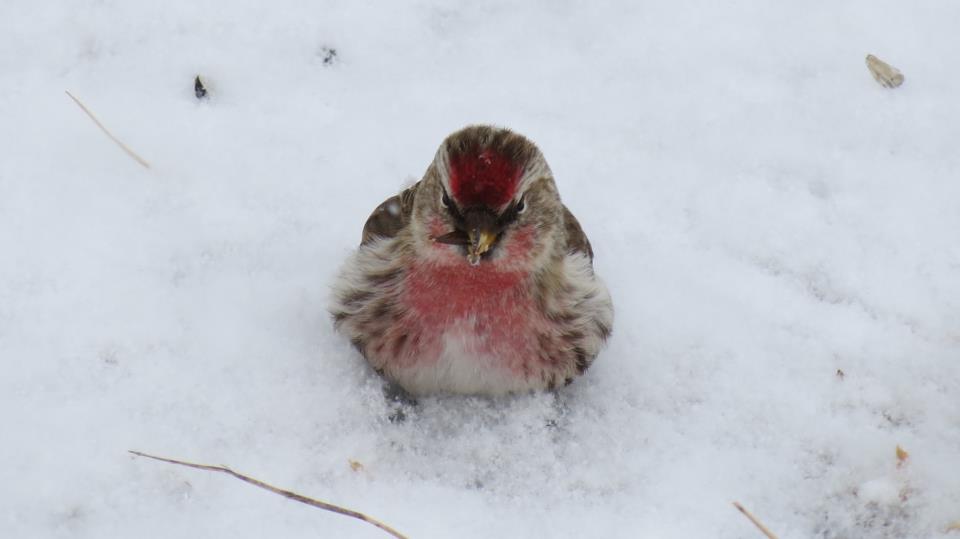
Count me in for the GBBC!

Count me in for the GBBC!

The Great Backyard Bird Count has begun!  From Friday, February 15 through Monday, February 18, anyone may participate.  Go to the webpage to create an account where you will enter your daily totals.  You may count birds for fifteen minutes or more, if you like, on any or all of the days of the GBBC.

What is the purpose of the GBBC?  The annual survey tells scientists where the birds are and in what numbers.  The complex distribution and movement of species tells a story about weather, habitat, and migration patterns.  Getting the “big picture” about bird populations reveals much about the general health of our environment with all its complexities of land, water, vegetation and human population impact upon wildlife.  The GBBC is a wonderful opportunity for anyone, young or old, to contribute to scientific knowledge about our world.

Posted in Nature and wildlife | Tagged , | Leave a comment

Matthews Beach in Seattle in the 1930s

Matthews Beach Park in northeast Seattle is on the shore of Lake Washington, off of Sand Point Way NE at NE 93rd Street.  At twenty-two acres, it is Seattle’s largest freshwater bathing beach, and the beach is only one aspect of the park.  The park has picnic, meadow and play areas.

The park has a direct connection to the Burke-Gilman Trail which crosses over Sand Point Way at NE 93rd Street.  Matthews Beach is the final outlet of Thornton Creek, where it enters Lake Washington.  The creek is visible along the access road into Matthews Beach.

The Matthews family was so willing to share the use of their property with neighbors that the area first began to be known as Matthews Beach in the 1920s while still under private ownership.  The first appeal to the City of Seattle to buy the property was in 1928.  Ironically the Parks Department vigorously opposed the purchase due to differences of opinion between those who wanted to acquire more parks in Seattle, and those who wanted monies to be allocated to maintenance of already-existing parks.

Since the City of Seattle was not able to go ahead with purchase of the Matthews Beach property in 1928, the Matthews family could easily have redeveloped or sold the site at any time.   It is a tribute to their stewardship and the efforts of north Seattle community clubs and activists that finally in 1951, the City purchased Matthews Beach.

Continue reading

Posted in Meadowbrook neighborhood, parks | Tagged , , , | 1 Comment

The Fischer Farm in Meadowbrook

Lake City mapIt is hard for us to imagine the leap of faith made by people who immigrated to America a century ago.  In the 1800s, without the aids of television or radio, immigrants could not get a very clear idea of what America was like or what they would find in that distant land.  Immigrants set out into the unknown, with hopes that in the new country they would find a new and better life.

In the Meadowbrook neighborhood (north of Wedgwood, near to present-day Lake City) some of the earliest settlers were families from Germany.  In Meadowbrook they found opportunity to own land, have a farm, have freedom from restrictions of social class and have a higher standard of living than they would have had in Germany.  Though they were not rich, they did fulfill their immigrant hopes and dreams, and they saw their children grow up as American citizens.

Please note:  text and photos on this article are protected under a Creative Commons Copyright.  Please do not copy without permission.

Continue reading

Posted in farms, Immigrant heritage, Meadowbrook neighborhood | Tagged , , , , , | 7 Comments

Avian Friday: Chickadees

chestnut-backed-chickadee-BirdNoteA commonly-seen winter bird is the chickadee which will come to your backyard bird feeder.  Learn more about this bird at BirdNote, a daily two-minute program on-line and on public radio.

BirdNote seeks to transport people out of the grind of daily life and into the natural world by highlighting birds and our connection to them.  Chickadee Line-up on BirdNote features descriptions and calls of the seven types of this bird family.


Posted in Nature and wildlife | Tagged , | Leave a comment

Yesler Swamp Trail

Valarie says: The Yesler Swamp is a wonderful nature area and bird sanctuary, easily accessed from the east corner of the parking lot of the Center for Urban Horticulture, 3501 NE 41st Street. There is a signboard for starting point of the Trail.  See the Friends of Yesler Swamp page for news of the trail project.

Franz Amador's avatarFranz Amador's Photoblog

20130119-IMG_6279

Back to the Yesler Swamp (part of the University of Washington’s Union Bay Natural Area, on the shore of Lake Washington). As I’ve mentioned before, this area is flooded in a foot or two of water all summer when the Army Corps of Engineers raises the level at the Ballard Locks. That keeps Seattle’s usually jungle-like undergrowth at bay, so in the winter these scraggly old trees lie on open ground instead of being buried in smaller plants. The ground level has to be just right for this to happen, and there aren’t many places around the lake like this. I keep looking for others, but so far this remains the best I know about.

View original post

Posted in Nature and wildlife | Tagged , | Leave a comment

Oriental Gardens in Meadowbrook

A massive earthquake struck the city of San Francisco in the early morning hours of April 18, 1906.  But worse than the damage caused by the earthquake itself were the fires which raged through the city for three days afterward.  Ships coming into the harbor were turned away because there was no place for arrivals to go, and that is how Denjiro Nishitani, immigrant from Japan, came to Seattle instead of San Francisco as he had intended.

Knowing no one in Seattle, Denjiro found his first job as a dishwasher in a restaurant.  From there he made his way to northeast Seattle and worked as a farmhand.  Through his determined efforts to advance himself, within five years of his arrival in Seattle Denjiro became the owner of a plant nursery called Oriental Gardens in what is now the Meadowbrook neighborhood.

Copyright notice:  text and photos on this article are protected by the Creative Commons Copyright.

Continue reading

Posted in churches, Immigrant heritage, Meadowbrook neighborhood, School histories | Tagged , , , | 1 Comment

Avian Friday: Owl at Discovery Park

Valarie says: It’s owl season, but spotting them takes time and patience.  Our thanks to photographer Joe Sweeney.

Joe Sweeney's avatarShort & Tweet Bird Reports

IMG_8976

This week’s photo, taken January 24, 2013 in Discovery Park in Seattle, WA, features a GREAT HORNED OWL, lounging on a limb after working the night shift.

Today, Thursday, I spend a few hours in Discovery Park, Seattle’s largest park. During my outing, bird activity is rather quiet, overall, but a few special sightings make up for the low numbers. At the pond, a SHARP-SHINNED HAWK perches and preens for several minutes. The hawk’s presence probably is the reason no other birds are visible in the immediate area. Meanwhile, in an evergreen tree deep in the forest, yet not far from the pond, a large owl sits close to the tree’s trunk. It has its back to me, but because of its massive size and prominent ear-tufts, it must be a GREAT HORNED OWL. When it eventually turns and looks at me, there is no longer any doubt.

At the…

View original post 85 more words

Posted in Nature and wildlife | Tagged , | Leave a comment