Names in the Neighborhood: Bryant

In northeast Seattle most of the neighborhood names are those of real estate developments such as Wedgwood, which originally was only a plat name.

The builder of the Wedgwood group of houses, Albert Balch, did not deliberately set out to name the neighborhood.  The name caught on gradually and gained popularity when businesses began using it.

Bryant is the neighborhood along the southern portion of 35th Ave NE, northeast of the University Village area.

Prior to Balch’s Wedgwood houses which he started building in 1941, there had been a Morningside real estate promotion which gave its name to the neighborhood in the 1920s.  From the 1940s, the Wedgwood name became the strongest identifier of the neighborhood so that in 1954, the Seattle School District chose it for the new Wedgwood School.

Other real estate developments in northeast Seattle including LaVilla, Inverness, Laurelhurst, Hawthorne Hills, View Ridge (also by Albert Balch) and Lake City, all gave their names to their neighborhoods.

One neighborhood name, Meadowbrook, was derived from the golf course at the present site of Nathan Hale High School.  This was a gradual process where the name seemed to “stick” while other, previously-used names faded.

Before Meadowbrook, a real estate development at NE 110th Street, Chelsea, had been advertised in the 1920s as an area of new homes for young couples.  The name Chelsea faded in use as the Meadowbrook Golf Course became the most prominent identifying feature at NE 110th Street.

The name Meadowbrook had enough staying power to continue to be used even after the golf course closed and a new high school was built on the former golf course site.  In 1961 area residents petitioned to have the new high school named “Meadowbrook.”   But the school district applied rules of how schools were named, and chose “Nathan Hale.”

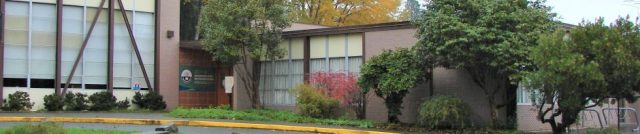
This blog article will tell about the designation of the name “Bryant” for the neighborhood near Bryant School at 3311 NE 60th Street, and the businesses that developed nearby, along 35th Ave NE in early years.

Continue reading

Posted in businesses, churches, gas stations, Immigrant heritage, Neighborhood features, School histories | Tagged , , | Leave a comment

The Trees of October in Wedgwood

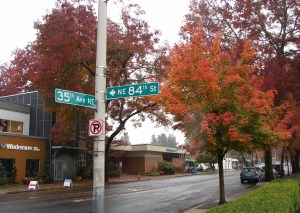
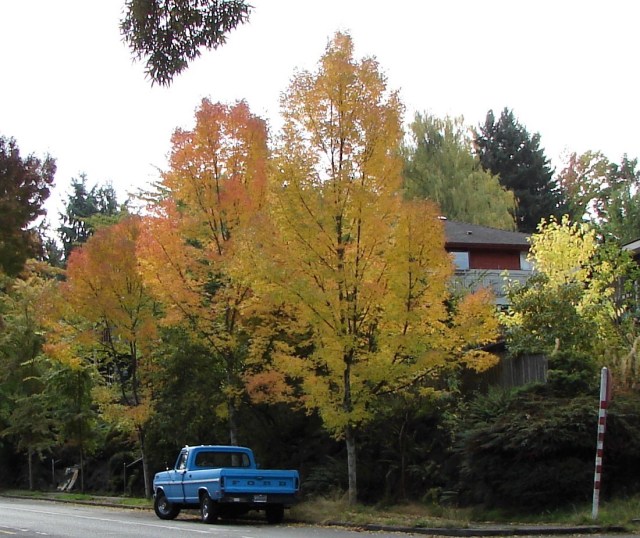
Wedgwood in northeast Seattle enjoys the autumn colors of leaves in October and November.  Street trees called Flame Ash will turn a deep red along 35th Ave NE.

Street trees in Wedgwood’s business district on 35th Ave NE.

The Flame Ash street trees which line 35th Ave NE were planted between 1970 to 1972, and are maintained by Urban Forestry of Seattle’s Department of Transportation.

Flame Ash is a “cultivar” meaning that the trees were grown to have the wanted characteristics and that all the trees in the group would look the same.   Related varieties are Raywood and Marshall Seedless, which were planted on NE 125th Street from Lake City westward to Roosevelt Way NE.

Find a map of Seattle street trees on the City site here.

Wedgwood’s row of Flame Ash trees begins in the heart of the business district at NE 84th Street and continues northward to NE 137th Street where 35th Ave NE merges with Lake City Way NE.  As the rainy season begins, the riot of color of Wedgwood’s trees gives us a warm burst of enthusiasm and enjoyment of the season.

Flame Ash trees along 35th Ave NE in the Wedgwood neighborhood of northeast Seattle.

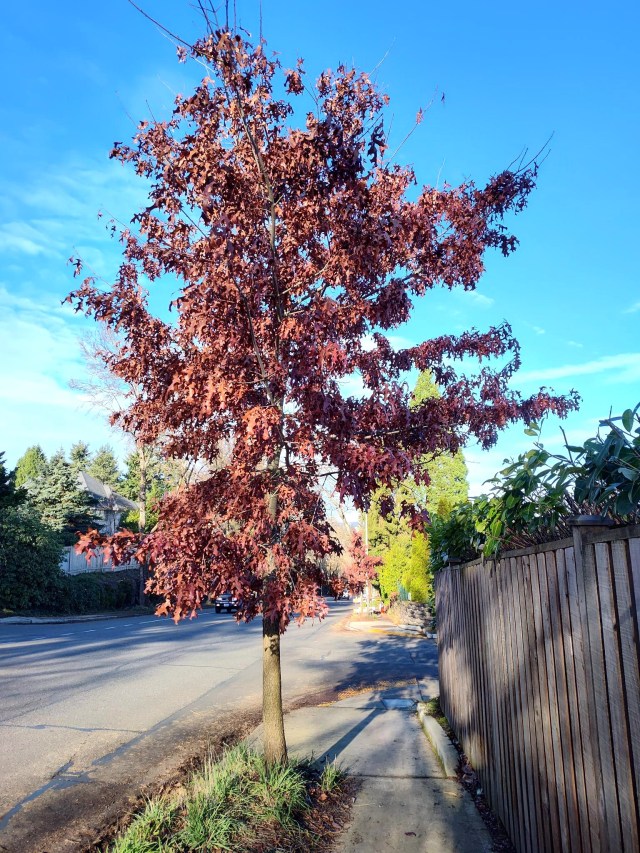
Unfortunately a big storm on November 19, 2024, caused a row of the trees to fall, most especially between NE 100th to 105th Streets along 35th Ave NE.  In January 2025 the City’s street department repaired damaged sidewalks where trees had tipped over, roots and all, breaking up the sidewalks.  It remains to be seen if the City will be able to plant new street trees there.  It can be seen that in recent years, a different variety, pin oak, is being planted instead of flame ash.

In recent years pin oak trees have been planted along 35th Ave NE. They are a smaller variety of tree and they withstood the big storm of November 19, 2024. Photo by Valarie, looking northward on 35th Ave NE at NE 100th Street.

Posted in trees | Tagged , , , , | Leave a comment

September in Flight: Bird Migration

As the weather gets cooler and the leaves begin to change color, birds begin their annual migration.  This article reprinted from All About Birds tells, how, why and where birds migrate.

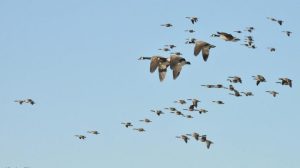
Geese migration

“Geese winging their way south in wrinkled V-shaped flocks is perhaps the classic picture of migration—the annual, large-scale movement of birds between their breeding (summer) homes and their nonbreeding (winter) grounds.

“Geese are far from our only migratory birds. Of the more than 650 species of North American breeding birds, more than half are migratory.”

Continue reading

Posted in Nature and wildlife | Tagged , , | Leave a comment

A Headstone for Captain John M Hoyt at Last

September 4, 2021:
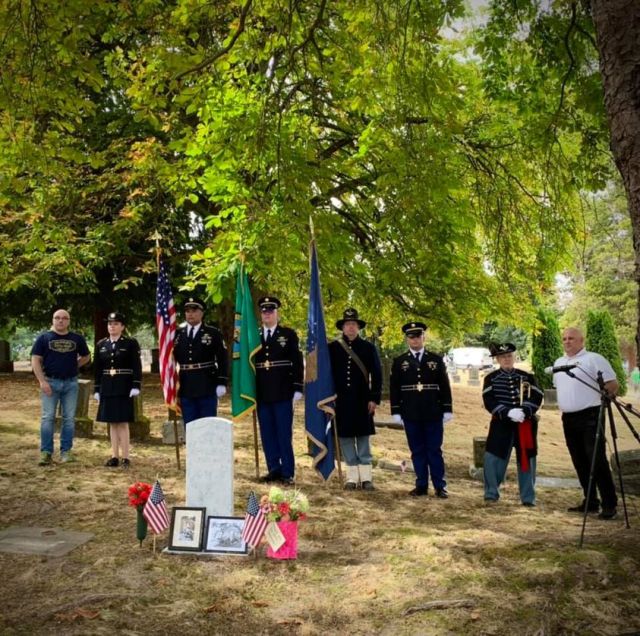
Graveside ceremony to honor Captain J.M. Hoyt, 7th Wisconsin/Civil War. Like many other Civil War veterans, Captain Hoyt later came to Seattle and spent the rest of his life here.

Guest article written by Richard Heisler on the Emerging Civil War blog:  the story of how the unmarked grave of a Civil War veteran was discovered and honored in Seattle.

Continue reading

Posted in Civil War | Tagged , , | Leave a comment

Far Beyond the Sounds of Battle: Seattle’s Civil War Legacy

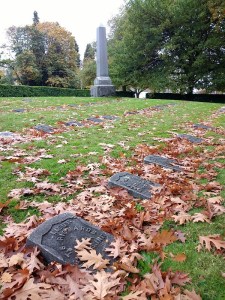
Grand Army of the Republic Civil War veterans cemetery in Seattle

This guest article by Richard Heisler of the Civil War Seattle project is reposted from the Emerging Civil War blog of June 29, 2021.

A letter received in Seattle in 1863, telling of actions during the Civil War, was reprinted in the local newspaper.  Despite Seattle’s remoteness from the rest of the USA, residents of Seattle were anxiously following the actions of the Civil War as they understood its national significance.

In the decades after the Civil War, veterans gradually made their way to the Pacific Northwest and became active members of the community.  Today, the Civil War Seattle project is documenting the lives of these veterans.

Continue reading

Posted in Civil War | Tagged , | Leave a comment

Aretha Curtis and Maple Leaf Gardens

In the years 1915 to 1945 the lives of Americans were bracketed by two world wars with an economic depression in the middle.

For a few years in the 1920s, after the First World War and before the stock market crash of 1929, there was relative prosperity and economic opportunity in the USA.  After the First World War and the ending of the flu epidemic of 1919, everyone looked forward to starting a new phase of life in a peacetime economy.

During the 1920s a young couple, Percy & Aretha Curtis, moved from Spokane to Seattle to start out their married lives.  They became residents of northeast Seattle where Aretha started a flower sales business.

Continue reading

Posted in businesses, Houses, Neighborhood features | Tagged , , | Leave a comment

Laurette Stanley in Wedgwood

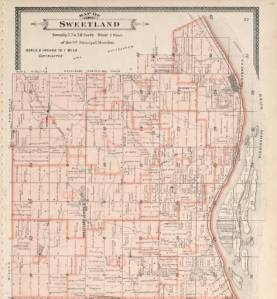
Laurette Augusta Young and Moses Terrell Stanley married in 1869 in Sweetland Township, Muscatine County, Iowa.  Each had come to Iowa as children when their parents migrated from other states to take advantage of the rich farmlands on the expanding Western frontier of the USA.

Sweetland Township, Muscatine County, Iowa, with the Mississippi River at right (map of 1899)

Muscatine County, and the name of Iowa itself, were derived from Native American names for the plains and rivers of the state.  Muscatine was advantageously located on the Mississippi River, Iowa’s eastern border, with Illinois across the river.

Laurette, born in New Hampshire, was only a few months old when her parents decided to move to Iowa.  Laurette would live in Iowa until she was 55 years old, when she became a resident of Washington State.

At age 70 Laurette moved to the future Wedgwood neighborhood in northeast Seattle, where she nurtured the natural environment along the Maple Creek Ravine.  Laurette lived at the eastern end of NE 89th Street until her death at age 95 in 1945.

Continue reading

Posted in Houses, Maple Creek ravine, Plat names | Tagged , , , , | Leave a comment

Martha Hawks, Real Estate Agent in Morningside Heights

In the 1920s the (future) Wedgwood neighborhood first began to be known as Morningside Heights, the name of a real estate development.    Growth was facilitated by the new Victory Way highway, today’s Lake City Way NE, which made it much easier to reach what is now the Wedgwood area in northeast Seattle.

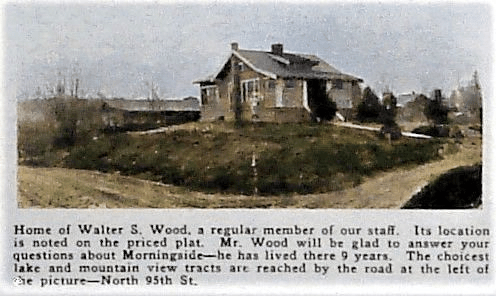
The promoters of Morningside Heights laid out streets and house lots on the west side of 35th Ave NE between NE 90th to 95th Streets.  The developers printed a promotional brochure, and they advertised Morningside Heights in the newspapers.  They had one or more representatives on-site, including the Walter Wood family at 9428 25th Ave NE whose house was the first one drivers would see, when they turned from Victory Way eastward onto NE 95th Street.


Continue reading

Posted in Houses, name of the neighborhood, Plat names | Tagged , | Leave a comment

Alexandrina McKenzie and Real Estate in Early Wedgwood

In the year 1900 Alexandrina McKenzie was a 43-year-old farm wife in Bingham Township, Huron, Michigan, with five of her six children still at home.

The Big Green House at 7321 35th Ave NE was demolished on February 17, 2015.

Ten years later, Alexandrina was a widow in Seattle, supporting herself and her children with income from real estate sales.  Alexandrina was a woman in real estate transactions in the early years of what would become the Wedgwood neighborhood of northeast Seattle.

Alexandrina lived in the 7301 block of 35th Ave NE near what would become the site of the Big Green House.  We don’t know for sure if she was the one who had the house built and lived in it, but the Big Green House story, part of neighborhood history, is still a source of fascination even though the house has been demolished.

In this blog article I will trace Alexandrina’s origins and how her activities paralleled the growth of northeast Seattle.

Continue reading

Posted in 7321 35th Ave NE, Big Green House, Houses, Immigrant heritage | Tagged , , | 1 Comment

Old-Time Stores and Gas Stations on Sand Point Way NE

Establishment of the Naval Air Station on the shore of Lake Washington in 1927 was the catalyst for street improvements and commercial development along Sand Point Way NE.  The City of Seattle officially named Sand Point Way and coordinated with King County in efforts to complete the road and pave it, for better access to the naval base.  With roadway improvements came more access to the area, and then little stores and gas stations sprang up along the way.

Current view of the entrance, former Sand Point Naval Air Station at 7400 Sand Point Way NE. Photo by Valarie.

Today, Sand Point Way NE is a very wide arterial from its point of origination at 45th & Union Bay Place NE, northward as far as the gate of the former Naval Air Station at NE 74th Street (present Magnuson Park).

North of the present Magnuson Park, Sand Point Way NE suddenly narrows down to only two lanes.  With the aspect of a country road, Sand Point Way winds its way along, parallel to the lake shore, until ending with a curve onto NE 125th Street.  This blog article will note stores and gas stations built along the road north of the Naval Air Station at NE 75th Street.

Continue reading

Posted in businesses, gas stations, grocery stores | Tagged , , | 4 Comments