The Roy Land Family of Meadowbrook

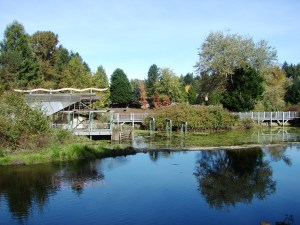
Matthew’s Beach is on Lake Washington at NE 93rd Street. In addition to the beach there are picnic and play areas overlooking the water.

In 1930 twenty-four-year-old Henry Land and his wife were living near NE 97th Street in northeast Seattle, where Thornton Creek flowed past on its way to what is now Matthews Beach.  Henry worked as a mechanic at one of the car companies owned by John Matthews.

John Matthews had come to Seattle in 1910 and engaged in multiple businesses, including logging operations, car sales, and real estate, as well as his original vocation, the practice of law.  In 1923 Mr. Matthews moved to a house on Lake Washington and became part of the northeast Seattle community, later to be called Meadowbrook and Matthews Beach.

Henry Land was concerned for his parents, living near Portland, Oregon and struggling with the lack of work during the 1930s Great Depression years of economic difficulty.  Henry told Mr. Matthews about his father, Roy Land, who was an experienced teamster.  The term “teamster” in those days meant someone who was skilled in harnessing and handling horses to pull wagons, farm equipment, road-grading or excavation equipment.  Mr. Matthews agreed to give Roy Land a job if he came to Seattle.

Continue reading

Posted in Meadowbrook neighborhood | Tagged , , , | Leave a comment

Meadowbrook in Early Years

Where is “Meadowbrook” in Seattle?

City of Seattle map of neighborhood

The Meadowbrook neighborhood in northeast Seattle derived its name from a golf course which was at the present site of Nathan Hale High School. This lowlands acreage with a creek running through it had once been part of the Fischer Farm.  Meadowbrook Golf Course opened in 1931 on the valley of forty acres from NE 105th to 110th Streets, 30th to 35th Ave NE.

In 1960 the golf course was taken by “eminent domain” to become school property. Many in the neighborhood would have liked the new high school to be named Meadowbrook, but it was not to be; the school district’s naming system specified presidents like Roosevelt and historic figures like Nathan Hale.

The Meadowbrook name was kept in some local usage even after the golf course closed.  Current Meadowbrook references are an apartment building on NE 110th Street, the swimming pool & community center at 10517 35th Ave NE, and the Meadowbrook Pond across from it on the east side of 35th Ave NE.  In 1990 a community council was formed for the neighborhood, and today the Meadowbrook Community Council coordinates volunteer work and is a liaison with city info.

Today Meadowbrook is defined as one of the neighborhoods in the greater Lake City area of northeast Seattle.  In a circle around the central Lake City business district are the neighborhoods of Victory Heights, Olympic Hills, Cedar Park and Meadowbrook.

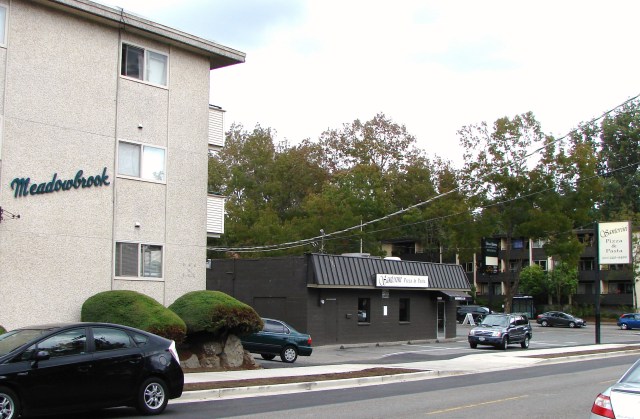
Meadowbrook business district on NE 110th Street at the corner of 35th Ave NE.

Continue reading

Posted in Immigrant heritage, Meadowbrook neighborhood, name of the neighborhood, Thornton Creek | Tagged , , | Leave a comment

The Swansons of Ravenna Valley

The little community of Ravenna in northeast Seattle began to expand in the early 1900s.  Population growth naturally moved in that direction as more people clustered near to the University of Washington.

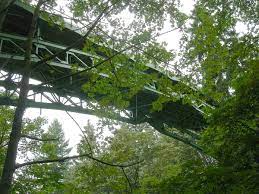
Ravenna Park Bridge on 20th Ave NE, built in 1913.

The growth of northeast Seattle was further stimulated by a world’s fair event scheduled for the summer of 1909 to be held on the university campus.  The fair, called the Alaska-Yukon-Pacific Exposition (AYPE), was of permanent benefit for the development of the campus, and it was the cause of nearby infrastructure improvements such as roads, bridges and streetcar lines.

In the run-up to the AYPE during the years 1906 to 1909, more real estate promotion was done in northeast Seattle which included plats of land divided into house lots.

Census and city directory listings show that in those years a lot of people migrated to Seattle to get in on its economic opportunities.  It can be shown that some of the new arrivals were of “secondary migration,” immigrants who had been in other areas of the USA before coming to Seattle.  Swan Swanson was one of those who had been born overseas, spent time in the Midwest states of the USA as a farmer and then came to Seattle as a carpenter and real estate dealer.

Continue reading

Posted in Dahl Playfield, Immigrant heritage, Plat names | Tagged , , | 2 Comments

Ravenna in Seattle

Where is “Ravenna” in Seattle?

When asked to define a neighborhood we might think of natural boundaries such as ravines or rivers.   There are also man-made dividing lines such as streets and business districts.

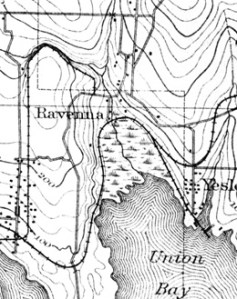
Ravenna map detail

The Ravenna business districts are along 25th Ave NE and NE 50th to 55th Streets, north of today’s University Village Shopping Center.  Ravenna’s origins were as a ravine which became a park, and a scenic stop on Seattle’s early railroad line.  The first cluster of businesses were near to the railroad stop on NE Blakeley Street.

The origins of Ravenna in Seattle

In 1938 long-time real estate agent C.T. Conover began writing a column for the Seattle Times newspaper.  He recounted stories of the old days and told that before he went into business in 1888, George Dorffel was one of only a few others in business full-time selling real estate in Seattle.  Today there is a street named in George Dorffel’s honor, Dorffel Drive, in the Denny-Blaine neighborhood.

Continue reading

Posted in name of the neighborhood, Neighborhood features | Tagged , | 1 Comment

Counting the Civil War Veterans in 1890

Headstone of Captain Hoyt at Mt. Pleasant Cemetery on Queen Anne Hill. Seattle is rich with the history of Civil War veterans.

In the years following the Civil War of 1861-1865, veterans migrated westward to find land and new lives.  By 1890 there were at least 1,000 Civil War veterans in the Seattle area and more in many other parts of Washington State.

The Census of 1890 included a “Special Schedule” which enumerated the veterans.  It was rich with information about where the veterans had served, their war injuries and their current status.  This Special Schedule was to be used in paying out pensions to veterans and widows.

Civil War Seattle is a project documenting the lives of Civil War veterans and how they participated in the growth of the young city of Seattle.  Here below, I am re-blogging an article by author Richard Heisler of Civil War Seattle, telling of the uproar over the Census of 1890 and the Special Schedule.  The article appeared as a guest post on a blog called Emerging Civil War.

Continue reading

Posted in Civil War | Tagged , , , | Leave a comment

The New Thornton Creek School

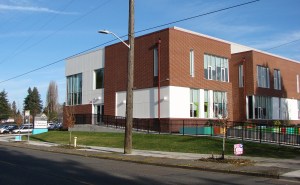
The new Thornton Creek School at 7712 40th Ave NE in Wedgwood.

Decatur School was built in 1961 at 7711 43rd Ave NE on the former site of a Navy housing complex called Shearwater.

In 1967 Decatur became a “program school” with a specific educational approach.  Over the years it had another name, Alternative Education #2, and then in 2008 the name Thornton Creek was chosen.  This program name was meant to characterize the emphasis on awareness of the environment, because northeast Seattle is in the Thornton Creek Watershed.

In the year 2016 the Thornton Creek program moved into a new building.  The Decatur School building is still occupied and has a program called Accelerated Education.

A new school building in the year 2016:
Thornton Creek School opened at 7712 40th Ave NE in September 2016, the first new public school building in the Wedgwood neighborhood in more than fifty years.

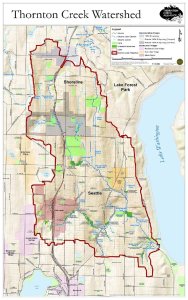
The school building is not on or adjacent to the actual creek but was named in recognition of the Thornton Creek Watershed which encompasses northeast Seattle.  Branches of the creek system converge at Meadowbrook Pond at NE 107th Street and flow out to Lake Washington at Matthews Beach.

There are now two different public schools on the same site, something which has never happened before in Wedgwood.  The Thornton Creek School building is on a ten-acre block which it shares with Decatur School, 7711 43rd Ave NE.  Each school operates separately with its own program.
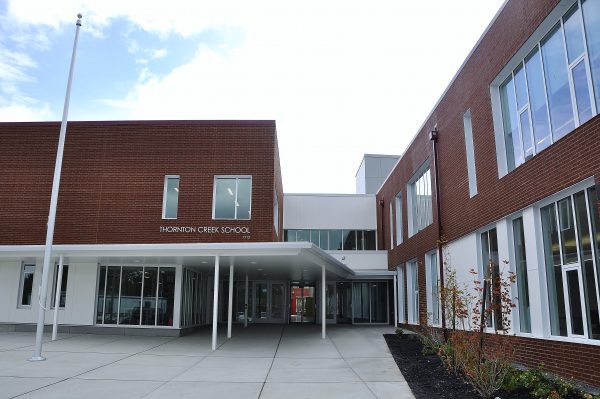
Thornton Creek School at 7712 40th Ave NE opened in September 2016. Before construction, consultants evaluated the site for environmental and historical concerns.

How the new building came to be:

Seattle has always had boom-and-bust population cycles.  Many Seattle residents can remember, in our lifetimes, when economic recessions caused the population of Seattle to decrease instead of increase.  Public school programs suffered from this contraction of economic resources as well as population.  Some buildings were closed and then later upgraded for renewed use, such as Lincoln High School which re-opened in September 2019.

Since passage of the Capital Projects School Levy in February 2013, planning, designing and building came to completion at the new Thornton Creek School.  The design of the building supports the Thornton Creek School learning environment which engages students through exploration and discovery.  The program is called Expeditionary Learning through projects and cooperative work in small groups and across grade levels.

To support small-group work, the design of the building includes gathering spaces.  The large Commons area, also used as the lunchroom, can host several classrooms to see and hear project presentations.

The central commons at Thornton Creek School is designed for multiple uses. It is a lunchroom but can also host classes to hear presentations.

School population:

Thornton Creek had an enrollment of 465 students in the 2016-2017 school year in grades kindergarten through fifth grade, with most grades having four classrooms, and additional students in two preschool classrooms.  There is capacity for the school to grow to 660 students.

The main entrance of Thornton Creek School faces 40th Ave NE. The office is at left, with a foyer where office personnel can see and speak to visitors. Here are school district representatives and community visitors at the open house before the school year began in September 2016.

Access and traffic patterns:

The front door to the new school building faces 40th Ave NE, a few feet north of the corner of NE 77th Street.  There is a drive-up and a canopied main entrance.  The drive-up will be used by special education buses and can also be used by parents when visiting the school.  An additional parking lot is located at the northeast corner of the block at NE 80th Street and 43rd Ave NE.

Morning arrival of students is divided with lower grades entering the school building at the corner of NE 77th, and upper grades from the NE 80th Street side.

The school has an outdoor covered play court on the north side of the building adjacent to the fields and playground.  There is an interior courtyard which leads to a preschool building.

Thornton Creek School has a preschool building accessed from an interior courtyard.

Access and security:

Doors to the school lock automatically when the school day begins.  After that time visitors to the building must come in through the main entrance foyer and check in with the front office.
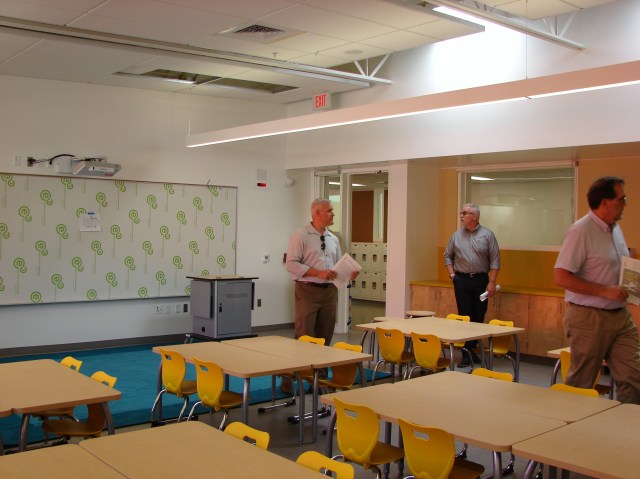
The classrooms at Thornton Creek School are filled with natural light from the exterior windows. They also receive light through the interior windows into the hallway. Each classroom has built-in energy controls, projection equipment and light sensors.

Energy efficiency:

The new building has a geothermal system with heat pumps and use of LED light fixtures with “smart” lighting controls which will dim when no one is in the room or when natural light is sufficient.  Each classroom has an exterior wall of windows and on the interior side along the hallway, there are windows which help let in light.

Alcoves between classrooms let in natural light. These spaces are for collaborative work.  This view shows that the alcove is in a setback of the exterior wall, which was created to preserve the Western Red Cedar trees along the NE 77th Street side of the school.  Photo by Valarie.

Classroom and common space design:

Between each classroom there is an alcove for project work and breakout into small groups.  Teachers can see and supervise students at all times because of the glass-partitioned rooms.  For large-group meetings of multiple classrooms, the core facilities of the dining commons, the library, gym and art/music rooms can be used.

An alcove between classrooms for collaborative work. This space on the NE 77th Street side views one of the large Western Red Cedar trees which were preserved.  Photo by Valarie.

In the Expeditionary Learning model, students typically do presentations to communicate what they have learned.  A presentation might be a written or visual report, or could include writing and presenting a play about the subject they have studied, or by doing a painting or other arts such as music.  Several classrooms can gather in the Commons to hear presentations.

Exterior site development:

The school playfields were restored with pre-germinated grass so that the fields were ready for use when the school year began.  There is a walking track, playground, covered play structure, and a garden with raised planter beds.  A rain garden on the NE 77th Street side is part of the landscaping and new sidewalks have been put in along NE 77th and 80th Streets.

Rain garden on the NE 77th Street side of Thornton Creek School, looking westward towards 40th Ave NE.  Photo by Valarie.

Curb cuts and bike lane markings have been put in on 40th Ave NE at the corners of NE 77th and 80th Streets and there will be flashing crosswalk lights.  Students are encouraged to walk or bike to school via the Greenway on 39th Avenue NE, and a sidewalk has been installed on NE 77th Street between 39th to 40th Avenues NE to aid pedestrians.
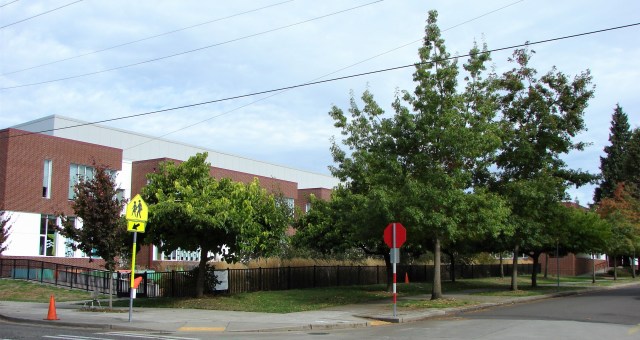
Looking eastward along NE 77th Street at the newly built Thornton Creek School. Photo by Valarie.

Sources:

Information for this article was gathered from the Seattle Public Schools info page, progress updates and attendance at community meetings during the process of building the new school.  I’ve written other articles about how Decatur School was first built, and how the name was chosen for Thornton Creek School.

The ten-acre block containing the two school buildings was once a Navy housing site called Shearwater.
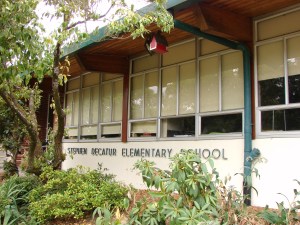
Decatur School, built in 1961, became a “program school” in 1967 and over the years its program name was of Alternative Education.  After renaming itself Thornton Creek, that program has moved into its own building as pictured in this article.

The Decatur School building closed for a year, 2016-2017, to be repaired and upgraded.  Decatur re-opened in 2017 as  a program school for accelerated education.

Another example of an Alternative Education program was at the Pinehurst School, located at the corner of NE 115th Street and Roosevelt Way NE.  That building was torn down in 2015.  A new building opened on the Pinehurst site in September 2016 and was re-named Hazel Wolf K through 8 (name of a noted environmentalist).

The next northeast Seattle school to be torn down and rebuilt will be John Rogers, projected to be finished in the year 2025.

Seattle School Histories were compiled in the year 2000 and are in alphabetical order in this on-line list.

Thornton Creek School looking west along NE 77th Street. We see one of the large Western Red Cedar trees which was preserved. Windows of the hallway alcoves look out to see these trees. Photo by Valarie.
Posted in School histories | Tagged , | 2 Comments

Meadowbrook Pond in Winter

While technically not a park, Meadowbrook Pond is a user-friendly Seattle Public Utilities accessible area with walking paths.  The Pond is on the east side of 35th Ave NE with an entrance marked by signage and boulders, directly across the street from the Meadowbrook Pool & Community Center which is at 10517 35th Ave NE.

The Thornton Creek Watershed of northeast Seattle is a creek system with two main branches, north and south.  The branches converge in Meadowbrook in the block between NE 105th and 110th Streets alongside the arterial 35th Ave NE.  This area is called The Confluence.

Meadowbrook Pond was created at this point in The Confluence to reduce flooding, filter the water and slow the flow of the creek to its outlet at Matthews Beach at NE 93rd Street on Lake Washington.  This blog post will highlight the beauty of Meadowbrook Pond in winter, with photos taken by members of the Friends of Meadowbrook Pond.

Continue reading

Posted in Meadowbrook neighborhood, Nature and wildlife | Tagged , , , | 1 Comment

Candy Cane Lane 2021

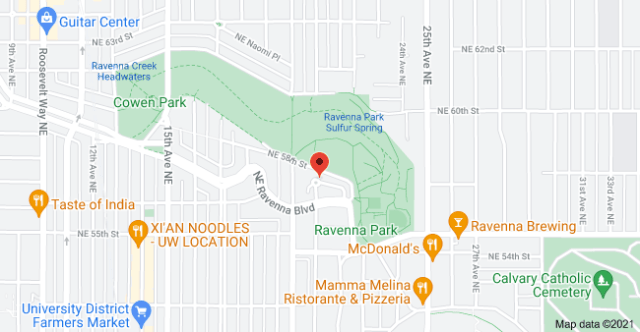
A fun family holiday event in northeast Seattle is the annual Candy Cane Lane lights and decorations.  Located on NE Ravenna Blvd at 21st Ave NE, Candy Cane Lane is a cluster of 1920s houses all decked out for the holidays.

Candy Cane Lane in northeast Seattle

Beginning on December 4, 2021, through New Years Day 2022, you can drive through or walk through Candy Cane Lane nightly.  Hours on Sunday through Thursday nights are from 4 PM to 9:30 PM.  Friday and Saturday night hours are 4 PM to 11 PM.

Pedestrians are welcome at all times, and there are two nights when Candy Cane Lane will be closed to traffic and will host pedestrians only:  Thursdays, December 9 and December 16.

You are encouraged to bring food donations (canned or dry food like spaghetti boxes) for the University District Food Bank barrel at the end of the lane.

Candy Cane Lane is open from December 4, 2021 through New Years Day 2022.  See their Facebook page for updates and more detailed directions.

The history of the houses on this street called NE Park Road (Park Home Circle) is that it was developed in the 1920s with a site plan and architectural plan for the houses as a group.  The site was owned by the Beck family who developed the Ravenna community beginning in the 1880s.

Candy Cane Lane location map

Posted in Events and holidays | Tagged , | Leave a comment

Hunter Tree Farm in Wedgwood in 2021

Christmas 2021 at Hunter Tree Farm in Wedgwood

The Hunter family of the Olympic Peninsula farm, dating back to the 1880s, began growing Christmas trees in 1948.

In the 1950s the Hunters began selling cut trees in Seattle.  After the site in the present Northgate area closed, the Hunters learned of an available site in the new neighborhood of Wedgwood.  They moved the Christmas tree sales to a vacant lot at what is now a grocery store lot at the corner of NE 85th Street along 35th Ave NE.  This post-World-War-Two neighborhood was acquiring a Wedgwood identity.

In the 1940s and 1950s developer Albert Balch was building small starter homes accessible to young couples, especially war veterans.  The name “Wedgwood” started out as just a plat name for houses he was building but eventually “Wedgwood” caught on as the name for the neighborhood.

Continue reading

Posted in Events and holidays, Hunter's Tree Farm, Neighborhood features | Tagged , , | Leave a comment

Names in the Neighborhood: Rogers School

In the summer of 2023 the John Rogers School building at 4030 NE 109th Street was demolished.  Over the next two years a new building was constructed on the same site.  This blog article is a history of the school’s founding, and photos of the new building.

The original John Rogers School, built 1956, replaced 2025.

Continue reading

Posted in Meadowbrook neighborhood, Neighborhood features, School histories | Tagged , | Leave a comment