An alert from the Seattle Parks and Recreation Dept: Construction may affect use of the Burke-Gilman Trail between NE 125th and NE 135th Streets.
-
Recent Posts
Archives
Categories
-
Join 733 other subscribers
The South Fork of Thornton Creek flows eastward through culverts under 35th Ave NE at NE 107th Street in Meadowbrook. Work is underway this summer to widen and improve this channel of Thornton Creek. Instead of a straight, vegetation-choked channel, meanders will be created and a floodplain to absorb more water during rainy seasons, as part of the overall plan for The Confluence of the two branches of Thornton Creek. The culverts which carry the creek under 35th Ave NE are being replaced with much larger ones this summer. As part of digging up the creek, fish are being counted and conserved. Watch here:

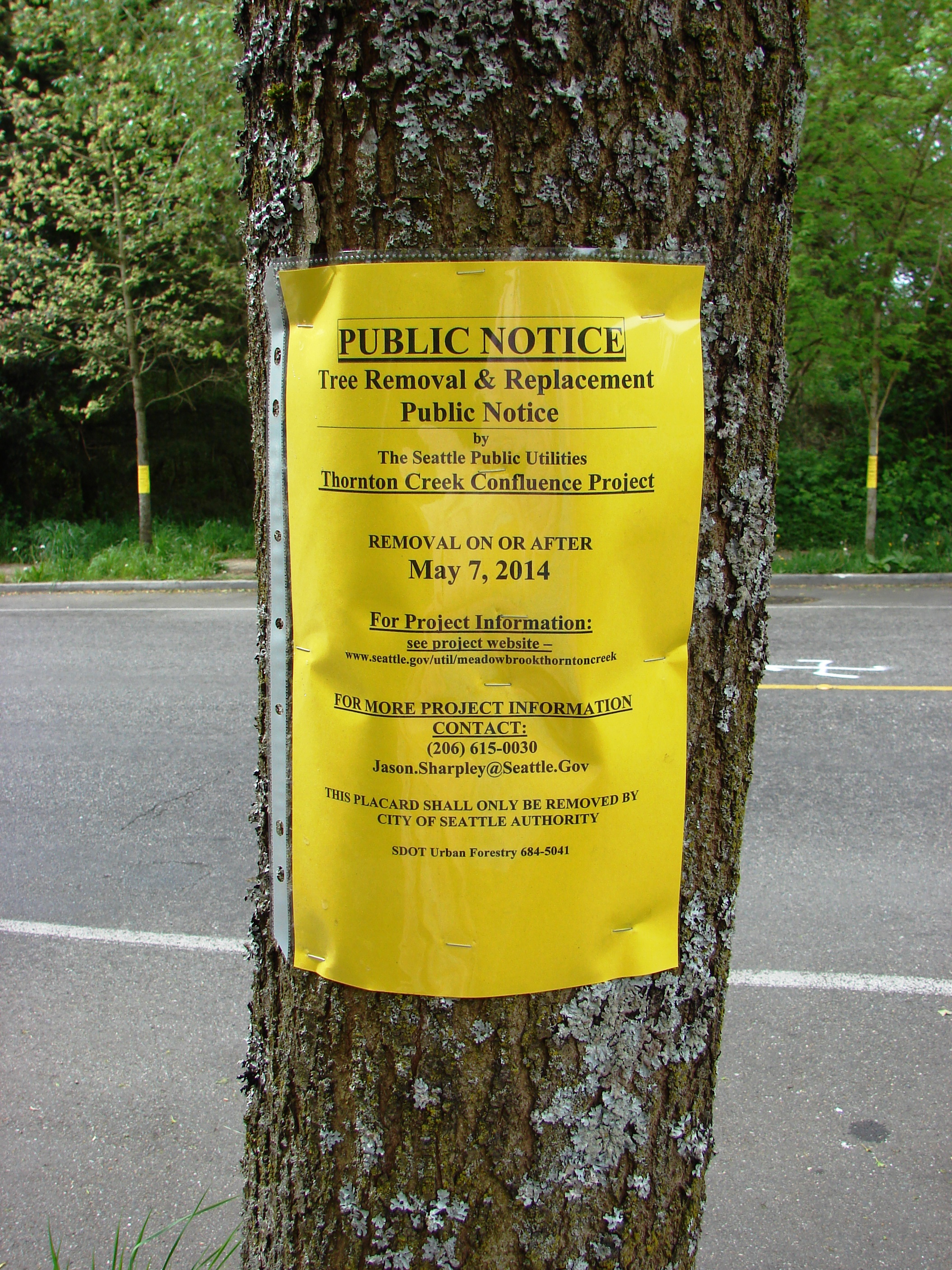
In summer 2014 work will be done to enlarge the capacity for water at the point of NE 107th Street where the South Fork of Thornton Creek crosses under 35th Ave NE. Some tree removal will be required to create more space for the creek channel.
Road closure update: As of June 2nd, 2014, 35th Ave NE is CLOSED at NE 107th Street. Summer construction work will be done to enlarge the creek bed of the South Fork of Thornton Creek and put in new, much larger culverts under the road.
The Thornton Creek Watershed of northeast Seattle flows toward Matthews Beach at NE 93rd Street on Lake Washington. The Confluence is the flat area along 35th Ave NE between NE 107th to 115th Streets, part of the Meadowbrook neighborhood. It is the site of convergence of the North and South Forks of Thornton Creek, and many smaller tributaries join in this area, as well. The creek system flows into Meadowbrook Pond at about NE 107th Street on the east side of 35th Ave NE. The Pond collects and filters the water before it flows down to Matthews Beach and out into Lake Washington.
The Reese brothers, Fred and Albert, grew up in a German-speaking farm community in Minnesota in the 1880s. It was a hard-working life with limited opportunities, and the boys’ formal education ended at the eighth grade. From then on they worked on the farm and later in other laboring occupations.
Fred Reese married in 1906 at age 28 and he and his new wife, Nellie, lived in the home of Nellie’s parents James and Agnes Russell in Brainerd, Minnesota. The Russells ran a boarding house located near the town train station. Both Nellie and Agnes helped with the cooking, while Fred Reese worked outside the home as a blacksmith. Fred and Nellie named their first child Russell Reese, in honor of his maternal grandparents. In those early years before 1910, we can speculate on whether Fred and Nellie had ever even heard of Seattle, let alone imagine that they would someday live there.
In the 1950s and 1960s the Wedgwood Community Club (WCC) was busy dealing with issues of city limits, zoning, street improvements, establishment of a business district and needed services such as schools and postal delivery. The Club was proud of the developing community, and the WCC president of 1955-56, J.J. Jackson, thought of another way to publicize Wedgwood. He noted that “princess” candidates from Seattle neighborhoods competed each year to be chosen Queen of the Seas at the summer festival called Seafair. Jackson proposed, “let’s have a ‘Miss Wedgwood” contest!”
The idea took off quickly. A WCC committee was formed to take applications and set up a selection process, and the contest was advertised in the Wedgwood Echo newsletter of May 1956. “Wedgwood has become such an important community that we feel it should be represented by a queen in the Seafair activities,” said Harold Kester, incoming WCC president of 1956.
In the 1940s and 1950s the neighborhoods of northeast Seattle grew rapidly, with housing developments filling up what had been semi-rural areas which were still outside the city limits. Some people resisted the process of being absorbed into the City of Seattle, but eventually, district by district, sections and voting precincts voted themselves into the city. The annexation process placed the north city limits where it is today, at 145th Street from Puget Sound all the way over to Lake Washington.
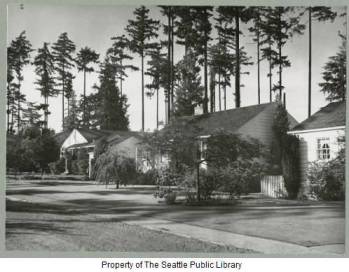
Houses on NE 84th Street in 1953, photo by Werner Lenggenhager. An amateur photographer, Lenggenhager left much of his collection to the Seattle Public Library. He spoke approvingly of Balch’s Wedgwood development with houses which were modest in scale and harmonious in style, and with the preservation of tall trees.
“Wedgwood” was first used in 1941 by Albert Balch as a plat name for a housing development from NE 80th to 85th Streets, 30th to 35th Avenues NE. This forty-acre tract of houses in similar scale and harmonious styles (with New England-style Cape Cod detailing) was a huge success.
After the end of World War Two in 1945, many war veterans got married and were able to buy a Wedgwood house with a GI loan, the government assistance program for veterans.
After the war, young couples flocked to the Wedgwood development to establish homes and start new lives, hoping to leave behind the hardships and deprivations of the war years. Into the 1950s Balch acquired more tracts of land near the first Wedgwood plat, and he did more well-planned, attractive streets and groups of houses on both sides of 35th Ave NE. The neighborhood was gradually “becoming Wedgwood” by taking its identity from the orderly and charming Balch housing developments.
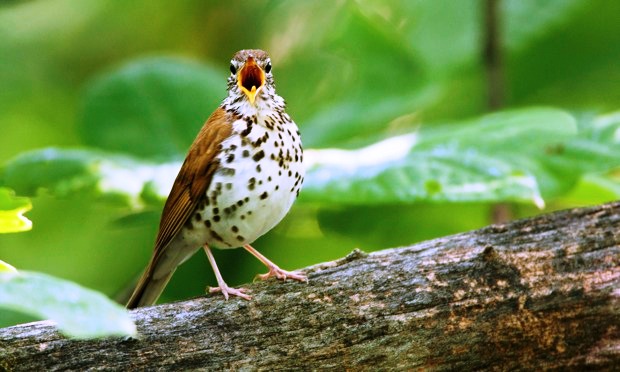
The Great Backyard Bird Count (GBBC) is an annual four-day event that engages bird watchers of all ages in counting birds to create a real-time snapshot of bird populations. Participants are asked to count birds for as little as fifteen minutes (or as long as they wish) on one or more days of the event, February 14 to 17, 2014, and report their sightings online at www.birdcount.org.
Anyone can take part in the Great Backyard Bird Count, from beginning bird watchers to experts, and you can now participate from anywhere in the world! You can participate from your kitchen window by simply counting the birds you see in your yard.
Valarie says: This map is based upon information about what would happen if all of the world’s ice sheets melted, flooding Seattle. We see that the Wedgwood neighborhood would survive!


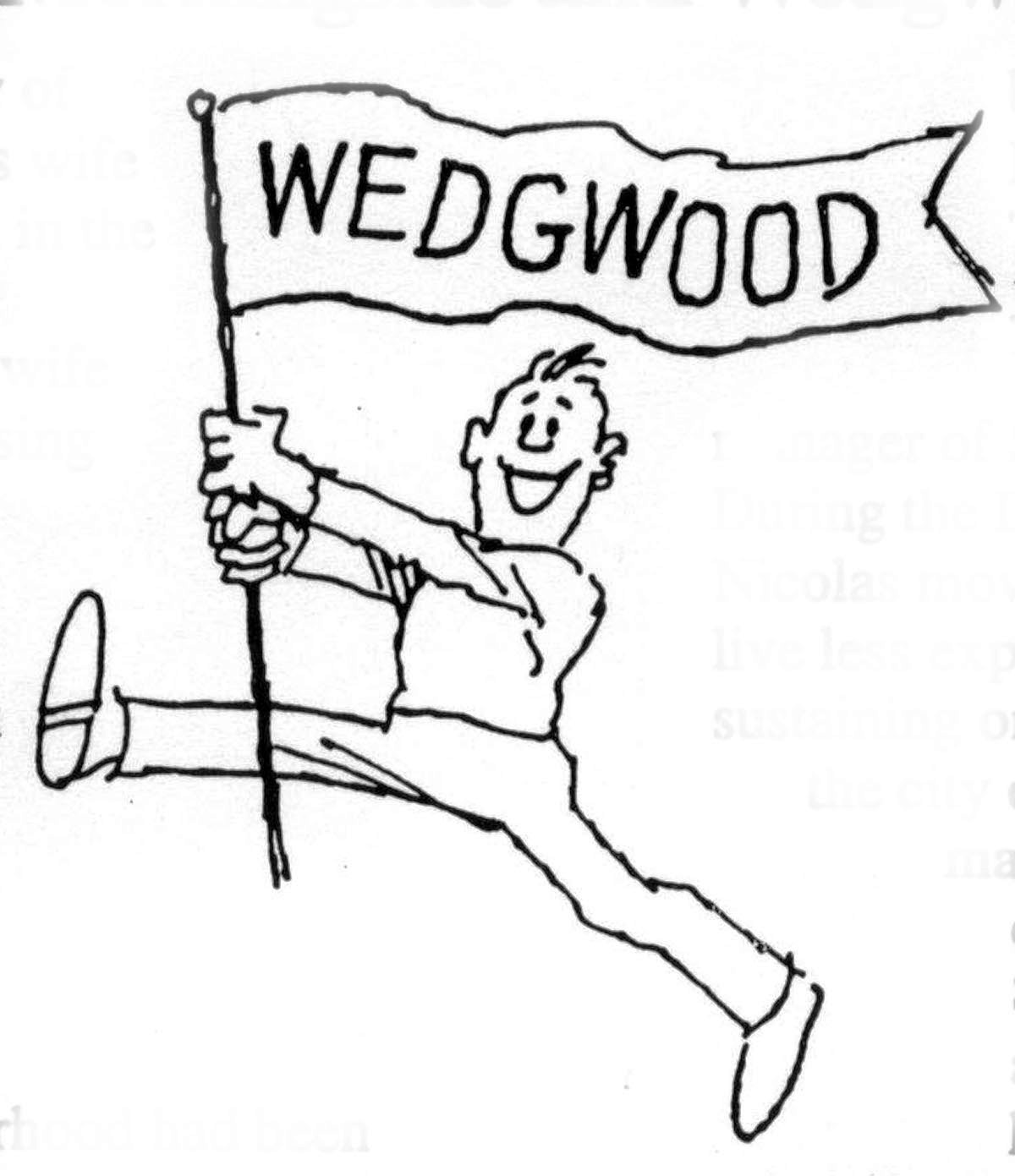
Wedgwood banner cartoon by Bob Cram, Wedgwood Newsletter of March 1996. All rights reserved; do not copy.
In the early 1900s Wedgwood in northeast Seattle did not have a name or a definite identity as a neighborhood. It took a post-World-War-Two growth spurt in population, and a housing development by Albert Balch, for the neighborhood to coalesce around the plat name he had chosen, “Wedgwood.”
Some areas in or near Seattle, such as the Fremont neighborhood, had been founded with an official name. In May 1888 an investors group including Edward & Carrie Blewett from Fremont, Nebraska, platted Fremont, Seattle as a townsite. This was the official “start date” of the Fremont neighborhood. As soon as lots began to be sold in 1888, there was a kind of land rush to populate Fremont. In contrast, Wedgwood had no developers, planners or official name in early years.
Northeast Seattle areas including Wedgwood grew very slowly over many decades. The biggest growth in Wedgwood came after World War Two ended in 1945, when serviceman returned home from the war and got married. These young couples looked for housing to start their new lives. Wedgwood began to acquire its neighborhood name in that era, after developer Albert Balch filed a plat of land and built houses called Wedgwood in 1941. Wedgwood did not fully come into the Seattle City Limits until the 1950s.
Larry Hubbell is a renowned artist, photographer and author of the Union Bay Watch Blog which tracks the birds and animals on the body of water south of Laurelhurst. Larry is especially well-known for documenting the daily life of eagles who like to sit on the light poles above the 520 Floating Bridge to Bellevue, scanning for a meal.