
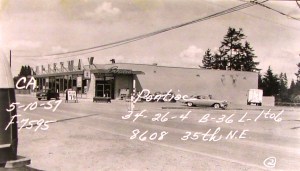
Evans Thriftway was in a 1946 grocery building which was remodelled and expanded in 1956-1957 and renamed for owner Russ Evans. The Jasper Apartments are now on this site. Photo courtesy of Puget Sound Regional Archives. The writing on the photo is the legal description with block number and address.
The commercial district of the Wedgwood neighborhood in northeast Seattle is arranged along the arterial 35th Avenue NE with clusters of stores at the NE 75th and NE 85th Street intersections. The majority of the storefronts and office buildings were built during an intense period of development after World War Two ended in 1945.
Soldiers returning from the war married and started families, and in the 1940s and 1950s the vast areas of vacant land in northeast Seattle filled up with single-family housing. During those years with a growing customer base in the new Wedgwood neighborhood, the Wedgwood business district took form with various kinds of stores and services. The business district is primarily aligned along the linear arterial of 35th Ave NE and has a 1950s aspect because that decade was the peak period of small businesses.
Today we are beginning to see the tear-down and replacement of commercial buildings in Wedgwood along 35th Ave NE. Due to the lack of action from Seattle City Council on zoning issues, townhouses with blank walls are being built in the commercial district instead of the storefronts which are wanted by the Wedgwood community.
This blog article will primarily address what happened from 2012 to 2017 with the Jasper Apartments, 8606 35th Ave NE, which marked a major change in the type of commercial building in Wedgwood. As of 2022 another major change in the neighborhood is pending, the redevelopment of the shopping center at the southeast corner of NE 85th Street. That project was just announced in 2022 and will be discussed in another article on this blog as plans for the project are firmed up.





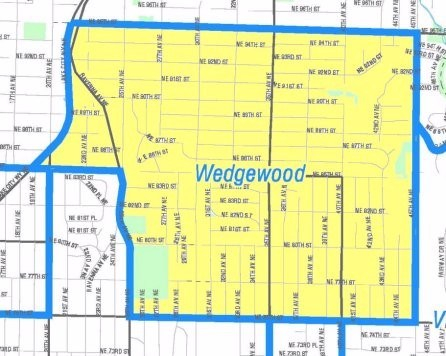
 Wedgwood in Seattle History