Balch and Beyond: New Architecture in Wedgwood

The Wedgwood neighborhood in northeast Seattle acquired its name and identity in the 1940s with the work of developer Albert Balch.  Balch filed a plat plan on July 31, 1941 for a forty-acre tract of land (five square blocks) on the west side of 35th Ave NE from NE 80th to 85th Streets, which Balch named Wedgwood.
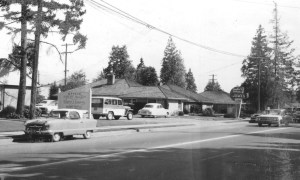
Balch offices in 1962, with the Crawford & Conover real estate sign at 8044 35th Ave NE. Photo 76719 Seattle Municipal Archives.

Balch did not deliberately set out to name the whole neighborhood, but his new housing development gave such a “sense of place” that the Wedgwood name was soon adopted by local businesses, the community club and a new elementary school.  Wedgwood became the epicenter of the Balch construction and real estate businesses when he built his own offices at 8050 and 8044 35th Ave NE, which he used for the rest of his life.

The first group of Wedgwood houses had a unified appearance with all of the houses in consistent scale (size) and setback (distance from the curb).  Balch asked Clyde Grainger and Harlan Thomas, architects of the original Wedgwood, to design houses with New England/Early American motifs including Colonial and Cape Cod styles.  The house styles were all similar, and Wedgwood was a completely finished development with curbs and sidewalks.
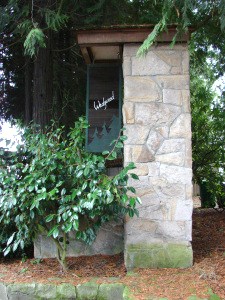
Gateposts as entrance markers to the original Wedgwood plat

As an allusion to English estate properties, Balch put in gateposts as entrance markers on 35th Ave NE at NE 81st Street.  The gateposts, reminiscent of an estate entrance, are ornamental-only but they do give a sense of arrival.

Now more than eighty years since the beginning of Wedgwood in Seattle, we are seeing tear-downs of small, 1940s and 1950s Balch houses all around the Wedgwood neighborhood, with new kinds of designs, materials and house forms coming in.  It can be visually jarring to see the contrast between old, traditional architecture and the new styles.

What are houses in Wedgwood “supposed” to look like?  Do new kinds of house forms and materials “fit in” with Wedgwoodian house culture?

Continue reading

Posted in Architecture, Balch, Houses | Tagged , , , , | 6 Comments

Early Architecture in Wedgwood

7714 37th Ave NE, built in 1911 by Dutch immigrant Ryk Spoor.

The history of the Wedgwood neighborhood in northeast Seattle goes back only a little more than one hundred years.  Wedgwood was slow to be settled because northeast Seattle was inland, not located on a water resource such as a river or lake, and not close to downtown Seattle for the convenience of commuting to places of employment.

The first families in the (future) Wedgwood area built small houses for ease of heating.  They used wood or coal stoves until electricity came to Wedgwood in about 1923.

Continue reading

Posted in Architecture, Houses, Plat names | Tagged , , , , | Leave a comment

Wedgwood’s Nathan Eckstein Middle School

Wedgwood courtesy of HistoryLink

Wedgwood neighborhood in northeast Seattle. Map courtesy of HistoryLink.

In 1919 the Seattle School Board established a new program of “intermediate education” for grades 7, 8 and 9.  Up until that time, elementary schools went through the eighth grade and high school was four years.  One of the main reasons for creation of intermediate schools was to relieve crowding in the elementary schools.

In the 1920s there was strong population growth in the north Seattle neighborhoods of Green Lake and Wallingford, and these were the first in north Seattle to get separate intermediate schools.  After the 1920s there were no more intermediate or high schools built in north Seattle until the 1950s, including Nathan Eckstein School at 3003 NE 75th Street in the Wedgwood neighborhood.

Continue reading

Posted in School histories | Tagged , | 5 Comments

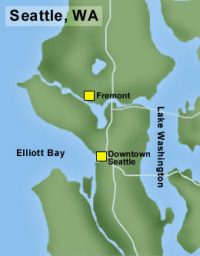
Fremont and Seattle’s Ship Canal

Fremont was a successful early community because of its advantageous location at one corner of Lake Union.

Seattle’s earliest white settlers saw immediately that it would be possible to connect its freshwater lakes to the saltwater Puget Sound by means of a canal.  At a Fourth of July picnic in 1854, Thomas Mercer proposed the name of Lake Union because that body of water was in the middle between Lake Washington to the east and Puget Sound to the west.

Thomas Mercer and David Denny took land claims at the south end of Lake Union near today’s Seattle Center.  Two single men, John Ross and William Strickler, searched out the land and in 1853-1854 they took claims at the northwest corner of Lake Union, which today is the Fremont neighborhood.

From those earliest times Seattle settlers thought to build a ship canal but little did they know that it would take more than sixty years to come to fruition.  Finally in 1910-1917 all of the needed legislation, financing and public support came together to create the Lake Washington Ship Canal. 

Continue reading

Posted in Fremont neighborhood in Seattle | Tagged , , , | Leave a comment

Balch’s Office Buildings in Wedgwood

Wedgwood map from City Clerk

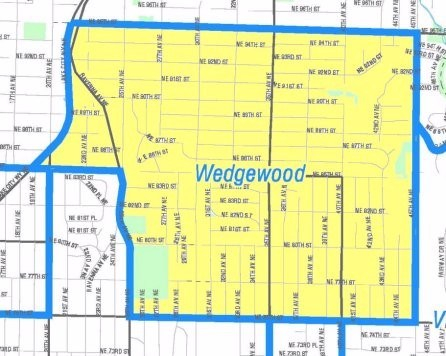
The Wedgwood neighborhood in northeast Seattle is defined as from NE 75th to 95th Streets. Wedgwood has a linear commercial district along 35th Avenue NE.

In 1940 the Wedgwood neighborhood did not yet exist in northeast Seattle.  There were vast tracts of undeveloped land and except for Hansen’s Tavern at NE 85th Street, there were no other businesses at that intersection on 35th Ave NE.  The other three corners of that intersection were vacant until the 1950s.

In the years from 1941 to 1959 the NE 85th Street intersection and the surrounding blocks were transformed by a visionary developer, Albert S. Balch.  The neighborhood acquired the name of “Wedgwood” in a gradual process, taken from the name of Balch’s first plat of houses.  The first business in the neighborhood to use the name Wedgwood, was Hansen’s Tavern which had been rebuilt in 1945-1946, and renamed Wedgwood Tavern.  Other businesses began using the name so that it spread in this way and became the name of the neighborhood.

Today the Wedgwood neighborhood is defined by its commercial corridor along 35th Avenue NE, between NE 75th to 95th Streets.

Continue reading

Posted in Architecture, Balch, businesses, name of the neighborhood, Neighborhood features | Tagged , , , | Leave a comment

Cherry Blossoms in March 2017

It was a rainy Sunday in Seattle but cherry trees in bloom signaled the hope of Spring.

Continue reading

Posted in trees | Tagged , , , | 2 Comments

Seattle Walks: Discovering History and Nature in the City

Seattle author David B. Williams is well-known for his geology walks and talks.  In recent years he has been doing research into Seattle history and how the city has interacted with and altered its natural environment, and he wrote the story of Seattle’s regrading projects in Too High and Too Steep.   On March 1, 2017, Mr. Williams launched his newest book, Seattle Walks: Discovering History and Nature in the City.

Continue reading

Posted in Events and holidays, Nature and wildlife | Tagged , , , , | Leave a comment

The Great Backyard Bird Count 2017

Walking outdoors in nature or just looking out your window and observing birds is a great stress-reducer.  On February 17 through 20, 2017, you have a good excuse for gazing out the window:  you are a citizen scientist in the annual Great Backyard Bird Count!

Continue reading

Posted in Nature and wildlife | Tagged , , , | Leave a comment

People of the Ship Canal: McMullen Fuel Company

In 1889 J. S. McMullen, age 55, pulled up stakes and went out West.  He had spent most of his life in Michigan but perhaps he was enticed to start a new life by word of the rich natural resources of the Seattle area.  McMullen brought his wife and four adult children, and the family became business leaders in the Fremont neighborhood.

Continue reading

Posted in Fremont neighborhood in Seattle | Tagged , , | 2 Comments

People of the Ship Canal: Waldo B. Staples Boat Marina

When the Lake Washington Ship Canal was constructed in 1911-1917, people hoped that the canal would benefit Seattle’s business environment.  It was difficult to foresee, however, all that might happen, and what would be the actual impact of the canal work.  In the Fremont neighborhood of Seattle, Waldo B. Staples found that the new, deeper and wider canal caused problems at first, when part of his property was flooded, but then unexpectedly the canal created a new means of livelihood for him.

Continue reading

Posted in Fremont neighborhood in Seattle | Tagged , , , | 8 Comments