In the early 1900s nationalist fervor built up in Europe until the tensions exploded into the First World War from 1914 to 1918. When Germany declared war on Russia, it set off power struggles within that country which ended Russia’s Romanov dynasty and led to even more political and social upheaval. Vladimir Lenin claimed to be leading a “workers revolution,” but he seized power and became dictator of the world’s first communist country, the Soviet Union.
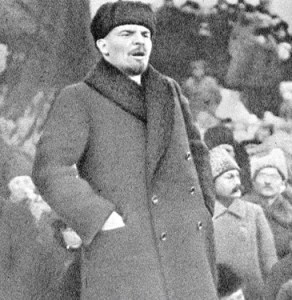
Lenin speaking at a rally in 1919
In Seattle after the First World War there was some economic instability and social unrest such as the Seattle General Strike in February 1919. In 2019, the centennial year of the Seattle General Strike, the event was re-examined as to its causes, course, and conclusion.
Some believe that the Seattle General Strike was triggered in part by news of the “workers revolution” in Russia. Unfortunately for Russia, the so-called “power to the people” movement devolved into nothing more than another oppressive regime, led by Lenin.
Despite some turmoil in Seattle in 1919, free enterprise prevailed. One of the key factors in overcoming oppression is the freedom to make one’s own choices of work and other opportunities. In Seattle in the 1920s immigrants could take hold of the American Dream by owning their own businesses. One such example of immigrant success was the Fremont Tire Shop at 3526 Fremont Place North, in the Fremont neighborhood of Seattle. The business was established by two Norwegian men.
The content of this article is protected under a Creative Commons Copyright. Do not copy text or photos.
Continue reading →





 Wedgwood in Seattle History