Vision 2020

To have 20/20 vision refers to a measure of sharpness of eyesight, being able to see clearly at 20 feet, what should normally be seen at that distance.  In this new year of 2020 we may apply the concept of “vision” to our spiritual eyes of what we can and can’t see, due to distance.  We can’t look out over the year 2020 and see all that it will hold, but we can put on our spiritual “glasses” to sharpen our vision.  The glasses we wear, is hope.

None of us could have predicted the coronavirus pandemic which crept up and then suddenly sprang into view, early in the year 2020.  Our vision was not sharp enough to see it coming!  However, God knew all about it.
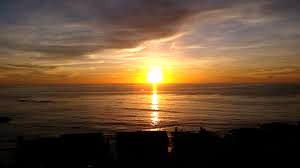
We look out over the coming year of 2020 with confident hope in God’s good purposes.

Just as glasses help to focus our vision, hope is defined not as vague, unfocused expectations, but as confidence based upon a sure source: God.  As a practicing Christian I know that hope comes from the assurance that God is working for good at all times, and He wants us to work with Him to reach our world.  When we see hatred, confusion, injustice and oppression we can ask God to give us His guidance and strength for the battle.  This is my vision for 2020.

“For you have been my hope, O Sovereign Lord, my confidence since my youth…  In You, O Lord, I have taken refuge… …as for me, I will always have hope.” (Excerpts from Psalm 71)

Despite the difficulty and dismay of what we are going through in this pandemic, God is still God, and we can still have hope.  This is our affirmation, that God has not forgotten us and He is still at work for His good purposes.  And what are “God’s purposes?”  We know that He always is calling out to us to join in with Him and get into relationship with Him.   With His direction, He wants each of us to help in some way, to lift up other people and point them toward God’s loving care.

Posted in Faith | Tagged , | 1 Comment

How Birds Survive the Cold: Feathers + Food = Warmth

This article by Charles Eldermire in All About Birds tells of the strategies used by birds to cope with cold weather.

For the winter season we might well follow the example of the birds:  Get some friends to hang out with, and eat as much nourishing food as possible!  Both strategies are ways we can have fun during the season of cold weather.

1. Get Some Friends To Hang Out With

Especially if the weather is crummy. Ever notice that nearly all of the birds that hang around in the winter do so in flocks? Having other birds around makes it less likely that something will eat you; more eyes = less chance of a predator sneaking up. Plus, if something does sneak up, you only have to be faster than the guy foraging next to you! Friends are also good at letting you know where the primo food is.

Continue reading

Posted in Nature and wildlife | Tagged , | Leave a comment

Festive Wedgwood in December 2019

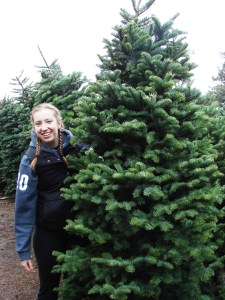
A customer tries on a tree at Hunter Tree Farm.

The Wedgwood neighborhood in northeast Seattle abounds with delights of the holiday season in December 2019.  Wedgwood’s walkable business district has coffee shops offering holiday goodies, great gift ideas from local shops, and opportunities for charitable giving.

Check out the gift ideas at Wedgwood’s newest locally-owned shops near the corner of NE 85th Street:   Blue Poppy Floral with gifts and flower arrangements; and Luu’s Cafe for beverages, snacks and lunches.

The holiday season in Wedgwood’s business district features Hunter Tree Farm where the smell of the fir trees will put you in a festive mood.  Enjoy the lights and decorations while chatting with the members of the Hunter family who return each year to their tree sales site at 7744 35th Ave NE.  Hours of operation are 9 AM to 9 PM daily.

Continue reading

Posted in Events and holidays | Tagged , , , | Leave a comment

An Immigrant in Wedgwood: Gerda’s Story

Wedgwood neighborhood in northeast Seattle. Map courtesy of HistoryLink.

Perry & Gerda Frumkin were among the young married couples who found a new home in northeast Seattle in the post-World-War-Two years of 1945 to 1965.  Northeast Seattle was at that time a region where developer Albert Balch had acquired enormous tracts of vacant land available for building “starter homes.”

In the early 1940s, Albert Balch built a plat of 200 houses called the Wedgwood Addition, located on the west side of 35th Ave NE between NE 80th to 85th Streets.  The Wedgwood name for the neighborhood grew gradually in the nearby business district with the Wedgwood Tavern being the first business to use it.

By the time of establishment of an elementary school for the neighborhood in 1954, the name “Wedgwood School” was chosen, and the neighborhood gained its Wedgwood identity.

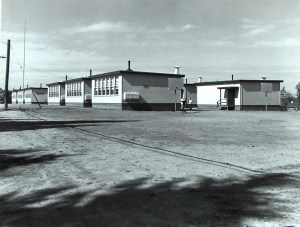
Wedgwood School opened in 1953 with all-portable classrooms while the permanent building was under construction.

After World War Two ended in 1945, soldiers returned from war, got married, began having children and looked for homes suitable for families.  Housing development in northeast Seattle then became so rapid that schools could not keep up with the population explosion.  The large numbers of children born from 1946 to 1964, called the Baby Boom generation, were at first crowded into existing schools like Bryant and Ravenna.  New schools like View Ridge and Wedgwood began with portable classrooms until permanent buildings could be constructed.

This blog article will tell the immigrant story of Gerda, and will tell how Jewish couples like Perry & Gerda Frumkin were part of the move of the young married population out into northeast Seattle in the 1940s and 1950s.

Continue reading

Posted in Immigrant heritage | Tagged , , , | Leave a comment

Immigrants, Houses and Growth in Northeast Seattle

The growth of Seattle is the story of waves of immigrants responding to historic events and economic opportunities in the young city.  This blog article is about people on 40th Ave NE around NE 70th Street in northeast Seattle in the 1920s and 1930s when there were many immigrants from Holland and Germany, as well as from other places such as Russia and Japan.  We will trace the life of one man, William Rose from Germany, whose story represents the immigrant experience in Seattle.

Like William Rose, some immigrants had stopped off at other places in the USA before finally coming to Seattle, a place with economic opportunity and cheap land in the early 1900s.  We will see how northeast Seattle was thinly settled until the 1940s when the area was developed with housing for the increasing population during World War Two.  The developer of View Ridge and Wedgwood, Albert Balch, played a key role in building houses in northeast Seattle in the post-World War Two years.

The William Rose house at 6810 40th Ave NE was built in 1925.

Continue reading

Posted in Houses, Immigrant heritage | Tagged , , | 6 Comments

The Trees of Autumn in Wedgwood

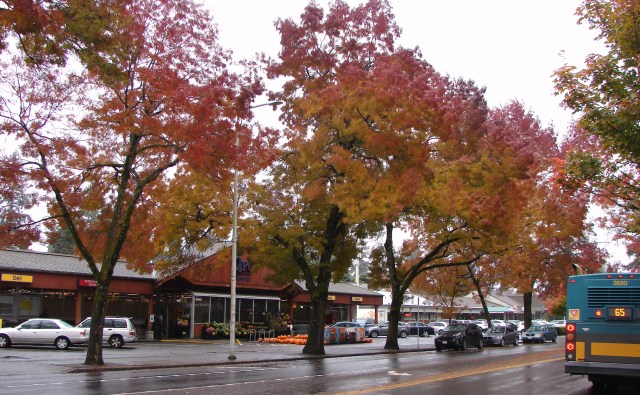
The flame ash street trees along 35th Ave NE in Wedgwood are vibrant with color in the autumn season.

The center of the Wedgwood business district is at the intersection of NE 85th Street where there is a QFC grocery store, the Wedgwood Broiler restaurant, stores and banks. Photo by Valarie.

The flame ash street trees which line the arterial 35th Ave NE were planted between 1970 to 1972 under the City of Seattle’s first effort to plant street trees along arterials.  Today all street tree work is done by Urban Forestry of the Seattle Department of Transportation.  Here is the City of Seattle map of street trees.

The flame ash street trees which line 35th Ave NE extend from NE 85th Street in Wedgwood, out to NE 137th where the arterial merges with Lake City Way NE.  Photo by Valarie.

Posted in Neighborhood features, streets, trees | Tagged , , , , | Leave a comment

October 2019 in the Wedgwood Neighborhood of Seattle

The Wedgwood neighborhood in northeast Seattle is rich with colorful trees in the autumn season, including the drive along 35th Ave NE with its street trees.  Oranges and yellows abound, set off by pumpkin decorations.

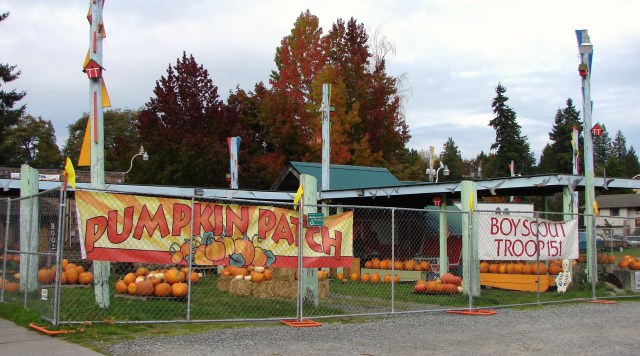
Two traditional activities in October in Wedgwood are the pumpkin patch and the trick-or-treat in the business district on Halloween.

Continue reading

Posted in Events and holidays, trees | Tagged , , , , | Leave a comment

The Business District of Wedgwood, Then and Now

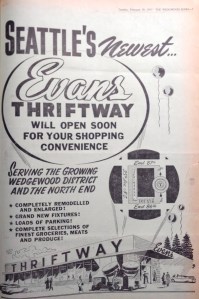
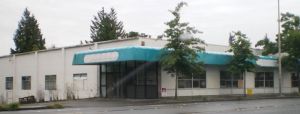
Evans Thriftway opened in 1957 at a remodelled IGA store at 8606 35th Ave NE.

Those of us who grew up in the Wedgwood neighborhood of northeast Seattle tend to be nostalgic about businesses and buildings of bygone years.  Some types of businesses which once were in Wedgwood, such as Dairy Queen, 7-Eleven stores and small gas station markets, no longer exist.

Some buildings in the commercial district of Wedgwood have been remodelled and re-used by a succession of businesses, until finally being torn down and replaced, as was the grocery store building at 8606 35th Ave NE.

There have been many changes in the business environment in Wedgwood in the decades since the neighborhood was created in the 1940s.  There are much fewer small, locally-owned shops now, than there were in the early years of the business district.

Wedgwood now has some kinds of businesses which didn’t exist in the 1940s, such as a tanning salon, a yoga studio, chain stores like Rite Aid and Starbucks, and even banks — there were no bank branches in Wedgwood until the 1960s.

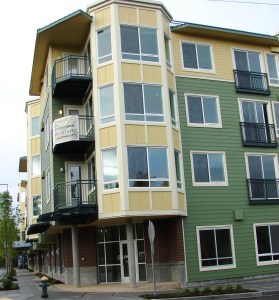
By 2007 the old grocery building at 8606 35th Ave NE was at the end of its useful life. It stood vacant while a redevelopment project was on hold.  Finally in 2012 the Jasper Apartment building went up on this site.

Some of the commercial buildings in the Wedgwood business district wore out and were replaced out of necessity.  The former grocery store building at 8606 35th Ave NE was used by a nonprofit agency for a while, then was torn down and replaced by a four-story apartment complex, the Jasper, completed in 2012.

Up until the plans to build the Jasper, Wedgwood neighborhood activists had been unaware that the zoning allowed for a four-story building on 35th Ave NE in Wedgwood.  It was this controversy which began in 2007, which set off the process of trying to come up with a plan to preserve the business district of Wedgwood.  Efforts to support, enhance and preserve the business district continue with Wedgwood activists today.

The overpowering, tall Jasper Apartment at 8606 35th Ave NE was the shock which set off neighborhood activism for better zoning regulations.

We have to accept changes over the passage of time, but what we should not accept is the current lack of support for the business district in Wedgwood – support that should come from the City of Seattle in proper zoning of business blocks to preserve commercial use.

This blog post will describe the current status of “zoning” which means the regulations on what can be built, as to the height, bulk and scale of buildings and their designated use for residential or commercial occupancy.

The construction of the Jasper, pictured at right, set off a Wedgwood community project which was meant to bring about enhancement of the business district via improved zoning, but these recommendations were never implemented by Seattle City Council.  Newer City Council representatives still have not responded to the need to support neighborhood businesses.

Copyright notice:  the text and photos of this article are protected under Creative Commons Copyright.  Do not copy without permission.

Continue reading

Posted in businesses | Tagged , , , | 4 Comments

The Early Community in the State Park Plat in Wedgwood

In the early 1900s almost no one lived in what is now the Wedgwood neighborhood in northeast Seattle, due to the area’s lack of access to water, its remoteness and the lack of roads.

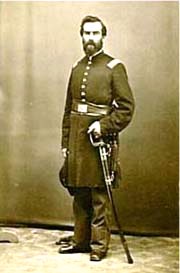
Capt. DeWitt C. Kenyon

In the 1870s, Capt. DeWitt C. Kenyon, a Civil War veteran from Michigan, came to Seattle and made a homestead land claim of 160 acres on both sides of the present NE 75th Street.  Land records tell us of the boundaries of the Kenyon claim, but we don’t know exactly where the Kenyon’s log cabin home was located.  Possible locations include the present site of Nathan Eckstein School at 3003 NE 75th Street.

After living in Seattle for about twelve years, Capt. Kenyon moved on to California.  In 1888 Capt. Kenyon’s north Seattle homestead claim property was sold to a young land speculator, Charles H. Baker, and his group of investors.   But Baker’s land investment never did yield a profit for him; house lots did not sell well due to the remote location and the ups and downs in the Seattle economy in the 1890s.

Wedgwood neighborhood in northeast Seattle. Map courtesy of HistoryLink.

This blog post will tell how Baker’s investment land, named the State Park plat, was populated by just a few families by 1910.  A few more people came to Wedgwood in the 1920s and 1930s.  Finally the Wedgwood area really began to grow in the 1940s due to the wartime demand for housing for workers, and development of the first Wedgwood houses by Albert Balch.

Looking at the houses along 31st and 32nd Avenues NE gives a representative history of the phases of Wedgwood housing from the early 1900s to today.  We know that some of the earliest houses in Wedgwood were located here, just north of the (future) Nathan Eckstein school site, and that these streets did not get completely filled up with houses until the 1950s.

Copyright notice:  text and photos on this article are protected under a Creative Commons Copyright.  Do not copy without permission.

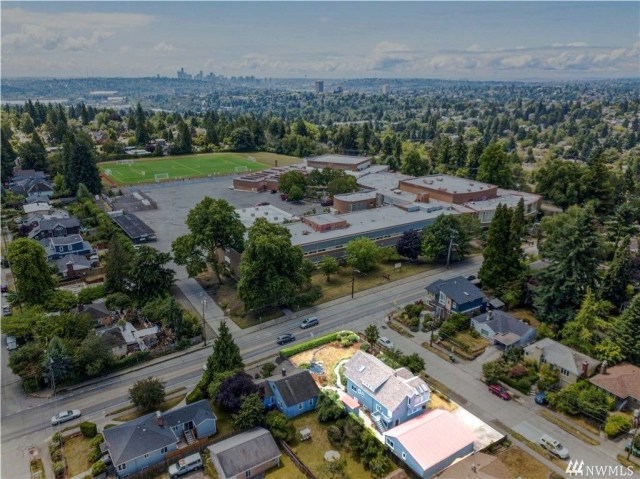
The house at 3202 NE 75th Street, highlighted in the foreground, was for sale in 2019, and was demolished in 2021. Looking southward across NE 75th Street, we see the Nathan Eckstein school site. Both properties were on homestead claim land until 1888. Photo courtesy of Northwest Multiple Listing Service.


Continue reading

Posted in 3202 NE 75th Street, Houses, Land records and surveys, Plat names | Tagged , , | 1 Comment

Lincoln High School in Seattle

A ribbon-cutting and open-house event was held at Seattle’s Lincoln High School on September 3, 2019, as the school celebrated its modernization and renovation.  There will be more opportunities for alumni to tour the building — see the Lincoln Lynx Alumni Association page for more info.

Ribbon-cutting ceremony on September 3, 2019 at Lincoln High School. Photo by Valarie.

Continue reading

Posted in School histories | Tagged , | 4 Comments