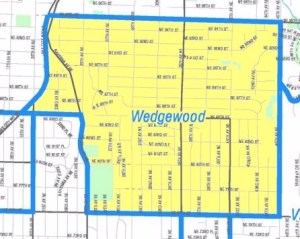
Wedgwood’s Wild Western Edge

The western Wedgwood neighborhood boundary is along Lake City Way NE between NE 85th to 95th Streets.

The western boundary of the Wedgwood neighborhood is along Lake City Way NE between NE 85th to 95th Streets.

The western boundary of the Wedgwood neighborhood is Lake City Way NE, a highway whose official name is Washington State Route 522.  The road was first called Victory Way, then Bothell Way.  In 1970 the name of the portion of the highway within the Seattle City Limits was changed to Lake City Way NE.

The highway was put through because of the meteoric rise in car ownership in the early 1900s.  Automobiles made it much more convenient for people to live in outlying areas like Wedgwood and Lake City which were never served by any streetcar or other public transportation system.

The romance of the road on Wedgwood’s western edge led to car-oriented businesses such as drive-in food.  The roadhouses along Lake City Way NE often were built in “novelty architecture” of unusual shapes and designs meant to catch the eye of passing motorists.

Continue reading

Posted in Architecture, boundaries, businesses | Tagged , , , , | 12 Comments

Fremont’s Early Houses and Immigrants

One way to outline the history of a neighborhood is by studying its houses:  the land areas which were platted, the pattern of population growth and the design of the houses.
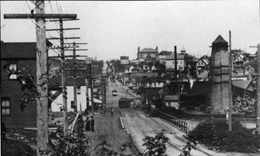
The early Fremont Bridge was a wooden trestle. This 1903 view to the north as we cross the bridge into Fremont shows the lumber mill in the foreground and B.F. Day School on the horizon. Photo courtesy of HistoryLink Essay 3309.

Fremont in Seattle was officially founded as a separate area, like a suburb, with its own name in 1888.  Its boosters were real estate men who, in addition to selling lots, also made sure that it was easy to get to Fremont — they controlled the earliest electric streetcar system in Seattle and they built a line to Fremont.

Fremont was soon settled by people who worked in lumber mills, carpentry and railroad work, and many of them were Scandinavian immigrants.

Swedish immigrant Emil Nelson worked in Fremont at the Bryant Lumber & Shingle Mill Company in the early 1900s.  In 1905 Emil Nelson and George Nordquist who had been a foreman at Bryant Lumber, left the company and went into business together.  They established Nordquist & Nelson which produced sash (window frames), doors, moulding and interior finishes for houses.

The house at 4407 2nd Ave NW was built in 1908 by Swedish immigrant Emil Nelson.

In 1908 Emil Nelson built a home for his family at 4407 2nd Ave NW in the Palatine Hill plat.  Perhaps Nelson intended the house to be a showcase for wood products from Nordquist & Nelson.

Nelson’s house has unusual arched windows on the second floor, and decorative porch railings.  The barge boards and knee braces under the eaves are highlights of Arts & Crafts finishes to this Craftsman-style house.

In the early 1900s as Fremont was developing, it was very common for a carpenter-builder to buy all of the lots on a block, build his own house and then begin building and selling additional houses.  The name of Emil Nelson was listed on the construction permits for other houses on his block which filled up with Swedish immigrants.

The house-histories of Fremont convey a sense of their time period in their architectural interest and in the description of the early residents.
Posted in Fremont neighborhood in Seattle, Houses | Tagged , | 1 Comment

Charles Baker, Land Investor in Fremont and Wedgwood Neighborhoods in Seattle

Fremont was a successful early community because of its advantageous location at one corner of Lake Union.

Fremont was a successful early community because of its advantageous location at one corner of Lake Union.

The Fremont neighborhood has a lively history which parallels the story of the City of Seattle’s growth and development.  Just as in the beginnings of Seattle in what is now downtown, the earliest white settlers of Fremont were attracted by the availability of natural resources, most importantly water and timber.

Located just to the northwest of Lake Union, Fremont was on the banks of a stream which at first was called The Outlet, flowing westward through today’s Ballard and then out to Puget Sound.

The Outlet was also called Ross Creek and it was used to float logs to mill.  Eventually the creek became part of the route of today’s Lake Washington Ship Canal.

One way to outline the history of a neighborhood is by learning about its early land investors.

Continue reading

Posted in Fremont neighborhood in Seattle, Land records and surveys | Tagged , | Leave a comment

A Picardo Perspective

In the Spring of the year our thoughts turn to gardening.

Continue reading

Posted in farms, Immigrant heritage, Neighborhood features, Picardo Farm | Tagged , , , | 5 Comments

There’s a Bird in My Yard, What Kind of Bird Is It?

There’s a bird in my yard!  How can I find out what kind of bird it is?

Continue reading

Posted in Nature and wildlife | Tagged , , | 14 Comments

Wedgwood’s Commercial Intersections

Wedgwood has a linear commercial district along 35th Ave NE running through the center of the neighborhood from NE 75th to 95th Streets.

Wedgwood has a linear commercial district along 35th Ave NE running through the center of the neighborhood from NE 75th to 95th Streets.

In early years before the Wedgwood neighborhood in northeast Seattle acquired its identity, it did not have a commercial center on 35th Ave NE at NE 85th Street as it does today.

In the 1920s there was much more residential development near the NE 95th Street intersection.  In the 1930s local businessmen opened stores on 35th Ave NE at NE 95th Street where they thought a commercial district would thrive.

Today, there isn’t much “going on” at NE 95th Street and the heart of Wedgwood is found at the NE 85th Street intersection, instead.  This blog post will explore the reasons why.

Continue reading

Posted in Balch, businesses, name of the neighborhood | Tagged , , , , , | 5 Comments

Completing the Trail at the Yesler Swamp

The name of Henry Yesler is associated with Seattle’s earliest years.  Yesler set up a sawmill in 1853 at the site of today’s Pioneer Square and the mill became the economic engine which gave the small community a reason to hope for greater things.  In the 1880s Yesler opened a second site on Union Bay in northeast Seattle.  In those days the water of the bay came up higher than it does now.  When the ship canal was completed in 1916 and the level of Lake Washington was lowered, along the shoreline a wetland area was left, which today is called the Yesler Swamp.

Continue reading

Posted in Nature and wildlife, Neighborhood features | Tagged , , , | Leave a comment

The Great Backyard Bird Count 2016

Don't forget to count me for GBBC!

Don’t forget to count me for GBBC!

Are you in love with birds?  February 12 to 15, 2016, including Valentines Day, is a weekend for those in love — with birds, that is. You can share your love of birds by spending just fifteen minutes per day (or more) counting them as part of the Great Backyard Bird Count citizen science initiative.  Not only is it fun, but results are used to help study and ultimately protect birds.

The Great Backyard Bird Count is easy — no need to go out in the cold and rain, just count the birds in your backyard!  Or on your lunch hour at work, you can take fifteen minutes to look out the window and count the birds you see.  On the website of the Great Backyard Bird Count 2016 you can register to participate, explore data, learn about birds and get tips on identification of species.

Great Egret photographed by Larry Hubbell at Portage Bay in northeast Seattle.

Great Egret photographed by Larry Hubbell at Portage Bay in northeast Seattle.

Information gathered by citizen scientists and reported online will help scientists track changes in bird distribution, some of which may be traced to El Niño storms and unusual weather patterns in 2015-2016.

A Great Egret seen by photographer Larry Hubbell of Union Bay Watch is a tall bird that looks like a heron, but it is white.  The Great Egret usually winters in the southern USA and we don’t know why it is hanging around Seattle this winter!

It is normal for bald eagles to hang around Seattle during the winter but you need to keep a sharp eye out to see them.  Seattle bicycle blogger Tony wrote about his eaglepalooza along the Burke-Gilman and Sammamish River Trails at Lake Washington.

UPDATE:  This year’s Great Backyard Bird Count was the biggest effort ever!  More than 160,000 participants from all corners of the earth, counted 5,689 species.  That is over half the world’s birds and is 599 species more than last year’s count!  See the detailed summary of GBBC 2016 at birdcount.org


Posted in Nature and wildlife | Tagged , | Leave a comment

Seattle’s Pioneers of Fremont: John Ross

Ross Park, the former site of the old Ross School, is on 3rd ave NW at NW 44th Street in western Fremont.

Ross Park, the former site of the old Ross School, is on 3rd ave NW at NW 44th Street in western Fremont.  Photo by Valarie.

Fremont, a neighborhood in north Seattle, was named by property investors from Fremont, Nebraska.  Prior to the development’s receiving its official name in 1888, there were other nearby neighborhood reference points, such as the community of Ross.  Today the former site of the Ross School is a park at NW 43rd Street and 3rd Ave NW, about one mile west of the business center and bridge on Fremont Avenue.

On this blog, Wedgwood in Seattle History, I mainly write about northeast Seattle neighborhoods, but because I also enjoy Fremont history I am telling some of its stories here.  One of the earliest Fremont-area land claimants was John Ross, a name which is now little-known.  In this blog post we will puzzle over John Ross’s pioneer story.

Continue reading

Posted in Fremont neighborhood in Seattle, Land records and surveys | Tagged , , , , , , | 6 Comments

Seattle’s Pioneers of Fremont: B.F. Day – Part Two

The Panic of 1893, a nationwide economic crash, had a chilling effect upon Seattle.  Historian Thomas Prosch wrote that Seattle businesses, banks manufacturers and even churches closed down and went out of business due to lack of money to operate. Rents went down so low that property owners could not make enough profit to pay their mortgages, and so they lost their holdings.  Ten years later, in a court case in 1903, B. F. Day of the Fremont neighborhood in Seattle testified that in 1893 he had been in “financial embarrassment” and he had been left with nothing but his own house.  At that time he had put title to some of the land he owned into the names of other people so that the properties would not be taken from him by creditors.

The Fremont neighborhood is on the north side of the Ship Canal.

The Fremont neighborhood is on the north side of the ship canal. Here we are standing on the Fremont side, looking east toward the Fremont Bridge.  Photo by Valarie.

B.F. Day had come to Seattle in 1880 at age 45 and he quickly became involved in the life of his newly-adopted city.  He worked in real estate and served one term on Seattle City Council before moving out of the city limits.  As shown in lists of construction permits of 1888-1889, B.F. Day and his wife Frances built a big house where they had land holdings in Fremont, a suburb of Seattle.

The history of the Fremont neighborhood closely parallels the ups and downs of Seattle itself.  In Part Two of the story of B.F. Day, we will read how his life was impacted by the economic crash of 1893.

Copyright notice:  Text and photos on this article are protected under a Creative Commons Copyright.  Do not copy without permission.

Continue reading

Posted in Fremont neighborhood in Seattle | Tagged , , , , | Leave a comment