The Copestick Building in Wedgwood

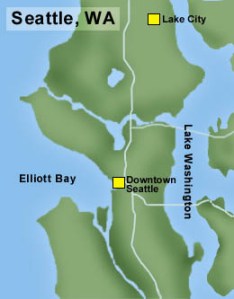
Wedgwood neighborhood in northeast Seattle. Map courtesy of HistoryLink.

During World War Two from 1941 to 1945, Americans put their personal plans on hold so that they could serve in the military, work in war production industries or in support services.  After the end of World War Two the focus of American life turned from supporting the war effort to pursuing dreams of home and family which had been deferred during the war.  There was pent-up demand for houses and for consumer goods which had not been produced for civilian use during the war.

The Wedgwood neighborhood, including its name and its identity, was a creation of this post-World-War-Two pressure for housing for young married couples.  There still were large tracts of vacant land in northeast Seattle which developers like Albert Balch, the father of Wedgwood, used to create more single-family housing.

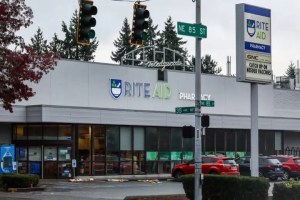
The creation of the new Wedgwood housing development in the 1940s led to the growth of an adjacent business district, centered at or near the NE 85th Street intersection along the arterial 35th Ave NE.  This blog article will tell about the Copestick building at 8613 35th Ave NE and how it was affected by the growth of Wedgwood, most especially the pressures of the arterial 35th Ave NE.

Continue reading

Posted in businesses, streets | Tagged , , , , , | 1 Comment

Car Show and Cancer Fundraiser at the Wedgwood Broiler

Sunday, August 26, 2018 will be a day of fun, 10 AM to 3 PM, at the Wedgwood Broiler, 8230 35th Ave NE, for the Eleventh Annual Wedgwood Car Show and Cancer Fundraiser.

Continue reading

Posted in businesses, Events and holidays | Tagged , | Leave a comment

Remembering Shearwater

The Decatur Annex building was on NE 77th Street at the corner of 43rd Ave NE, at the southern end of what is now Decatur School.  The little white wood-frame Annex was the last building from the complex of Navy housing, called Shearwater, which was on the site from 1945 to 1966.

The Decatur Annex building was located on NE 77th Street at the corner of 43rd Ave NE.  It was demolished in July 2019.

In 2018 neighborhood activists learned that the school district planned to tear down the Decatur Annex, and the activists brought the matter to the City of Seattle Landmarks Board to advocate for historic preservation.  The Annex building represented the era of World War Two housing for personnel of the Naval Air Station in Seattle and a time when housing for Navy personnel was racially integrated.

At the City of Seattle Landmarks Board meeting on January 2, 2019, the Decatur Annex failed to get enough votes in favor of historic preservation.  The large cedar tree on the corner of the lot was preserved when the Decatur Annex was torn down during the week of July 8, 2019.

The Decatur Annex, looking westward during demolition in the week of July 8, 2019. At left is the cedar tree which is being preserved. At right is the Decatur School building.

Continue reading

Posted in community club (old), School histories | Tagged , , , , , , | 2 Comments

A Market on Sand Point Way NE

During the Civil War in the 1860s, northern industrialists went to Scandinavian countries to recruit workers for mining, logging and factory operations, in place of American men who had gone to fight for the Union.

Frank Harold Rovainen (pronounced Rov-EYE-nen), born in Minnesota in 1905, was the grandson of a man who was in the first group of immigrants from Finland to Minnesota in 1865.  In the century following the Civil War, many immigrants and their descendants continued to move westward in search of other opportunities.  So it was that in 1936 Harold Rovainen, age 31, made the leap from Minnesota out to Seattle, where he got a job with a grocer at the Pike Place Market.

Continue reading

Posted in businesses | Tagged , , , , , | 5 Comments

Saving Wedgwood: Historic Preservation and Best-Use Planning in the Commercial Zones

In the 1940s during World War Two the population of Seattle swelled with war workers, and in the 1950s the population continued to increase with people who wanted to make their homes here in the beautiful Seattle area.

Young married couples of the 1950s loved the affordable homes built by Balch in the new Wedgwood development.

In the 1950s in Seattle a new generation of young married couples was starting new lives and wanted their own houses.  The thinly populated northeast Seattle area, much of which was still outside the official Seattle City Limits, began to fill up with single-family housing.

A developer, Albert Balch, acquired and built on tracts of land which became the Wedgwood neighborhood.  Wedgwood is centered around NE 85th Street with a commercial district on 35th Ave NE and with single-family homes to the east and west of 35th Ave NE.

The Wedgwood neighborhood in northeast Seattle has a linear commercial district along 35th Avenue NE.

Because Wedgwood did not come completely into the Seattle City Limits until 1954, Balch’s housing developments were not yet subject to City zoning regulations.  Balch did his own urban planning, reserving the intersection of NE 85th Street for commercial development along on the arterial 35th Ave NE.

Balch built office buildings at 8050 and 8044 35th Ave NE for his personal office and that of his accounting, architecture, development and real estate sales staff.  Other buildings in that complex from 8014 to 8050 35th Ave NE were medical and dental offices.  But Balch did not know that his office complex contained a fatal flaw:  it was built in a block which up to the present time is still zoned residential, not commercial.

Continue reading

Posted in Architecture, Balch, Neighborhood features | Tagged , , , , , , | Leave a comment

Dooley’s Tavern on Sand Point Way NE

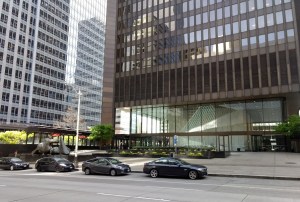
Safeco Plaza at 1001 Fourth Avenue (northwest corner of Madison Street) is on the former site of the Lincoln Hotel. I am standing with my back to the downtown Seattle Public Library, looking westward across Fourth Avenue; photo by Valarie.

A few minutes after midnight on April 7, 1920, the lights began to blink and go out at the Lincoln Hotel on Fourth & Madison Streets in downtown Seattle.  The desk clerk and the night watchmen smelled smoke, and they began telephoning the rooms and going along the hallways to rouse guests to flee the fire.  But before they could get very far, the heat and smoke of the rapidly-spreading fire forced them to leave the building, and they watched as flames shot up the central courtyard and began to consume the upper floors.  There were more than 300 people staying in the hotel.
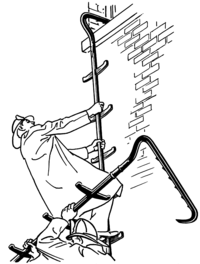
A pompier ladder, also called a hook ladder, is used by firemen to scale the sides of buildings.

When the fire department arrived there was little they could do to save the building, as the streams of water directed at the fire were not enough to quench the raging inferno.  Firemen commenced to rescue guests who were still inside the hotel.

As crowds watched from the sidewalk, Fireman Carl R. Dooley climbed a fire department ladder as far as it would go, up the exterior wall to the fifth floor of the hotel.  Then Dooley continued climbing up by using an extension pole called a pompier or hook ladder, to reach a woman who was frantically waving for help out of a seventh-floor window.

Dooley lowered the woman with ropes to Police Officer Phil McNamee, a former fireman, who pulled her in through a fifth floor window.  Then Dooley climbed back down himself.  Fireman Dooley and Patrolman McNamee received commendations from the Mayor of Seattle for their heroism on the day of the Lincoln Hotel fire, having rescued a number of people.
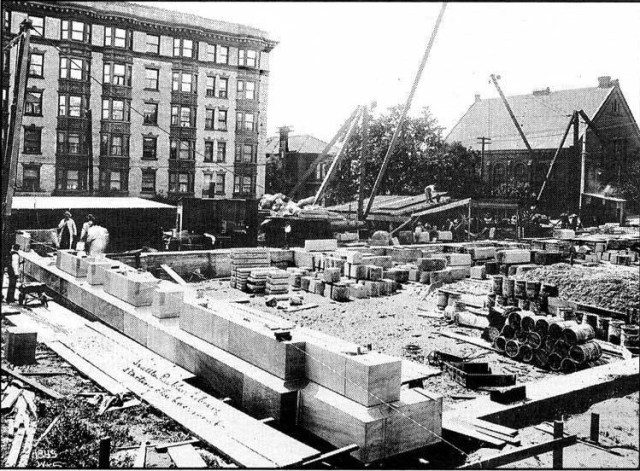
Seattle Public Library under construction in 1902; the Lincoln Hotel is seen across Fourth Avenue. At right is the First Presbyterian Church. Courtesy of Seattle Public Library Historic Photos.

Continue reading

Posted in taverns | Tagged , , , | Leave a comment

Wilson’s Food Store in Wedgwood

From 2012 to 2018 the building at 2415 NE 80th Street was the home of the NE Seattle Tool Library, an initiative of the NE Seattle Sustainable movement.  The Tool Library is a lending library for items which can be borrowed, saving money from having to buy seldom-used equipment such as a power-washer.  The NE Seattle Tool Library is also known for its classes and exchange of services, such as a Fix-It Night when people can bring household items and learn how to repair them.

In June 2018 the NE Seattle Tool Library moved to a larger space at the historic LaVilla Dairy building, located just east of Lake City Way NE at 10228 Fischer Place NE.

The little building at 2415 NE 80th Street started out as a neighborhood convenience store in 1946.  It was torn down in the summer of 2022 along with the adjacent North Seattle Friends Church at 7740 24th Ave NE, to build a new classroom building for University Preparatory Academy. For updates, see the photos at the end of this article.

Wilson's Grocery photo courtesy of Gerald Nielsen on Seattle Vintage

Wilson’s Grocery Store at 2415 NE 80th Street, photo courtesy of Gerald Nielsen. Continue reading

Posted in businesses | Tagged , , , , , | 3 Comments

A New Cafe Coming to Wedgwood

Good new businesses are always welcome in Wedgwood’s commercial district along 35th Avenue NE.  A Seattle company, the Grand Central Bakery, announced that they will open a Wedgwood cafe at 7501 35th Ave NE, in the former View Ridge Pharmacy space at the northwest corner of NE 75th Street.

Grand Central Bakery.construction as of October 9 2018

Grand Central Bakery and Cafe in-process, 7501 35th Ave NE, October 2018.

Continue reading

Posted in businesses | Tagged , , , | Leave a comment

From Ravenna to LaVilla: the NE Seattle Tool Library

Tool Library new coordinators Chris and Mike.June 2016

Tool Library Coordinators

The NE Seattle Tool Library is a community-based nonprofit organization for sharing tools and knowledge of how-to-fix-it.  The Tool Library has been very successful in its mission and in June 2018 it moved from its original site, 2415 NE 80th Street, to 10228 Fischer Place NE in the historic LaVilla Dairy Building.  Membership fees, annual tool sales, fundraisers and a grant from the City have helped the Tool Library pay rent and utilities.

Continue reading

Posted in Meadowbrook neighborhood, name of the neighborhood | Tagged , , , , | Leave a comment

Mylo Lindgren, Wedgwood Hero

The early years of the Wedgwood Community Club in the 1950s and 1960s were characterized by the dedicated involvement of young couples who had developed leadership skills through the World War Two years of the 1940s.   Mylo Lindgren was just such a community activist: he served in the war, married and then spent more than fifty years as a Wedgwood resident and community leader.

Continue reading

Posted in community club (old) | Tagged , | Leave a comment