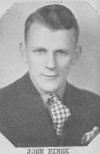
High school graduation portrait of John Binek of Minnesota
During the World War Two years of the 1940s the population of Seattle swelled with military and with civilian workers. People left other states in the USA to come to Seattle and get jobs in wartime industries such as Boeing Aircraft. People used to joke that some states such as Minnesota and the Dakotas had emptied out because it seemed that the entire population had relocated to Seattle.
So it was that the Binek family of Minnesota made a migration to Seattle in the 1940s. Eldest son John Binek, a restaurant owner, joined the Army and was stationed out of a Seattle-area military base. John’s widowed father thought it would be advantageous to start a new life in Seattle, and he brought some of his other young adult children to Seattle, as well.
John Binek’s father settled on Seattle’s Queen Anne Hill and opened a bakery at 3207 West McGraw Street in a newly-built block of storefronts. Binek’s Bakery prospered in this commercial district.
After the war: new life, new business in a new neighborhood
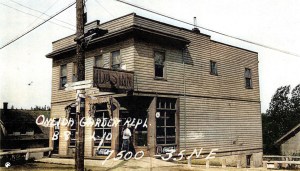
Ida’s Inn building was a grocery store before it became a tavern in 1934.
After the war, John Binek followed his father’s example of seeking out a newly-developing commercial district, contiguous with other storefronts, where John could open his own business. John found a place to open his own bakery in the growing Wedgwood district in northeast Seattle, on 35th Ave NE at the intersection of NE 75th Street.
Prior to 1945, before the Wedgwood neighborhood acquired its identity, the intersections of NE 75th, 85th and 95th Streets were each anchored by a tavern: Ida’s Inn, Hansen’s Tavern, and the Fiddler’s Inn.
There were very few stores along this stretch of 35th Ave NE. The first large grocery store did not come in until 1946, McCullough’s IGA Foodliner at 8606 35th Ave NE (present site of the Jasper Apartments).
The Safeway at the southeast corner of the NE 75th Street intersection, opened in 1951.
The business district of Wedgwood is built in the post-war era

Young couples loved the financially-accessible houses built by Albert Balch in the new Wedgwood in the 1940s.
After the war ended in 1945, young couples migrated into northeast Seattle in search of single-family homes. Newlyweds wanted to settle down with their own homes, and because there was still plenty of vacant land in northeast Seattle, it became a post-war neighborhood of houses with young families. Albert Balch, developer of Wedgwood, was building small houses which were financially within reach to young couples, including the home loan program for war veterans.
Businessmen observed the trend of population settlement in northeast Seattle and began building commercial buildings to access the growing customer base in the Wedgwood neighborhood.

It’s easy to have a nice day in the charming Wedgwood business district.
One of Wedgwood’s new buildings was in the 8500 block of 35th Ave NE where Mr. Hansen enclosed his old tavern along with new storefronts.
When Mr. Hansen renamed the tavern “Wedgwood” in 1945, it set off a naming trend which eventually gave the name to the neighborhood. The former Hansen’s was called the Wedgwood Ale House until it closed at the end of 2023.
McVicar & Son Hardware at 8507 35th Ave NE was one of the first new businesses in the Hansen block, opening in 1946.
Bud Gagnon started out at the southern corner of that 8500 35th Ave NE building, then built his own building at the north corner of the block, Wedgewood Pharmacy. The Wedgewood Pharmacy was torn down in 1971 and the present brick bank building was built (presently Wells Fargo.)
The 7500 block is built in the late 1940s

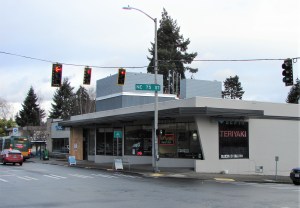
The north corner of the 7500 building being repaired in June 2020. The old Ida’s Inn is enclosed in this building. The next building, now Chase Bank, was once the McGillivray’s store.
The storefront which John Binek found for his new bakery was in the 7500 block, on the east side of 35th Ave NE where a row of new “storefront system” spaces was built in front of an original 1925 grocery building. In 1934 the building had become a tavern called Ida’s Inn.
When the Ida’s Inn owner died suddenly in 1948, a new owner of the building redeveloped the site with more commercial spaces. The tavern space did not re-open due to neighborhood pressures, because nearby residents expressed a preference for other kinds of businesses. The tavern was enclosed and became one of the storefront spaces, as it still is today.
The next building to the north of Ida’s Inn, 7512 35th Ave NE (present Chase Bank), did not yet exist at that time; the home of the VanderWel family was at that address. The McGillivray family was operating a store on the west side of the street at 7509 35th Ave NE (present site of a coin shop). When the McGillivrays decided to build a new store at 7512 35th Ave NE, they moved the VanderWel house off of the site, to 7308 38th Ave NE.
The Bineks among the first new businesses in the 7500 building
In 1950 John Binek and his new wife Dorothy, who had worked as a waitress in John’s restaurant back in Minnesota, settled in Seattle. They got a house in Wedgwood at 7554 35th Ave NE, at the north end of the same block where they were opening a new bakery.
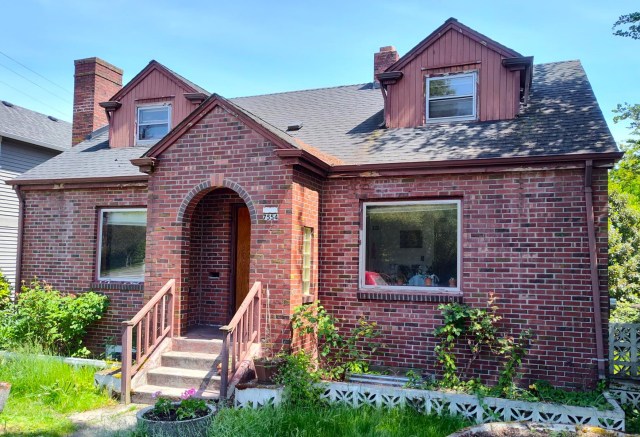
Binek’s house, built 1946, at 7554 35th Ave NE.
In deference to his father whose Queen Anne shop was already called Binek’s, John named his shop in Wedgwood “Binek’s Electric Bakery.”
In the 1950s the Binek’s Electric Bakery was in the middle space of the 7500 building. Above the roofline can be seen the enclosed Ida’s Inn.
In 1950-1951 the storefront spaces on the east side of 35th Ave NE were:
7508 Jim’s Shoe Repair
7506 Careful Cleaners
7504 Binek’s Electric Bakery
7502 Frosty Shop Ice Cream
7500 MacLennan’s womens clothing
On the west side of 35th Ave NE:
7517 home of Mr. & Mrs. Arthur R. McGillivray

7501-7509 35th Ave NE
–parking lot–
In the storefront building built in 1947 were these shops:
7509 McGillivray’s Variety Store, located here until they built the new building across the street at 7512. The present business in 7509 is Seattle Coin Shop.
7507 Thomander’s Barber & Beauty Salon
7503 Hueffed’s Foodstuffs
7501 Eastwood Pharmacy (later became the longtime View Ridge Pharmacy; today it is Grand Central Bakery & Cafe)
The Bineks were neighborhood boosters
In the 1950s the Wedgwood business district was like a small town, with small-locally owned shops whose proprietors lived in the neighborhood. There was a lot to do to build up the community in those years, and the Bineks were active advocates on issues which would benefit the neighborhood, such as streets.
One of the developments that was firmly resisted in northeast Seattle was the plan for the R.H. Thomson Expressway which would have been an extension of the Interstate-5 freeway through the Wedgwood neighborhood (see news article of September 1963, below).

In 1963 John Binek was among the Wedgwood neighborhood activists who opposed the R.H.Thomson Expressway.
Residents and businessmen like the Bineks lent their voices to the organized representation of the neighborhood community group, the Wedgwood Community Club, which did not want Wedgwood cut in half by an expressway.
The Bineks in retirement
By the year 1970 many business owners in Wedgwood, like the Bineks, Gagnons, McGillivrays and McVicars, were approaching retirement age.
The Bineks closed their business but they never stopped baking at home in their house on 35th Ave NE at the corner of NE 77th Street. They were known for their hospitality and for inviting passers-by to stop in for coffee and fresh-baked pastries. The Bineks lived in Wedgwood for the rest of their lives and were the epitome of the Wedgwood spirit of neighborliness.

Sources:
Census and City Directory listings for the Bineks.
“Expressway Expressions: 25th Ave NE Alternatives Hit.” Seattle Daily Times, September 5, 1963, page 5.
 “The Bineks: Wedgwood pair may be retired but they don’t loaf around.” University Herald newspaper, Seattle, date circa 1990.
Find A Grave photos of grave markers for John & Dorothy Binek.

 Wedgwood in Seattle History
Impressive research! I love reading these stories of Seattle’s history.
Thanks for the memories of Wedgwood! I was friends with John Binek (must have been John Binek III after his dad and grandfather) and Jan McVicar. My mom liked to shop at McGillivray’s. I fondly remember the Frosty Shop, having spent many hours in there after school at Nathan Eckstein JHS. Their licorice ice cream was especially tasty! I also remember Del Martin’s hair salon. Her daughter Orma and I were good friends in the 1960’s. This is a wonderful blog. Thanks!