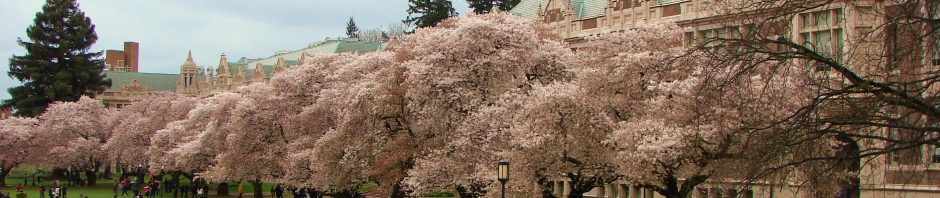

Fremont was a successful early community because of its advantageous location at one corner of Lake Union.
The Fremont neighborhood has a lively history which parallels the story of the City of Seattle’s growth and development. Just as in the beginnings of Seattle in what is now downtown, the earliest white settlers of Fremont were attracted by the availability of natural resources, most importantly water and timber.
Located just to the northwest of Lake Union, Fremont was on the banks of a stream which at first was called The Outlet, flowing westward through today’s Ballard and then out to Puget Sound.
The Outlet was also called Ross Creek and it was used to float logs to mill. Eventually the creek became part of the route of today’s Lake Washington Ship Canal.
One way to outline the history of a neighborhood is by learning about its early land investors.
Charles H. Baker in frontier Seattle

Charles Baker shown in an Argus magazine cartoon, sitting on Snoqualmie Falls and holding the electric lines of a streetcar.
Charles H. Baker came to Seattle in 1887 as a single man determined to make his fortune and establish himself so that he could get married. He worked as a surveyor for Seattle’s homegrown railroad corporation, the Seattle, Lake Shore & Eastern.
The survey work brought Charles Baker into contact with Seattle’s movers and shakers including Judge Thomas Burke, Edward C. Kilbourne and William D. Wood, and Baker’s name is seen on land investments with these men, including plats in Fremont and plats in the Wedgwood neighborhood in northeast Seattle.
Charles Baker lived in Seattle for about fifteen years. During his time in Seattle his land investments failed partly because of the economic depression which began in the year 1893. Another reason why his investments failed was because they were in lands which were slow to develop, such as today’s Wedgwood neighborhood, which was too far from downtown Seattle to be convenient.
In the 1890s Charles Baker built the power plant at Snoqualmie Falls, only to lose ownership of it because of legal issues when his father died. In 1904 Baker gave up on Seattle and moved to Florida. Even though the power plant which Baker built continues to supply electricity to Seattle today, few people are aware that it was Charles Baker who made this essential contribution to Seattle.

Palatine Hill plat of 1888 located in western Fremont
One of Charles Baker’s early investments (1888) was a plat of land at a high point in western Fremont at N. 43rd Street, which he named Palatine Hill. The name came from Baker’s home in a suburb of Chicago, Illinois.
In later years the streets in the plat had to be renamed for clarity, but the name Palatine Avenue was used for the former Adams Court (on the far right on the plat map.) On the left side of the plat map, Crawford shows the boundary with the Crawford family property, which became 3rd Ave NW.
One avenue formerly called Peck was later renamed Baker Ave NW between 2nd Ave NW (Harmon) and 3rd Ave NW (Crawford.) Chicago Street is now 1st Ave NW. What was designated as Palatine on the original plat map, is now called NW 43rd Street. Some of these street name changes reflect Seattle’s 1895 ordinance to reorganize the street naming system. It was required that north-south routes be called avenues, and east-west was called a street. That is why plats earlier than the 1895 ordinance, like Baker’s 1888 Palatine Hill plat map, have had name changes. Plats filed from 1895 onward, had to conform to the street system and have unique names for their streets, not re-using common names such as Broadway.
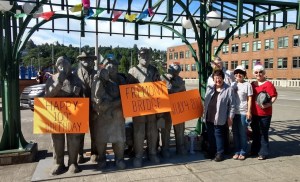
The Fourth of July, 2017, was the hundredth birthday of the Fremont Bridge. The statue is at the corner of Fremont Avenue and North 34th Street.
Fremont was officially founded as a separate area, like a suburb, with its own name in 1888. Its boosters were real estate men who, in addition to selling lots, also made sure that it was easy to get to Fremont — they controlled the earliest electric streetcar system in Seattle. They built a line to Fremont from downtown along Westlake Avenue, crossing the Fremont Bridge which was a smaller structure before the ship canal was built.
Fremont became a transportation hub, The Center of the Universe, where you could transfer to other lines going in different directions. The Waiting for the Interurban statue in Fremont commemorates another line, the Interurban railroad traveling northward to Everett.

View from the Fremont Bridge, eastward over the ship canal and the Aurora Bridge.

 Wedgwood in Seattle History