How does the history and development of Wedgwood compare to that of other neighborhoods in Seattle?
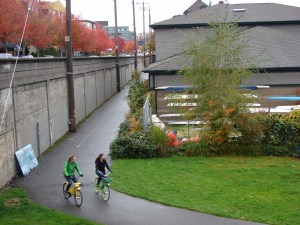
The Burke-Gilman Trail is the line of a former railroad and is parallel to the ship canal in Fremont.
Fremont was the site of some of the earliest land claims in Seattle in the 1850s, but it was not populated until developers bought the land in 1888. Fremont had this date as a definite start-point as a community with streets laid out. Its early development was planned by its land investors.
Many aspects of Fremont today, such as its street system and its hub for transportation, can be attributed to the strong period of development in the 1880s. Fremont’s early developers were also invested in the streetcar system and they brought this convenience to Fremont, as well.
Active Seattleite Henry Yesler was a member of the Lake Washington Improvement Company and in 1883 he bought some of William Strickler’s former homestead claim in Fremont for a place to create a canal at the northwest corner of Lake Union. That same year, Judge Thomas Burke bought some of the (future) Fremont land for the right-of-way of the Seattle, Lake Shore & Eastern Railroad. The railroad route has come down to us today as the Burke-Gilman Trail.
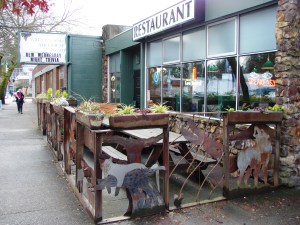
The Wedgwood Ale House at 8515 35th Ave NE is in Wedgwood’s earliest business block of the 1920s.
In contrast to Fremont, Wedgwood is a neighborhood which slept quietly until well after the year 1900, with no roads, railroads or other through-routes such as canals. Property records show ownership of land in what is now Wedgwood, but with no one in residence except for a period of homestead claims in the 1870s.
The Wedgwood neighborhood really began to grow in 1923-1926 when water and electric utilities became available. The biggest growth period in Wedgwood and the formation of the neighborhood identity finally came in 1945-1960 with the post-World-War-Two housing boom in north Seattle.
Continue reading →







 Wedgwood in Seattle History