Project FeederWatch 2015

Project FeederWatch is a fun citizen science project that anyone can do.  Set up a feeder, count birds, and report your sightings!  New participants receive the FeederWatch Handbook & Instructions, a Common Feeder Birds poster, a Bird-Watching Days calendar, and Winter Bird Highlights — a summary of the exciting data that you helped to collect.

Continue reading

Posted in Nature and wildlife | Tagged , , , | Leave a comment

Seattle Street Names

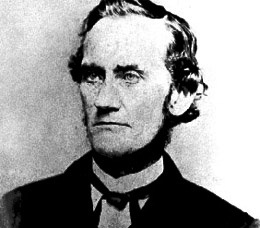
Arthur Denny 1822-1899

Arthur Denny 1822-1899

The vision of a city in the place where Seattle now stands was born in the heart of Arthur Denny, a 29-year-old surveyor in Knox County, Illinois in 1851.  As a surveyor Denny knew that in unexplored regions, early-arriving settlers would have the best chance at getting the best land.

Denny believed that the as-yet-undeveloped Pacific Northwest had great potential as a seaport and as a hub of railroad routes.   Two years after his decision to head Out West, Arthur Denny helped found the City of Seattle and name its first streets.

Continue reading

Posted in Land records and surveys, Plat names, research resources, Seattle History, streets | Tagged , , , , | 3 Comments

Following the Birds into Autumn Migration

Autumn migration by Marvin de Jong USFWS Migratory BirdsIn the autumn season when we see flocks of birds overhead, we know that cold weather is coming.

The annual migration does not mean that all birds are leaving the Pacific Northwest which is known for its mild winters.  Some birds, including some kingfishers and even hummingbirds, will stay through the seasons of autumn and winter.

There are a lot of great ways to follow bird activity all year round.  A fun way to follow the birds (while staying warm and cozy indoors!) is via on-line tracking sites.
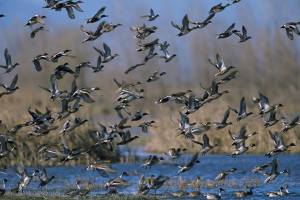
Migratory Birds USFWS photoNational birding websites include regional info to track your favorite species of birds, such as an article on All About Birds called “Where Can I Go to Watch Hawk Migration?

BirdNote, a daily bird-info site which has contributing writers from the Wedgwood neighborhood, tells about the behavior and typical migration patterns of different species, such as this article about Purple Martins (a swallow) on their journey to Brazil.

Are you interested in the migration patterns of eagles, hummingbirds, monarch butterflies or even frogs and whales ????  There is a migration tracking page for each, on the website of Journey North.   The Journey North page includes information on sunlight and seasons of migration, and other weather phenomenon which affect migration.

Watching the migrations of birds and butterflies heightens our appreciation of all of God’s creatures and the seasonal changes which are the rhythm of our lives on Planet Earth.
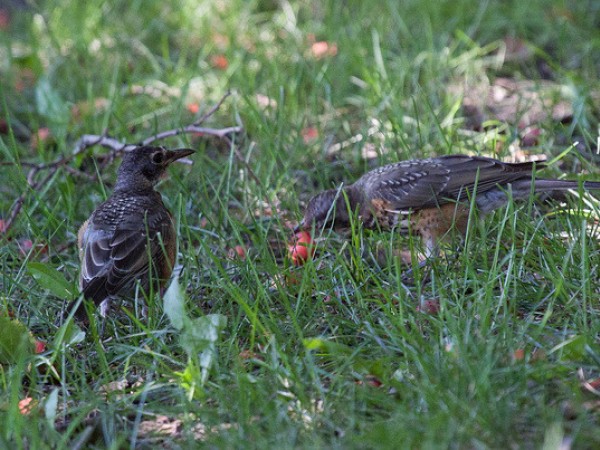
robins feasting on fruit

Robins feasting on fruit

Posted in Nature and wildlife | Tagged | 1 Comment

Q&A with ‘Too High and Too Steep’ author David B. Williams

Here are author David B. Williams’ comments on the fascinating story of Seattle’s regrading projects. Please note that there are more upcoming speaking dates when you can hear Mr. Williams’ presentation.

uwpressblog's avatarUniversity of Washington Press Blog

TooHigh-WilliamsIn his new book Too High and Too Steep: Reshaping Seattle’s Topography, David B. Williams tells an engaging story about the radical ways in which the leaders and inhabitants of Seattle have altered the landscape to better accommodate their visions for the city. Williams uses his science and nature writing background, extensive research and interviews, and deep knowledge of Seattle to illuminate the real physical challenges and sometimes rather startling hubris of these large-scale transformations: the altering of the original shoreline and lowering of the inconvenient bluffs; the filling in of the vast tideflats at the mouth of the Duwamish to make new, flat land; the creation of the ship canal to link Puget Sound with Lake Union and Lake Washington; and the removal of millions of cubic yards of earth in order to lower Denny Hill at the north end of downtown. He also helps readers connect the…

View original post 869 more words

Posted in Events and holidays | Tagged , , | Leave a comment

Old Houses and New Construction in Wedgwood: the Blue House

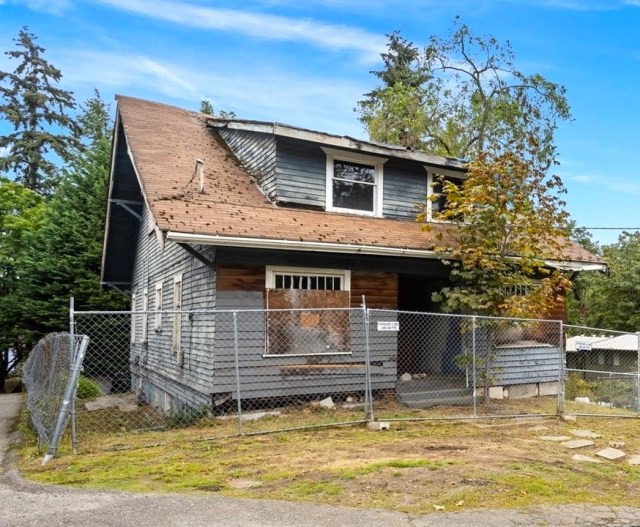
The Blue House at 2316 NE 85th Street in “western Wedgwood” had been vacant for quite a few years and finally it was sold in October 2024.  A developer bought the property and has filed a plan to build townhouses.

Today in Wedgwood there are many sites where old houses are being torn down and new ones built in their place.  At some sites which are zoned multiple-residency or commercial, single-family homes are being replaced by townhouses or apartments.

Real estate sales photo, 2316 NE 85th Street, October 2024.

Continue reading

Posted in Houses | Tagged , , , , , | 9 Comments

What We Want to Know: All About Birds

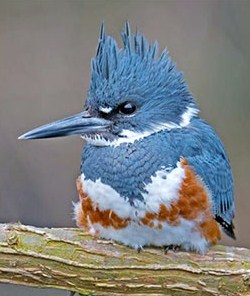
Female Belted Kingfisher bird photo by Brian E Kushner via Birdshare

Female Belted Kingfisher bird photo by Brian E Kushner via Birdshare

All About Birds is one of the best websites for help with bird identification and for answers to things we want to know about birds.

In a recent article on All About Birds about color differences between male and female birds, it was pointed out that in many species, the male bird is the more colorful.  But for the Belted Kingfisher species, the kingfisher female has an extra rust-colored band which looks like a belt and which makes her stand out.  What might be the reason for the color differences between male and female kingfisher birds?  Inquiring minds want to know!

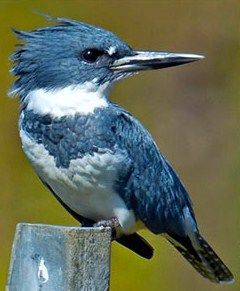
Belted Kingfisher, male of the species. Photo by Brian E Kushner via Birdshare

Belted Kingfisher, male of the species. Photo by Brian E Kushner via Birdshare

The Belted Kingfisher is a startling blue-color bird which is always found close to bodies of water, and can be found throughout North America.

Kingfisher birds may migrate in winter but it is not unusual for some kingfishers to stay in their “home territory” over the winter.  It is thought that, because the bird is territorial, male kingfishers may want to stay to defend their turf and await the return of females in the spring.  The All About Birds article about kingfishers, postulates that females are marked with a rust-colored band to distinguish them for “welcome” by the territorial males.

Posted in Nature and wildlife | Tagged , | 3 Comments

Seattle’s Regrading Mania

David B Williams book coverFrom the time that settlers first arrived in Seattle in 1851, they began redesigning the landscape.  There just seemed to be something about wanting to reconfigure the topography to suit civic purposes, which drove a near-mania for regrading.  It has been said that Seattle is the most engineered city in the world.  From the sluicing of Denny Hill to the digging of a ship canal, Seattle’s transformation has made its original form nearly unrecognizable.

In his new book, Too High and Too Steep, author David B. Williams has combined research, scientific background, and personal observations on how and why our city has been altered.  The book was introduced for the first time on September 9, 2015 at the University Bookstore, where the author told about his research and some of the amazing stories of Seattle’s regrading projects.  Mr. Williams’ blog page contains more regrading info links.  Here is a preview of the book with a video interview of the author.

Posted in Events and holidays | Tagged , , , | 4 Comments

A Walk Through Wedgwood History

Take a Walk Through Wedgwood History with me, Valarie, on any/all Saturdays in September 2015.  We will meet under the Safeway sign, 35th Ave NE at the corner of NE 75th Street at 10 AM.  We will look at the buildings we have in Wedgwood today and how Wedgwood got that way, during the post-World-War Two building boom.  Prior to the war’s end in 1945, there were no apartment buildings in Wedgwood and there still were many people who kept chickens and cows.   Today all the vacant spaces in Wedgwood are filled up and the neighborhood is beginning to experience the pressures of urbanization.

A 1953 view of NE 81st Street in the original Wedgwood emphasized its natural setting in tall trees. Photo by Werner Lenggenhager in the Seattle Public Library Historic Photos Collection.

A 1953 view of NE 81st Street in the original Wedgwood emphasized its natural setting in tall trees. Photo by Werner Lenggenhager in the Seattle Public Library Historic Photos Collection.

Wedgwood began to grow very rapidly after the end of World War Two in 1945.  With the end of the war came large numbers of returning servicemen who married and began looking for a place where they could have a house and raise a family.  As of 1945, while other parts of Seattle were already built up, in Wedgwood there were vast tracts of heavily treed, vacant land still available.  The post-war pressure for housing led to the creation of the Wedgwood neighborhood which is still in evidence today, with single-family homes on either side of a linear commercial district along 35th Ave NE.

Continue reading

Posted in boundaries, businesses, name of the neighborhood, Neighborhood features | Tagged , , , , | Leave a comment

Names in the Neighborhood: LaVilla

In March 1945 during the final battles of World War Two in Europe, a homesick soldier wrote a letter to the Seattle Daily Times newspaper.  Lieutenant Ralph A. Penington, age 34, was with the US Army’s 10th Mountain Division in Italy.  He told that after crawling into his sleeping bag one night, he had been able to drift off to happy dreams while reminiscing about his boyhood days as a newspaper carrier in northeast Seattle.  Lieut. Penington wrote,

Penington“It was twenty-five years ago this coming fall that I first started “in business” out in Morningside.  At that time I was nine years of age and I believe I had the grand circulation of fifteen papers.  Then as time went on I promoted Times circulation in Sand Point, LaVilla, Chelsea, Lake City, Cedar Park, Riviera and way points.”

In 1920 when nine-year-old Ralph became a newspaper carrier, his family lived at 9404 25th Ave NE in the Morningside Heights plat from NE 90th to 95th Streets, 25th to 35th Avenues NE.  Morningside had been named and promoted by a real estate firm but the Morningside designation gradually fell into disuse in the 1940s because of the rising popularity of Wedgwood as the new name for the neighborhood.

Ralph Penington’s letter of 1945 gave the names of northeast Seattle communities which are still recognized today, such as Sand Point, Lake City, and Cedar Park as well as Riviera which is a street name along Lake Washington.  Chelsea was the name of a store at 3400 NE 110th Street, present site of the Meadowbrook Apartments, and in the 1920s it was understood to mean the nearby residential area as well.   Chelsea was replaced by the name Meadowbrook because of the golf course which opened in 1932 at the present site of Nathan Hale High School at NE 110th Street.

One of Lieut. Penington’s northeast Seattle neighborhood designations, LaVilla, is unfamiliar to us now.  Where was LaVilla?

Continue reading

Posted in name of the neighborhood, Plat names | Tagged , , , | Leave a comment

Where Nature Lives

Hummingbird by Larry Hubbell August 2015 exhibitThis hummingbird photo along with more than a dozen other framed bird photos is part of an exhibit at Fuel Coffee in Montlake during the month of August 2015. The exhibit is entitled, “Where Nature Lives” by photographer and artist Larry Hubbell of the Union Bay Watch blog.

All of the photos are from western Washington and all but two are from around Union Bay near the Arboretum and near the University of Washington, Montlake and Laurelhurst neighborhoods of northeast Seattle.

Continue reading

Posted in Nature and wildlife | Tagged , , , | 6 Comments