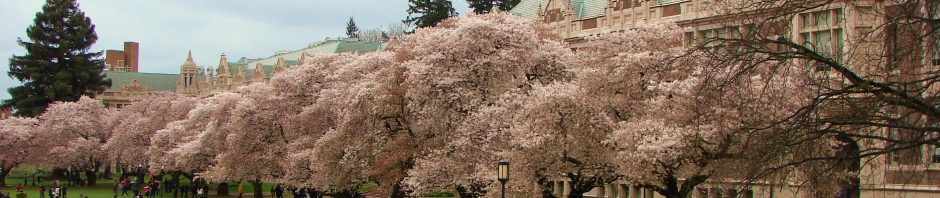
Nathan Hale High School in Seattle is on a large field at NE 110th Street, bounded on either side by the arterials 30th & 35th Avenues NE. The South Branch of Thornton Creek flows eastward across the school site. The neighborhood is called Meadowbrook, a name derived from a golf course which was on the site from 1931 to 1961.
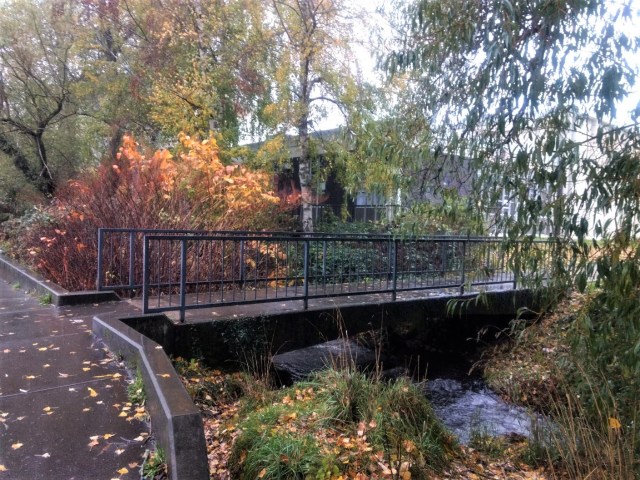
The south branch of Thornton Creek runs parallel to the Nathan Hale High School building. Bridges link the student parking lot to the building. Photo by Valarie.
Meadowbrook’s farming origins
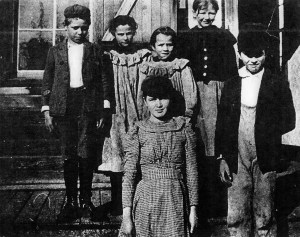
In 1898 the Maple Leaf School was made up of children from two German immigrant families, the Fischers and Ohlands. Photo courtesy of Al Blindheim.
In the 1890s the present Nathan Hale High School site was a farm area. Several German immigrant families including the Fischers, Beckers and Ohlands made use of the stream system through the area to water their crops and create pastures for cows. Circa 1890, the August Fischer family acquired the present Nathan Hale field at NE 110th Street and the hillside above it to the south, all the way to NE 100th Street.
The Fischer & Ohland families went in together on hiring a teacher for their school-age children. This 1898 photo of the children was taken at the first school site which was on Lake Washington at about NE 100th Street. Their teacher, who took the photo, was Howard A. Hanson. He later became an attorney whose contributions to state government were honored by naming Howard Hanson Dam (on the Green River at Eagle Gorge) for him.
Henry Ohland in Michigan during the Civil War
Henry Ohland was born in Germany and came to the USA with his parents and siblings in 1855, when he was about ten years old. The family settled in Saginaw, Michigan. When Henry turned eighteen in 1864, he enlisted in Michigan’s 29th Infantry Regiment, to go and fight for the Union in the Civil War. We may imagine that Henry’s parents were not too happy about this, because Henry’s older brother Frederick had enlisted three years earlier and had been wounded. By the time Henry enlisted, Frederick had mustered out and returned home.
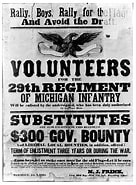 The 29th Michigan mustered with 856 soldiers from around the Saginaw Valley. They arrived in Tennessee on October 24, 1864, for the first of ten battles, repelling Confederate forces from around Murfreesboro, Franklin and Nashville. One of the Michigan soldiers’ main duties was to escort trains so that supplies would reach Union troops.
The 29th Michigan ended their military service in September 1865 and returned home, where the men were paid and the regiment disbanded. Henry Ohland had served safely.
One of the enticements to join the Union army in the Civil War was the prospect of land claims awarded for service. Veterans could count the length of their service as a discount on the number of years needed to file a homestead land claim. After the war, Henry Ohland filed a claim for thirty acres of land in McLeod County, Minnesota, not far from Minneapolis, but it doesn’t appear that he went there to live. McLeod County was a forested area and it may be that Henry Ohland intended to have logging done there for income, rather than farming. The censuses of 1870 and 1880 showed the Ohland family still living in Saginaw, Michigan.
The Ohland family goes Out West
As of 1888, Henry & Maria Ohland were over forty years of age and had a family of two sons and two daughters, all born in Saginaw, Michigan. Then suddenly in that year, the Ohland family left Michigan where they’d lived for more than thirty years and went out to live in Seattle. We can only speculate on the reasons.
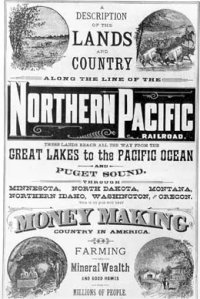
A railroad advertisement of the 1870s
In those days many Civil War veterans migrated Out West as their war experience had taught them the value of railroad lines. They knew that as railroads opened up the West, they could acquire undeveloped property which might increase in value. Henry Ohland may have known other veterans who were going Out West, or he heard of the untouched forests of the Pacific Northwest and the prominence of Seattle as a rail terminal and port city.
The Ohland family was listed on the Washington Territory Census of July 20, 1889, in Seattle, with their four children plus a newborn boy, born in Seattle, whom they named Henry Jr.
It is likely that in Seattle, the Ohlands connected with others in the German-speaking community. In Seattle in the 1880s there was already a German Reform Lutheran Church and a German language newspaper. Forty-three-year-old Charles Becker had a meat market in Seattle and had filed a homestead claim for the land at the site of today’s Nathan Hale High School. He sold much of this property to fellow German immigrant August Fischer, who farmed the land.
Albert Schlossmacher was a German immigrant who had a downtown Seattle tailor shop. As an investment, he bought a section of land on the north side of today’s NE 110th Street, although he never went out there to live. It seems likely that in Seattle the Ohland family would have encountered one or more of these fellow German immigrants who owned land near NE 110th Street, and the Ohlands settled nearby, on the east side of 35th Ave NE at NE 105th Street.
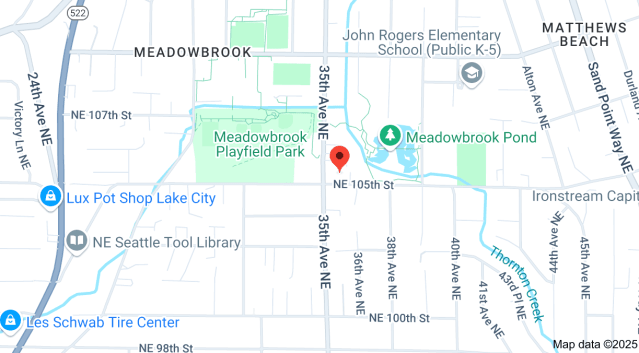
Today’s Meadowbrook map showing the location of the Ohland’s house.
Settling in early Seattle
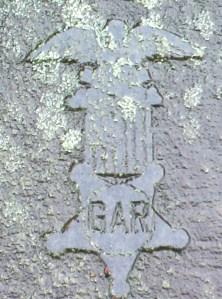
Grand Army of the Republic symbol on the grave marker of Henry Ohland, Sr.
Henry Ohland listed his occupation as “farmer,” but we know that he also engaged in land investing. He may have again exercised his status as a Civil War veteran to obtain land, or he may have paid cash, $1.25 per acre, for land claims he filed in Clallam County, over on the Olympic Peninsula of Washington. In Seattle he owned the property on the east side of 35th Ave NE between NE 105th to NE 110th Streets including much of what is now the Meadowbrook Pond flood control/water detention area.
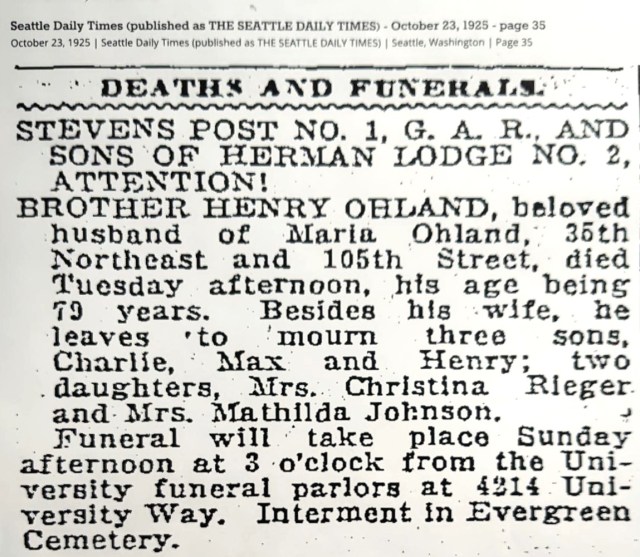
Despite living in what was then a remote location outside the Seattle City Limits, Henry Ohland networked in town with other Civil War veterans in a group called the Grand Army of the Republic. The group provided patriotic participation in public events such as Memorial Day, and a place for business networking with trusted fellow veterans. When Henry Ohland died in Seattle in 1925 a notice was posted for members of the group to attend the funeral.
The next generation on the Ohland ranch
The Ohland’s youngest child was Henry Ohland Jr, born in 1889 soon after the family’s arrival in Seattle. Henry Jr. spent his entire life at 3512 NE 105th Street, managing the property and gradually selling some of the surrounding lots for housebuilding.
After the death of his father in 1925, Henry Jr. needed to manage the Ohland family’s property for the support of his widowed mother Maria and himself. He could see that the neighborhood was transitioning from farm properties to suburban housing, due in part to the rise of car use and roadbuilding which made it possible for people to live “farther out” and commute to work in Seattle.
The Chelsea neighborhood
Melvin & Mae Yates, 3004 NE 110th Street, were the first in the neighborhood to realize that car traffic would transform the area. Their house was on the corner of 30th Ave NE where cars traveling northward out on the Erickson Road had to turn right, go across NE 110th Street, and then turn left onto 35th Ave NE to continue out on their way to Bothell.

The Yates house, built in 1914, is still at 3004 NE 110th Street where the old Erickson Highway took a turn to the east across NE 110th Street.. Photo by Valarie.
In 1916 the Yates became real estate developers by filing a plat of land on the north side of NE 110th Street and advertising the area as “Chelsea.” House lots were available, and a Chelsea store was built on the corner of NE 110th Street & 35th Ave NE.
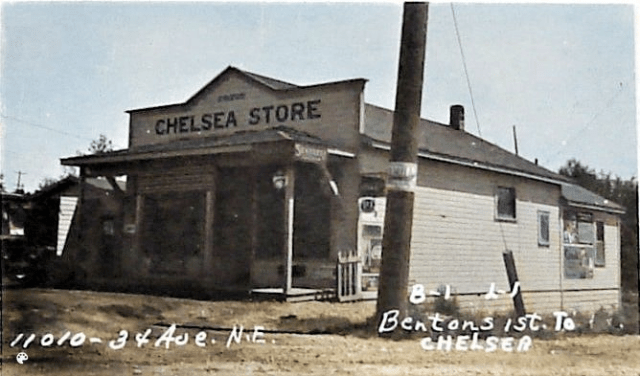
Chelsea Store at 35th Ave NE and NE 110th Street as it looked in 1938.
We may wonder what Henry Ohland Jr. thought about the modernizations which were occurring all around him in the 1920s-1930s, including the Erickson Road, and the newer Victory Way highway (Lake City Way NE), the Chelsea housing development and a commercial building, the Chelsea store, at 35th Ave NE & NE 110th Street. The neighborhood was becoming denser with housing and there was more car traffic. A gas station later opened on the corner of NE 110th Street, a completely new entity in the neighborhood because of increasing car use.
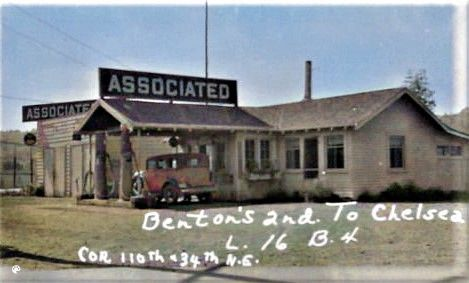
The first gas station in the (future) Meadowbrook neighborhood
The Meadowbrook Golf Course opens in 1931
In 1931 another big change happened, which transformed the neighborhood: the Meadowbrook Golf Course opened across 35th Ave NE from the Ohlands’ home.
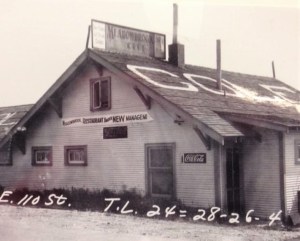
Clubhouse of the Meadowbrook Golf Course.
Farmer August Fischer, one of the early German-immigrant residents on the hillside, was transitioning into retirement in the 1920s and gradually reducing his farm activities. He platted the field area from NE 105th to NE 110th Streets to sell as house lots. Unexpectedly then the entire field was purchased to become a golf course.
As of 1931 the Ohlands were still keeping cows and planting crops in their fields on the east side of 35th Ave NE, but with the advent of the Meadowbrook Golf Course the Ohlands began to have problems.
Golf balls were sailing over the road and hitting the cows in Ohland’s pasture, and people broke down Ohland’s fencing when they came over to search for lost golf balls. In Ohland’s legal complaint, he implied that it was the golfers themselves who were invading his property to retrieve their golf balls, though I suspect some neighborhood kids were involved, too — kids could make money by re-selling golf balls. In 1933 Henry Ohland Jr. went to court with an exhibit of 700 golf balls which he said he’d collected from his pastures.
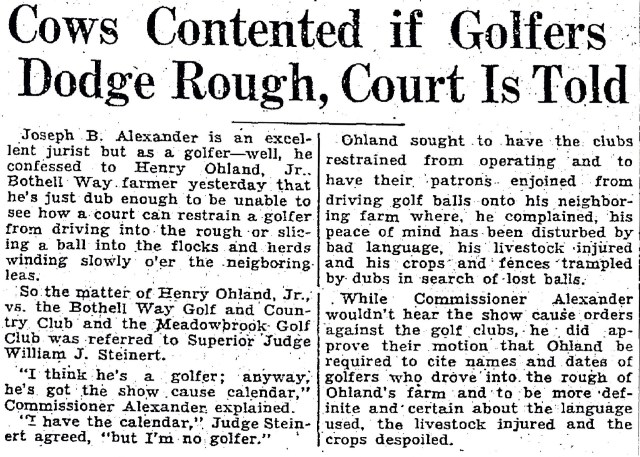
Article of May 14, 1932, Seattle Daily Times page 12.
The court declined Ohland’s request to have the Meadowbrook Golf Course shut down. The golf course agreed to make more strenuous efforts to advise golfers not to hit long drives in that direction, towards 35th Ave NE. The golf course also put up a fence on their side of the road to discourage golfers from going over to Ohland’s to search for lost balls.
Meadowbrook transformed
As late as 1943, the Ohlands were still filing complaints with the King County Sheriff’s office about people breaking down fences and roaming the Ohland’s pasture in search of golf balls.
Golf balls might still be soaring over 35th Avenue NE today, had not the Seattle School District decided that the Meadowbrook Golf Course would make a good site for a high school. The owners of Meadowbrook Golf Course at that time, Tachell & Burns, did not want to sell, but the school district successfully filed legal action to force the sale as a public necessity. In court in 1960, a judge ruled that Seattle needed a new high school site more than it needed a golf course. Meadowbrook Golf Course closed in 1961 and Nathan Hale High School was built, opening in 1963 as the last high school built in Seattle.
Today in the Meadowbrook neighborhood of northeast Seattle, there are no more pastures or cows. Henry Ohland Jr. outlasted the golf course; he lived on his “ranch” property until his death at age 92 in 1981.

Names in the neighborhood: Meadowbrook
On July 12, 1931, only two weeks before the opening of the golf course, the owners made an announcement of a name change. They’d decided that the name they had chosen, “Bothell Way Golf and Country Club,” was “a bit unwieldy.” The owners, Ed Miller and George Goodner, put out a news bulletin that the course would instead be called the Meadowbrook Golf Club.
The two owners were surprisingly young – Ed Miller was 29 and George Goodner was 42 when the Meadowbrook Golf Course opened in 1931. Neither had been born in Seattle. Each had come to the city to work in the oil & gas business, and they were corporate executives of the Richfield distributorship network.
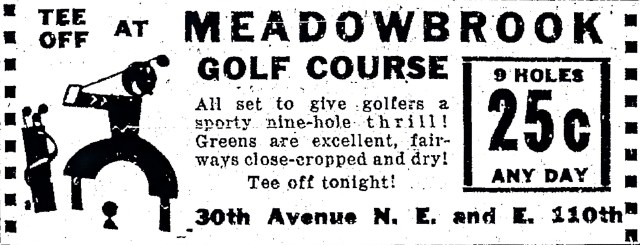
Meadowbrook Golf Course advertisement, Seattle Daily Times, April 28, 1933, page 27.
We don’t know where Miller & Goodner got the idea to name the golf course “Meadowbrook,” but we know that by 1931 there already were other golf courses in other states, named Meadowbrook. It seemed rather obvious, as well, since the new course was on a meadow with a brook flowing eastward (today’s south branch of Thornton Creek).
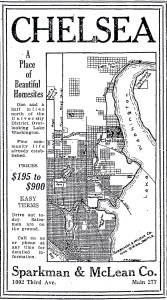
Chelsea real estate ad of 1920
The owners might instead have chosen to call it the Chelsea Golf Course, but at that time, 1931, it seemed that the previous “Chelsea” name for NE 110th Street, used in the 1920s, was already fading away.
Neighborhood names can be elusive and can change over time. An example is Morningside Heights, the plat name for houses at NE 90th to NE 95th Streets, a real estate development of the 1920s. The Morningside name faded and later became the Wedgwood neighborhood.
Beginning in 1941 developer Albert Balch built houses in land plats named Wedgwood, centered along 35th Ave NE at NE 85th Street. He did not deliberately set out to name the neighborhood “Wedgwood.” The name began to be used by local businesses and simply “caught on.”
The “staying power” of the Meadowbrook name is surprising. Even though the golf course closed in 1961, the Meadowbrook name hung on until the 1990s when it was designated as the official name of the neighborhood, by the Seattle Department of Neighborhoods, for a sense of identity during a time when community councils were being organized.
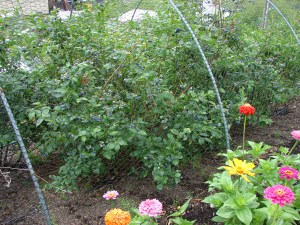
Meadowbrook Community Garden
Meadowbrook is defined as the area from NE 95th Street out to NE 125th Street so that Meadowbrook is between Wedgwood and Lake City. Schools in Meadowbrook include Nathan Hale High School, Jane Addams Middle School and John Rogers Elementary.
Features of the Meadowbrook neighborhood today include the schools, a community center building & swimming pool, athletic fields, Meadowbrook Pond, and Meadowbrook Community Garden.
Much of the Ohland’s former pasture is now the flood plain/water detention area of Meadowbrook Pond. This convergence point of the north and south branches of Thornton Creek is called The Confluence. Work began here in the 1990s to slow the flow of water, filter it and prevent neighborhood flooding. Final improvements were done in 2014-2015 to enlarge the flood plain on what was once the Ohland’s pasture. In the photo below, we are looking westward to Nathan Hale High School over on the other side of 35th Ave NE.
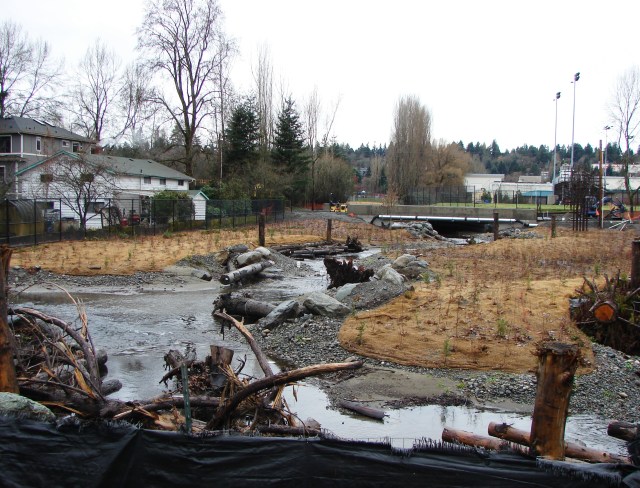
Ohland’s former pasture is now a flood plain to retain and filter the water of Thornton Creek. This view is westward, looking across 35th Ave NE toward Nathan Hale High School. The white house at left was Nessinger’s and was torn down in 2025. Photo by Valarie.
Sources:
Bureau of Land Management website – homestead claims of Henry Ohland Sr.
Genealogical resources including census, City Directories, Washington Digital Archives and Find A Grave.
Thanks to David Z for help with photos.
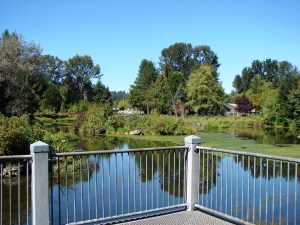
Meadowbrook Pond looking northwest
Newspaper articles:
Death notice of Henry Ohland Sr., funeral info for members of the Grand Army of the Republic. October 23, 1925, Seattle Daily Times, page 35.
“Heads of local Richfield oil & gas distributorship, Ed Miler, president and George Goodner,” August 28, 1927, Seattle Post-Intelligencer, page 69.
“Bothell Course Name Changed; Opens July 25.” July 12, 1931, Seattle Daily Times, page 23.
“Golf Hard on Property,” May 10, 1932, Seattle Post-Intelligencer, page 15.
“Cows Contented,” May 14, 1932, Seattle Daily Times, page 12.
“Death of George Goodner,” November 7, 1932, Seattle Post-Intelligencer, page 2. George Goodner, one of the original owners of Meadowbrook Golf Course, died at age 44 after an appendix operation. His wife Bernice retained her share of the golf course ownership and appeared in court in 1933 as a defendant in the lawsuit brought by Henry Ohland Jr.
 “Golf Balls – 700 of Them – Offered as Exhibits in Court,” March 31, 1933, Seattle Post-Intelligencer, page 7.
“Judge Dons Knickers for Golf Ball Damage Suit,” April 1, 1933, Seattle Post-Intelligencer, page 2. “Superior Judge Clay Allen and two attorneys joined a golf professional yesterday to make up a foursome and help try a legal case on the Meadowbrook Golf Course at NE 110th Street and 35th Ave NE.”
“Ohland Complains That Golfers Have Been Climbing Over His Fence in a Search for Golf Balls,” September 21, 1943, Seattle Daily Times, page 16.

The plan for the new Victory Way in 1921 — today’s Lake City Way NE. The dotted line is the old Gerhard Erickson Road. Photo from the Seattle Daily Times of March 14, 1920, page 5.

 Wedgwood in Seattle History
Thank you for a fun read! I’ve lived in the Meadowbrook neighborhood since 1991 and now I have a cheerful sense of the history. Quite relieved there are no more golf balls soaring eastwards over 35th Ave NE.