In the summer of 2023 the John Rogers School building at 4030 NE 109th Street was demolished. Over the next two years a new building was constructed on the same site. This blog article is a history of the school’s founding, and photos of the new building.
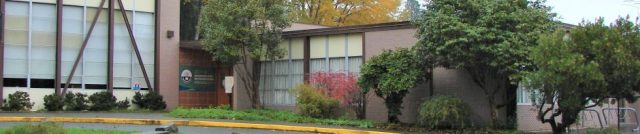
The original John Rogers School, built 1956, replaced 2025.
From the old to the new: the original John Rogers school building was demolished in the summer of 2023.

The original John Rogers School building, built 1956, was demolished in the summer of 2023 so that a new building could be constructed on the same site. Photo by Valarie.

Front entrance to the new John Rogers School building as seen from the driveway leading from NE 109th Street. Photo by Kim McCormick, Grand Opening Day on August 28, 2025.

The new John Rogers School building as seen from the south side, approached from NE 105th Street. Parking areas, playgrounds and pathways lead up to the building. Photo by Valarie, Grand Opening Day, August 28, 2025.
John Rogers School and the post-war Baby Boom
At the end of World War Two in 1945, military servicemen returned to the USA and many settled in Seattle. The population of Seattle increased by 100,000 people between 1940 and 1950 due to the influx of returnees and new residents. Many young couples got married at this time and started families. Seattle Public Schools then began a desperate scramble to get ready for what they knew would be coming: a huge wave of children born after 1945, called the Baby Boom, who would reach school age in the 1950s.
The need of new schools was particularly acute in northeast Seattle, an area of a lot of housing development after the war. In the 1940s-1950s northeast Seattle was still semi-rural, outside of the city limits and still had a lot of vacant land which could become available for building houses. Developers like Albert Balch in Wedgwood shifted into high gear to build starter-homes accessible to military veterans via government-supported home loan programs. Neighborhoods like Wedgwood where Balch was building houses, became populated with young married couples.
This blog article will tell about the John Rogers School at 4030 NE 109th Street, one of the new schools which opened in northeast Seattle in the post-war years. Then in 2023 the original building was torn down and construction of a new one on the same site, is underway.

John Rogers School at 4030 NE 109th Street as it looked when the building was completed in 1956.
Northeast Seattle’s early school buildings

A 1938 Seattle Engineering Dept. map of the city, showing the annexation dates of different neighborhoods. A “jog” can be seen at the northeast corner, where the city limits were at NE 65th Street. Northeast Seattle was outside the Seattle City Limits until the 1940s.
Only a few permanent school buildings existed in northeast Seattle prior to World War Two. These buildings were at Laurelhurst (built in 1931) Ravenna (1911 & 1923) Bryant (1926) Maple Leaf (1926) and Lake City (1931). Each of these schools had histories going back into the early 1900s, usually with one-room wood-frame schoolhouses before their brick buildings were built.
From 1910 until the early 1940s, the city limit was at NE 65th Street in northeast Seattle. Maple Leaf School on NE 105th (later on NE 100th Street) and Lake City School on NE 125th Street had been organized as independent schools, outside of Seattle. The Shoreline School District was formed in 1944 and it absorbed these independent schools and others like Haller Lake and Oak Lake.
One of Shoreline Schools’ first initiatives was to build a junior high school, Jane Addams on NE 110th Street, in 1949. It was operated by Shoreline Schools until 1954 when the Seattle City Limits were finally set at 145th Street. Then the Jane Addams school was transferred to Seattle Public Schools.
Building new schools in the 1950s
Post-war elementary schools in northeast Seattle included View Ridge, Wedgwood, Decatur, Sand Point, John Rogers and Cedar Park. All but Decatur started with clusters of portable classrooms while permanent buildings were under construction.
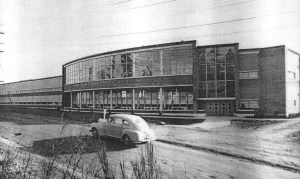
Eckstein Junior High School, 3003 NE 75th Street, as it looked in 1958.
New schools needed to be built for the Baby Boom kids but the acquisition of property was a slow, arduous process.
In a few cases like that of Eckstein Junior High at 3003 NE 75th Street, Seattle Public Schools already owned the site. During a relatively prosperous economic period in the 1920s, a successful school bond provided money to build north Seattle’s first junior high buildings, Marshall & Hamilton. The site of Eckstein, being outside the city limits at that time, was purchased and held for more than twenty years until Eckstein was built in 1950.
While searching for available property in northeast Seattle, the school district had plenty of pastures to choose from. The Eckstein site on NE 75th Street had been used as a pasture for decades, since the early 1900s, and was clear of other buildings. At the site of Wedgwood School on NE 85th Street, a large piece of property had only recently been sold to developer Albert Balch when the school district made a last-minute grab and appropriated it.

The Jones house at 3010 NE 85th Street was one of four houses moved off of the site of Wedgwood School.
The site designated to become Wedgwood School in the 1950s already had four houses on it, two older homes including that of the previous property owner, Mr. DeVries. There were two new houses built by Balch whose families had just moved in, only to be told that they would have to move their houses off of the site.
The Stone and Robinson families had to find new lots and arrange to have their houses moved. Mr. DeVries did, as well, and his house now stands at the northeast corner of NE 85th Street & 30th Ave NE. Next to his is the Jones house now at 3010 NE 85th Street, built 1928, which was also moved from the site of Wedgwood School.
The site of John Rogers School

Walkway along the western edge of Rogers field parallels Thornton Creek.
Another vacant pasture site acquired by Seattle Public Schools was between NE 105th to 110th Streets about five blocks east of the arterial 35th Ave NE.
Thornton Creek flows in a southeasterly direction along one side of the site which was one reason why it had been a pasture, where horses and cows could get water. Another reason was the seasonal flooding as the creek was known to rage with overflow of heavy winter rains. Earlier settlers in the area, such as the German immigrant families who farmed at Meadowbrook, had sense enough not to build on low ground close to a creek, so this area was still not built up with houses as of the 1940s.
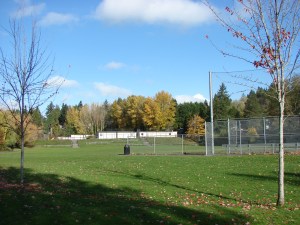
Rogers School has a field extending to NE 105th Street. From there we are looking northward to the original school building.
People thought of the field area as the Matthews neighborhood, because John Matthews, namesake of Matthews Beach, had owned large tracts of land including the pasture. When the school finally opened in September 1953 with all portable classrooms, at first it was called Matthews School.
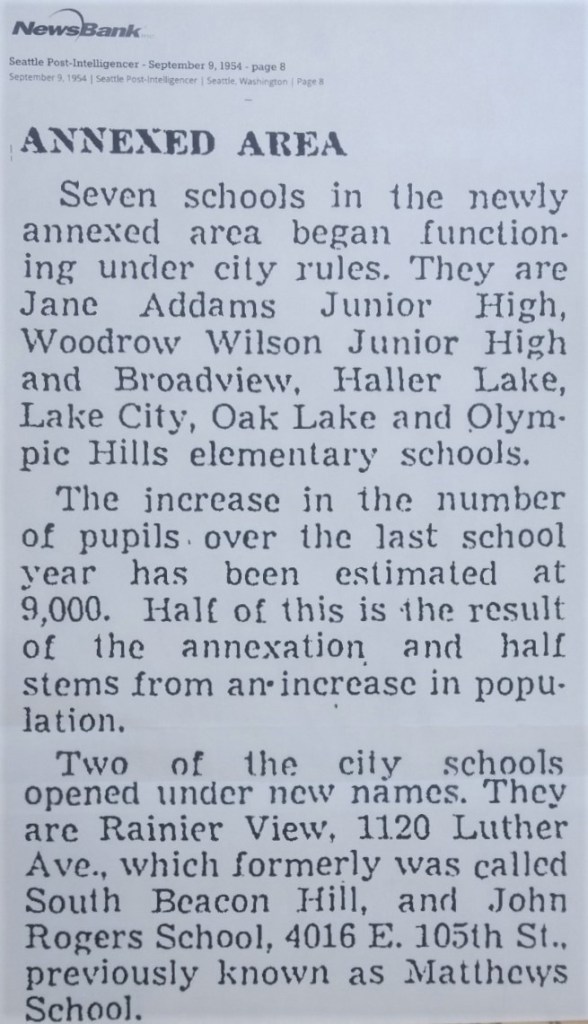
Although neighbors protested, the school was renamed John Rogers School on June 1, 1954, a choice of naming by the school district (see news article posted at the end of this page).
In 1956 the new brick building was completed. The Rogers School site is on more than nine acres and includes the former pasture which now has ball fields closest to NE 105th Street.
In the naming of schools, Seattle Public Schools sometimes followed along with the existing name of the neighborhood as was done at Wedgwood and View Ridge schools. In other cases a school was assigned the name of a “worthy person,” even if that person had no direct association with Seattle. Bryant School on NE 60th Street was named for a poet and journalist of the 1800s in the eastern USA.
Who was John Rogers?

John Rogers 1838-1901
The name given to the new elementary school at 4030 NE 109th Street was that of John Rogers, a former governor of Washington State and the author of the “Barefoot Schoolboy Law.” While serving in the Washington State Legislature in 1895, Rogers wrote and introduced a bill to provide equal funding to all schools throughout the state. Prior to the implementation of this law, each school district was on its own to find sources of funding. Some urban areas such as Seattle had a tax which provided money for schools; other districts did not.
The purpose of the Barefoot Schoolboy Law was to equalize the money spent on schools by collecting a tax and assigning a dollar amount to be spent for each student throughout the state. The reason for the name “barefoot schoolboy” was to express the idea that no matter the economic status of a family, through the state support of education every child can attend school with equal amounts of money spent per student.
The future of John Rogers School

The original Rogers School front entrance from NE 109th Street (This building was demolished in 2023). Photo by Valarie, early summer 2023 before demolition.
Over the past ten years the Seattle Public Schools has assessed its existing school buildings for safety and function, and a series of school levies has provided money for upgrading or replacing buildings. Each school goes through seismic review and other screening, including an evaluation of the building’s history and architecture. John Rogers School was brought before the Seattle Landmarks Board in August 2021. They wrote,

old Rogers School playground
The Landmarks Board acknowledges the cultural history associated with the school but believes this may not be embodied in the building itself… we recognize this building as a mid-century design but do not believe it rises to the level of a landmark. This assessment was informed by a site visit and thorough review of the property on August 12, 2021.
After assessing the building for safety and function, Seattle Schools’ decision was that it would be best to replace the John Rogers building. A new building would make better use of the site in the functionality of the building, with new mechanical systems and a better layout.
The construction began with demolition of the old building in July 2023. During 2023-2025 the John Rogers school met at a temporary site, the Marshall building at Green Lake. The new John Rogers School building was finished and open in September 2025.
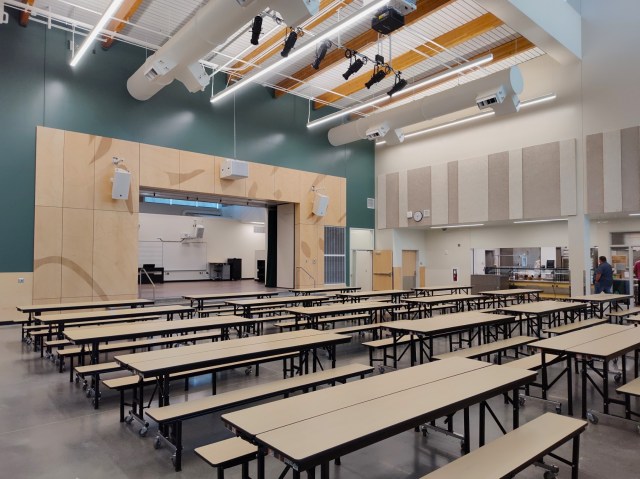
The new lunchroom/central gathering space at the newly rebuilt John Rogers School. Photo by Valarie, Grand Opening Day, August 28, 2025.
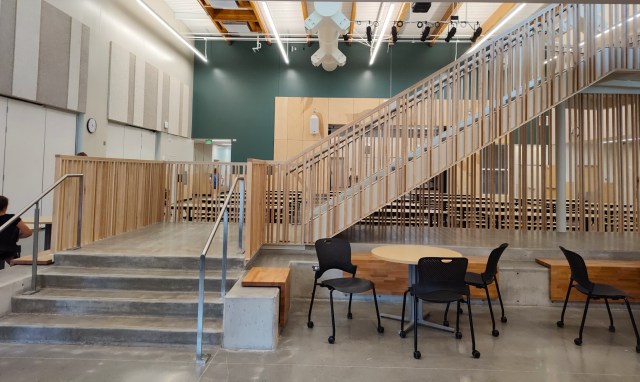
Central stairway to the second floor, in the new John Rogers School building. Seating areas surround the stairs. Photo by Valarie, Grand Opening Day at the new school, August 28, 2025.
Sources:
City of Seattle Landmarks Preservation Board, staff report of August 12, 2021: John Rogers Elementary School, 4030 NE 109th Street.
HistoryLink Essay #10003, “Washington’s Barefoot Schoolboy Act is passed on March 14, 1895,” by John Caldbick, 2012.
John Rankin Rogers (1838-1901), Wikipedia. Accessed 11/12/2021.
John Rankin Rogers (1838-1901), HistoryLink Essay #22955 by Phil Dougherty, 2024.
“School Board has changed the name of the Matthews School, 4016 E. 105th Street, now the John Rogers School,” Seattle Daily Times, September 5, 1954, page 13.
“School Board accepted final plans and will call for bids on a new John Rogers Elementary School, E. 105th Street and 40th Ave NE. The John Rogers School will replace ten portable classrooms now in use. It will be constructed of brick and concrete and will cost about $500,000.” Seattle Post-Intelligencer newspaper, March 19, 1955, page 4.
Seattle Public Schools, John Rogers Elementary Replacement Project. Source of funding is the Building Excellence V (BEX V) Capital Levy, approved by Seattle voters in 2019.
Seattle School Histories, “John Rogers School.”
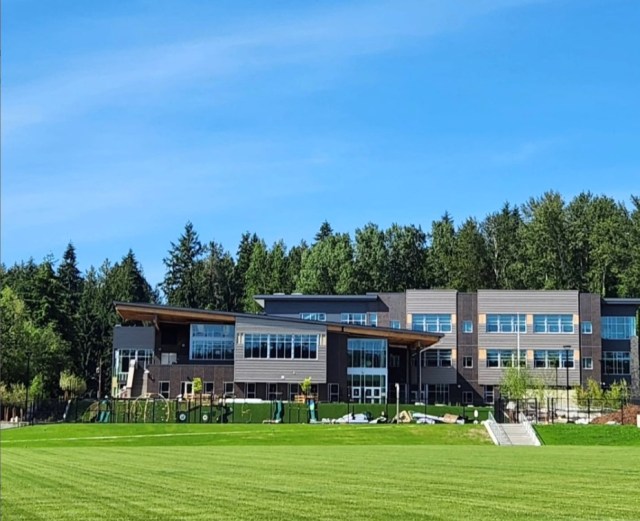
The new John Rogers School building in 2025, as seen from the south side. Photo by David Zimmerman.
Notes on school changes, upgrades and replacements:
Two northeast Seattle elementary school buildings which had been leased out to other entities, were later restored and are now open again: Cedar Park at 3737 NE 135th Street, and Sand Point at 6208 60th Ave NE.
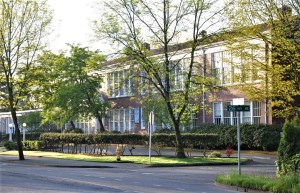
The former Lake City School is now an office building on NE 125th Street.
The Lake City School at 2611 NE 125th Street which had closed, was sold to become an office building.
Decatur School at 7711 43rd Ave NE was closed for interior renovation for a year 2016-2017 and then re-opened with an Accelerated Education program. A new school, Thornton Creek, was built on the site on the 40th Ave NE side so there are now two functioning elementary schools on that block.
Elementary schools which have already been torn down and replaced are Olympic Hills at 13018 20th Ave NE, and Hazel Wolf-Pinehurst at 11530 12th Ave NE.
A new building for Northgate Elementary School, 11725 1st Ave NE, opened in September 2023 and the name of the school was changed to James Baldwin Elementary.
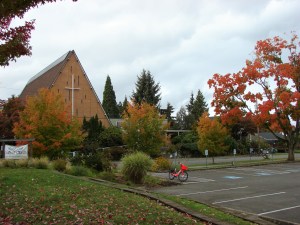
Parking lot, foreground, is the footprint of Maple Leaf School which was torn down.
The Maple Leaf School, 3216 NE 100th Street, was torn down. The site stood vacant for many years while the school district still owned it, and the surrounding community disputed as to whether to preserve the site as a park or not. The eastern side of the site was later sold to a developer and there are houses there now.
Maple Leaf Lutheran Church at the corner of NE 100th & 32nd Ave NE, was able to get a parking lot on the remaining original school site.
Northeast Seattle school buildings which are “landmarked” under Seattle’s Historic Preservation Program are Bryant, Cedar Park, Eckstein and Lake City (even though the Lake City School is now an office building). In some cases the landmarking includes only the front façade of the building, such as Eckstein. Landmarking requires designation on the basis of at least one of six criteria such as outstanding architecture or historic significance.
Two other landmarked buildings in the Wedgwood area are the Northeast Branch Library at 6801 35th Ave NE, and the Theodora (now a regular apartment building) on the southwest corner of the intersection of NE 68th Street.

 Wedgwood in Seattle History