Sacrifices and Safety

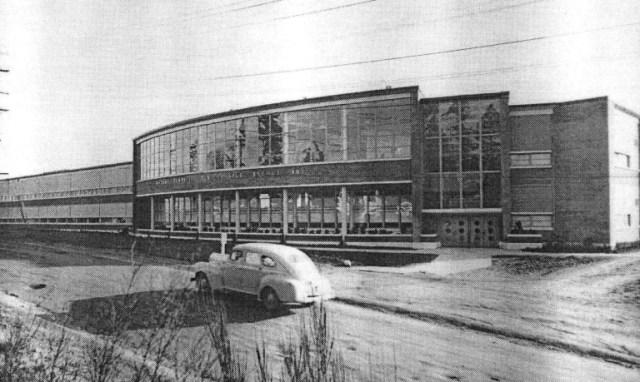
The newly-built Eckstein Junior High School, 3003 NE 75th Street, as seen circa 1950. In the foreground we see that the arterial NE 75th Street had not yet been paved. Photo courtesy of Seattle Public Library.

In the 1950s the Wedgwood neighborhood in northeast Seattle was in a growth spurt with the demand for housing following World War Two, and the generation of children, called the Baby Boom, born in that post-war era.  In the photo above we see the newly built school, Eckstein Junior High at 3003 NE 75th Street, a symbol of the new era of post-war neighborhood development.

In the foreground of the above photo we see a car bumping along on the yet-unpaved NE 75th Street.  The unpaved road was a sign of the rural conditions in Wedgwood which was just then, in the 1950s, coming within the Seattle City Limits.  We may chuckle at the thought of an unpaved NE 75th Street, but we may also ponder whether the roadway was in some respects safer in those days, as excessive speed was not possible.

This blog article will reflect upon the tenth anniversary of a horrific crash which took place on NE 75th Street, almost in front of the Eckstein school building, on March 25, 2013.  Two pedestrians were killed outright, and two more were permanently disabled.  We may ask: have the sacrificial deaths and injuries of that day, led to improved traffic safety conditions now?

Continue reading

Posted in streets | Tagged , , | Leave a comment

The Hillcrest Houses in Wedgwood

In 1939 a newlywed couple, James & Bonnie May Burnett, moved into a new house on NE 88th Street in northeast Seattle. Their block of new houses was occupied mostly by other young couples.  This was only the Burnett’s first house, as they moved to newer houses twice more, following the real estate trends in northeast Seattle.

James Burnett was an up-and-coming real estate salesman who had moved to Seattle for its more hopeful economic outlook.  Seattle was beginning to pull out of the long down-period of the 1930s and houses were beginning to be built again.  James Burnett’s career as a real estate salesman and as a developer, followed the growth of northeast Seattle.

Continue reading

Posted in Architecture, Houses, Plat names | Tagged , | Leave a comment

The Mysteries of Montlake

Part of the fun of blogging is being able to network with other researchers and writers.  Here is an article from the blog of Rob Ketcherside, with his deep exploration of the “portage” at today’s Montlake.  The Portage, a place where two bodies of water were close together, became the first part of Seattle’s ship canal.

Montlake crossings in a simple timeline

Bicycle paths map of 1900


Posted in Seattle History | Tagged , | Leave a comment

Mary Boman: Seattle and Beyond

George Boman was only 46 years old when he died in Seattle on December 19, 1890.  He had grown up in Tennessee and after fighting in the Union Army in the Civil War, he never went back home.  He journeyed across the USA and spent the last fifteen years of his life in Seattle, where he became a prosperous businessman with investments in real estate.  He married for the third time in 1885 and seemed happy, but Boman’s life and his marriage were cut short by death.

After George’s death, the widowed Mary Boman, age 35, was able to continue on much as before, because George had left her in comfortable financial circumstances.  George & Mary had a house on Woodland Park Avenue North on the edge of the Fremont neighborhood in Seattle. They lived together with Mary’s parents, her brother Edward, and her nine-year-old son from a previous marriage.

Early in the year 1891, Mary Boman kept herself busy with completing the plan which George had started, for an even larger new house on the same street.  In the process of buying furniture for the new house, Mary became romantically involved with the salesman at the furniture store, Harry Donald.

This blog post is the fifth and final article in the series about the life of George Boman.  In this article we will see what happened to his widow Mary after his death.

Mary Boman’s card of thanks published in the Seattle Post Intelligencer newspaper, December 22, 1890.

Continue reading

Posted in Civil War, Fremont neighborhood in Seattle, Seattle History | Tagged , , , | Leave a comment

George Boman in 1890 in Seattle

George Boman, originally from Tennessee, was a Civil War veteran who made the classic American western migration across the USA in search of opportunities.  After his Civil War service ended in 1865, Boman went to Kentucky, spent a few years in Nebraska, and then came to Seattle in 1875.  He formed business partnerships with developers of streetcar lines, real estate promoters and Seattle visionaries who planned improvements such as a railroad and a ship canal.

Boman and the small population of Seattle held on and refused to give up through the 1870s and 1880s, though they could not be sure that Seattle would ever amount to anything.

Seattle’s big breakthrough came, ironically, via a fire which burned thirty blocks of the downtown core.   Seattle’s Great Fire of June 6, 1889, caused a reorganization of the street system, the institution of building codes, and a rebuilding boom.  Newcomers poured into the city in search of jobs in the rebuilding.  They brought increased diversity to the economy and a vast array of skills such as that of architects, contractors, carpenters and brickmasons.

The year 1890 dawned brightly for George Boman and his wife of four years, Mary.  They had profited from real estate investments and the economic outlook seemed to point toward continued prosperity.   Little did they know that despite all the good things of the year 1890, at age 46 George Boman’s health would fail, and he would die on December 19, 1890.

This is the fourth article on this blog about the life of George Boman, tracing him from his origins in Tennessee, through the Civil War, his arrival in Seattle in 1875 and his prosperity in the 1880s in Seattle.

Continue reading

Posted in Civil War, Fremont neighborhood in Seattle, Seattle History | Tagged , , , | 1 Comment

George Boman in the Prosperous 1880s in Seattle

In 1882-1883 George Boman split up with his second wife, Adelia, and started a new life in a house on the north shore of Lake Union, on what is now Woodland Park Avenue North near Stone Way.  Those streets did not exist at that time and very few people lived in the area.

The Fremont neighborhood in Seattle is located at the northwest corner of Lake Union. Map courtesy of HistoryLink.

In 1888, the Fremont development was created, which caused increased prosperity for George Boman.  His property was on the eastern edge/just outside of the official Fremont plat.  Boman’s property increased in value because of its location which was made more convenient by the Fremont development.  There were more people interested in buying house lots in the area of the new Fremont community.

Boman also owned farmland in Duvall, eastern King County, and he had gotten acquainted with the Selleck family of Cherry Creek Farm.

In November 1883 the entire Selleck family left the farm and came to live with Boman at his house on what he then called Boman Avenue (today’s Woodland Park Avenue North).

The Selleck family included John and his wife who were about sixty years old, their two adult children Edward and Mary, and Mary’s little boy, Ralph.  A newspaper article noted the family’s move to Seattle.  We may wonder who wrote the line that Mary would “rejoin her husband” in Seattle, as it soon became clear that she had no intention of doing so.
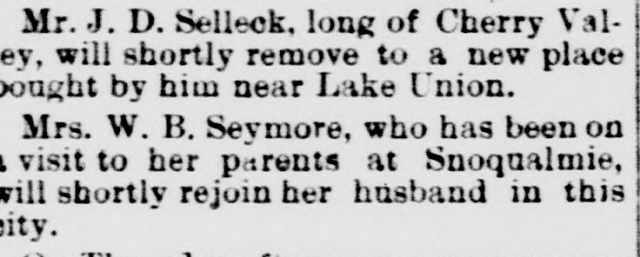
The Seattle Post-Intelligencer newspaper of December 1883 noted the move of the Selleck family to Seattle.

It may be that the Sellecks were planning to buy Seattle property from George Boman or perhaps he had made a boarding arrangement with them since he was living alone, that he might take meals with the Selleck family and that they would help maintain his property.  His house had been built as a duplex so it seems that he’d intended to have someone else live there, perhaps so that during the day when he was at work, someone was there on site to tend to the property.

This article is the third in a series about George Boman, a Civil War veteran.  The first article is about his origins in Tennessee and his Civil War service.  The second article begins with his arrival in Seattle in 1875.  In this article we will see the activities of George Boman in Seattle in the 1880s.  Throughout the 1880s, Boman prospered with real estate and business investments.

Continue reading

Posted in Civil War, Fremont neighborhood in Seattle, Seattle History | Tagged , | 1 Comment

A Civil War Veteran in Seattle: George Boman

As of 1874 George Boman had done a lot of living in his thirty years of life.  He’d already been married and divorced in Tennessee, had fought for the Union in the Civil War, had made a new marriage in Kentucky and had gone to Nebraska to obtain land via a homestead claim.

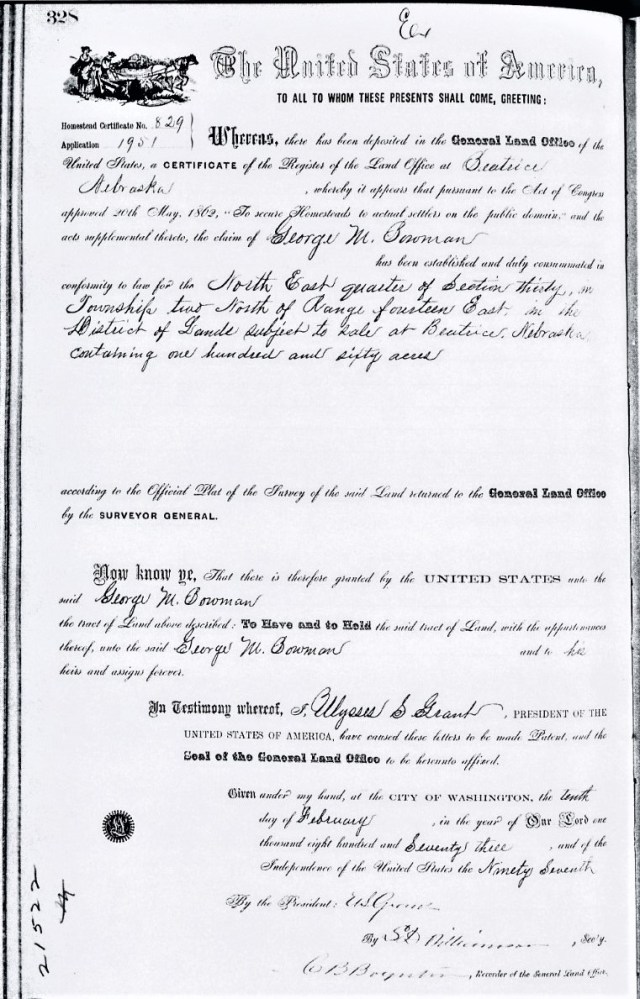
After his Civil War service with the Union Army ended in June 1865, Boman did not go back home to Tennessee to live.  He lived a few years in Kentucky, where he took a new wife, Adelia.  George & Adelia then went to Richardson, Nebraska, and lived there about seven years until they had “proved up the claim” and had been awarded ownership of the land.  A land grant document was recorded for George Boman on February 10, 1873, meaning that he owned the land and could then sell it if he wanted.

As he considered what he might do next, it is possible that while George Boman was still in Nebraska, he read newspaper articles about Seattle’s May Day Picnic of 1874.  Working together as a community on May Day, the fledgling City of Seattle had a can-do spirit with determination to build Seattle’s own railroad.  As a Civil War veteran who had learned the vital necessity of rail corridors as supply lines, Boman might have been attracted to the young, vigorous City of Seattle with its potential for economic advantages of rail and port.

This blog post is the second article about the life of George Boman.  In this article we will see what things Boman did once he moved to Seattle in 1875.

Continue reading

Posted in Civil War, Fremont neighborhood in Seattle, Seattle History | Tagged , | Leave a comment

The Journey of a Civil War Veteran: George Boman of Tennessee

In the years after the Civil War of 1861 to 1865, veterans became part of the Western Movement in the USA.  Most soldiers returned to their home states at first, and then many former soldiers pursued opportunities in undeveloped lands Out West.  They tended to stop in “prairie states” first, to make land claims, then eventually they continued moving farther west.  They tended to move along the lines of railroads which were being extended farther and farther west.  This blog article is about a Civil War veteran, George Boman, who followed this pattern.

In the 1870s the news about the westward extension of railroads likely influenced Civil War veterans to travel in search of new economic opportunities.  Many Civil War veterans were from rural backgrounds and had their first exposure to cities and railroads during their war service.  These experiences and their wartime travels may have whetted their desire for adventure, or veterans simply thought that the grass might be greener Out West.

Cumberland Gap in eastern Tennessee

One Civil War veteran whose life was completely changed by the war was George Boman of Tennessee.  His early life was spent in the mountainous Cumberland region, and he likely had never been on a train or knew much about the workings of trains until he enlisted in the Union Army.

Boman served during the last nine months of the war, October 1864 to June 1865.  In his war service with the Union Army, Boman traveled to Nashville, Tennessee and nearby points such as Franklin and Chattanooga which were along vital railroad supply lines.   His regiment, the 6th Tennessee Mounted Infantry, spent much of its time guarding railroads.  His regiment’s key battles were at Franklin and Nashville,  railroad arteries of supply lines for the Union forces.

This blog article will tell of George Boman’s origins in Tennessee and his life in the ten years following the war, until he arrived in Seattle in 1875.  This article is the first in a series about the life of George Boman.  His name is not well-known, but he was a person vitally involved in early Seattle.

Map of the state of Tennessee

Continue reading

Posted in Civil War, Fremont neighborhood in Seattle | Tagged , , , | Leave a comment

The 2022 Season of Cheer: Candy Cane Lane in Ravenna

The lights and decorations of Candy Cane Lane begin on Saturday, December 3, 2022, at 4 PM.  Candy Cane Lane is a circle of houses all decked out for the holidays, located on Park Road NE off of NE Ravenna Blvd.

Candy Cane Lane location map, Park Road NE off of NE Ravenna Blvd.

Beginning on Saturday, December 3, 2022, through New Years Day 2023, you can drive through or walk through Candy Cane Lane nightly.  Hours on Sunday through Thursday nights are from 4 PM to 9:30 PM.  Friday and Saturday night hours are 4 PM to 11 PM.

Pedestrians are welcome at all times and there will be designated nights when Candy Cane Lane will be closed to traffic for hosting pedestrians-only.  See the Facebook page of Candy Cane Lane for info.  This year’s pedestrian-only nights are Sunday, December 11, and Wednesday, December 14.  Music groups will play at 6:30 PM on both of those nights.

You are encouraged to bring food donations (canned food or dry food like spaghetti boxes) for the Food Bank barrel at the end of the lane.

The history of houses on this street, Park Road NE, is that it was developed in the 1920s with architectural plans for the group of houses.  The site was owned by the Beck family who developed the Ravenna neighborhood.

Posted in Events and holidays, Seattle History | Tagged , , | Leave a comment

The 2022 Season of Cheer: Hunter Tree Farm in Wedgwood

Take a stroll in Wedgwood to enjoy the smell of evergreens, the twinkle of lights and the sounds of music at the Hunter Tree Farm, 7744 35th Ave NE, next to the post office.  The Christmas tree lot is set up like a magical forest which comes to life at the holiday season.

The Hunter family began selling Christmas trees at a retail site in the Northgate area in the 1950s.  When that site was lost to impending freeway construction, the Hunters found a new, receptive market in the Wedgwood neighborhood in northeast Seattle.  Hunters sold Christmas trees at the corner of NE 85th Street for a few years until they were able to acquire the present lot nearest to NE 80th Street.

Each year Wedgwood enjoys the holiday spirit at this locally-owned business.  The tree lot is open from 9 to 9 daily, through December 23, 2022.


Posted in Events and holidays, Hunter's Tree Farm | Tagged , , | Leave a comment