Property Records: Removal of Racially Restrictive Language

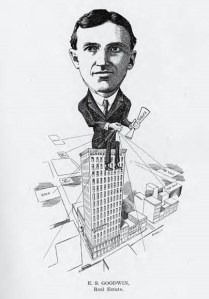
Ervin S. Goodwin, developer of Hawthorne Hills and Victory Heights.

In the 1920s, as developers began to build plats of houses in northeast Seattle, some attached property covenants specifying that no person of a race other than White, could own property in that neighborhood.  One of the first to do this was Ervin S. Goodwin who bought and developed large tracts of land including Hawthorne Hills and Victory Heights.

On the east side of 35th Ave NE between NE 55th to 65th Streets, in the 1920s the Crawford & Conover Real Estate Company filed restrictive covenants on their plats called University Home Tracts and University Gardens, in what today is referred to as the Bryant neighborhood.

Like Crawford & Conover who had been active in real estate since the 1880s, there were other companies who held vacant land in northeast Seattle until such time as the population increased and more infrastructure (roads, electricity, etc.) was available.  During the housing demand in Seattle during World War Two, the Mylroie family built houses on a section of land from NE 88th to 90th Streets.  These traditional-style houses may have inspired developer Albert Balch who later built the original Wedgwood tract of houses.
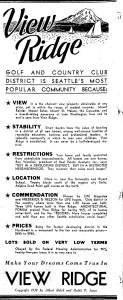
In the 1930s two young men quit their jobs as radio advertising salesmen and went into real estate.  Ralph Jones and Albert Balch started with just one lot, built a house and sold it.  They kept expanding and named their development View Ridge.  Ralph Jones went on to build houses in the Sand Point Country Club & Golf Course.

In 1941 Albert Balch bought a forty-acre tract of land on the west side of 35th Ave NE between NE 80th to 85th Streets.  He named it the Wedgwood Addition.  The name “caught on” in popularity as businesses began to use it, until Wedgwood became the name of the neighborhood.

All of the above plats of land have restrictive covenants.  Developers likely knew one another and kept track of how their developments were planned.

Although the restrictive covenants are now illegal, you can also apply to have a covenant completely removed from your deed records.  Read on for more info.

Continue reading

Posted in Controversies, Land records and surveys, Seattle History | Tagged , | 5 Comments

The First Airfield at Sand Point in Seattle

Magnuson Park in Seattle with its entrance gate at 7400 Sand Point Way NE, is the former site of an airfield which first began to be developed in the 1920s.

In September 2024 we are celebrating the First World Flight, the planes which took off from Sand Point in April 1924 and returned in September that year.   Visit the First World Flight Centennial Celebration page for news of the commemorative events.

The story of how Sand Point on Lake Washington became the site of an airfield is that of citizen activists in Seattle.

Continue reading

Posted in Events and holidays, Seattle History | Tagged , | 2 Comments

Names in the Neighborhood: Meadowbrook

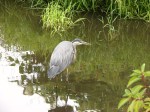
Blue Heron in Meadowbrook Pond. Photo by Valarie.

Meadowbrook began as the name for the golf course which opened in 1932 on the former Fischer Farm property, present site of Nathan Hale High School on NE 110th Street.

Gradually other entities, including real estate developers, adopted the Meadowbrook name.  Meadowbrook officially became the name of the neighborhood in the 1990s as designated by the City of Seattle atlas of neighborhoods.

Meadowbrook is set in a beautiful natural environment at The Confluence of the North and South Forks of Thornton Creek.  These streams converge at Meadowbrook Pond on the east side of 35th Ave NE at about NE 107th Street.

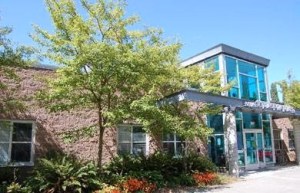
Meadowbrook Community Center at 10517 35th Ave NE

Today the center of the Meadowbrook neighborhood is on 35th Ave NE where there are features such as Thornton Creek, Meadowbrook Pond, and the Meadowbrook Community Center & Swimming Pool.

Nearby is Nathan Hale High School and Jane Addams Middle School on either side of NE 110th Street.  John Rogers Elementary School is five blocks to the east, at 4030 NE 109th Street.

Other activities in Meadowbrook include the Thornton Creek Alliance volunteer group, the Meadowbrook Garden & Orchard, and the Nathan Hale Horticulture and Urban Farm.   Meadowbrook has a lively community council which serves as a clearinghouse of information about the neighborhood and a forum for discussing concerns.

Continue reading

Posted in Meadowbrook neighborhood, name of the neighborhood, Neighborhood features, School histories, Thornton Creek | Tagged , | Leave a comment

Come Sit Awhile: Harry Murfitt’s Bench

A favorite saying of Harry Murfitt, 9125 35th Ave NE, was to invite friends & family to “come sit awhile” for fellowship.  Today Harry’s bench memorializes his life and his legacy in the Wedgwood neighborhood.

Continue reading

Posted in Neighborhood features | Tagged , | 4 Comments

Wedgwood Neighborhood Business District Trivia Quiz 2024

Wedgwood residents want businesses and services in the commercial district.

Over the past one hundred years since Wedgwood began to develop a commercial district, the types of businesses have changed.  Some types of businesses have disappeared from Wedgwood, such as a hardware store, appliance store and women’s dress shop.

Some of the present businesses are unique to Wedgwood, such as the Hunter Farm’s Christmas Tree lot.

Here is a quiz to test your knowledge of businesses in the Wedgwood neighborhood of northeast Seattle, then and now.

Continue reading

Posted in businesses, Neighborhood features | Tagged , | Leave a comment

The Hara Family in Seattle

By 1910 there were about 13,000 Japanese immigrants in the state of Washington.  Many of these worked in lumber mills, railroad construction crews, or in agricultural work.  Of that number, about 6,000 lived in Seattle.

Nihonmachi Hotel on Yesler Way circa 1913. Photo courtesy of Densho.

Japanese in the City of Seattle were concentrated mainly in the Chinatown/International District which was becoming Nihonmachi (JapanTown).  The Seattle Japanese were businessmen in operation of hotels, restaurants, commercial laundries, barber shops and retail establishments.  The Nippon Kan Theater at 628 South Washington Street was a major cultural center and gathering place.

Historian Richard C. Berner wrote, “Japanese immigrants to Seattle played a role in the city’s development far out of proportion to their number.”  In this blog article we will trace the stories of the Hara family members down three generations in Seattle.

Continue reading

Posted in Immigrant heritage | Tagged , , | 3 Comments

Community Life in Pinehurst in Seattle

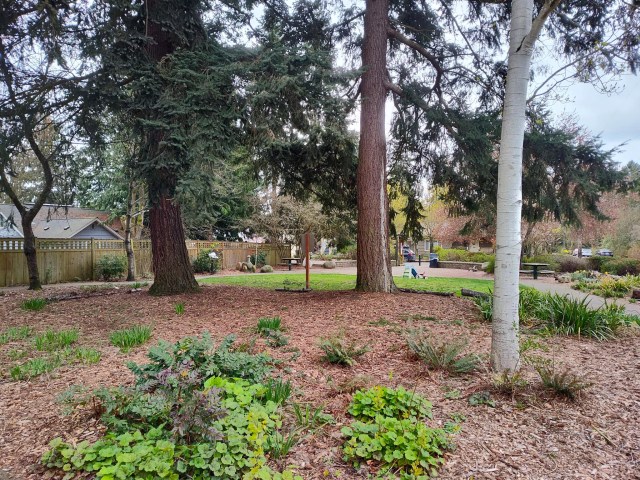
North Seattle neighborhoods like Pinehurst grew slowly from the 1920s until after 1945, when a post-War-Two housing boom began. Once the neighborhood really started to grow, residents knew they would have to preserve space for community resources such as parks and schools. Today Pinehurst has a variety of gathering places including a pocket park, playfield, and P-Patch.

One of Pinehurst’s amenities is a pocket park at 11700 19th Ave NE. Photo by Valarie.

Continue reading

Posted in Neighborhood features | Tagged , | Leave a comment

The Pinehurst Safeway Store in Seattle

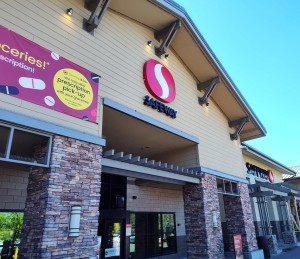
The present site of the Pinehurst Safeway grocery store, on 15th Ave NE between NE 123rd to NE 125th Streets, once had a cluster of semi-industrial buildings including a lumber yard and a dairy processing plant with a company office.

For many years after the first Pinehurst Safeway opened in 1965, it still shared its block with a gas station and a home supply & hardware store.

Today the Pinehurst Safeway, newly built in 2010, takes up most of its block except for line retail at the corner of NE 125th Street where there was once a gas station.

This blog article will tell what the block looked like before the first and second Safeway buildings, and what the block looks like now.

Continue reading

Posted in businesses, grocery stores | Tagged , | Leave a comment

The Business District of Pinehurst in Seattle

The Pinehurst neighborhood in Seattle was named by two men, its landowner and a real estate salesman, in 1926.  William Hartranft and George Spencer had known each other since 1889 when each came to Washington Territory and taught school in rural districts.  Both men moved to Seattle, served as school principals and then as school superintendents, before transitioning into business careers.

Pinehurst plat map of 1926

Hartranft & Spencer were sixty years old in 1926 and perhaps the Pinehurst investment was to be a source of potential retirement income.  The two men laid out a plat map marked with streets and house lots, on the east side of 15th Ave NE between NE 115th to 125th Streets.

In 1926 Pinehurst was outside of the Seattle City Limits and there were no zoning regulations as to what parts of the development would be designated as a commercial district and which lots would be residential.  However, 15th Ave NE was already put through as an arterial and created the most likely place for business traffic.

This blog article is a then-and-now look at the Pinehurst business district on 15th Ave NE during early years when most businesses were clustered around NE 117th Street at the center of the neighborhood.  Another article on this blog will tell about the present Pinehurst Safeway store in the block from NE 123rd to NE 125th Streets.

Continue reading

Posted in businesses, name of the neighborhood | Tagged , | Leave a comment

Names in the Neighborhood: Pinehurst in Seattle

Pinehurst in Seattle started out as the name for a plat of land on the east side of 15th Ave NE, between NE 115th to 125th Streets.   Many Seattle neighborhoods acquired their names in this way, as a plat which was first named by real estate investors.

Today the 15th Ave NE commercial corridor is the center of Pinehurst, including a Safeway grocery store at the corner of NE 125th Street, and a school at NE 117th Street as anchor points of the neighborhood.

This blog article will tell about the two men who were the inventors and promotors of Pinehurst, beginning in 1926 when the plat map was filed.

Continue reading

Posted in name of the neighborhood, Neighborhood features, Plat names | Tagged , | Leave a comment