Wedgwood’s Wildlife

Throughout northeast Seattle there are many ravines, big and small, with creeks running eastward down to their outlets at Lake Washington.  As can be seen throughout the city, there are possum, raccoon and coyotes living in Wedgwood’s ravines.   It has been rumored that deer live in the wooded ravines, as well.

Continue reading

Posted in Maple Creek ravine, Nature and wildlife | Tagged , , , , | Leave a comment

Original Resources, Real History

Have you heard of Frederich Drumpf, a German immigrant who operated a restaurant in Seattle in the 1890s?

Real historians use original documents and verify their sources, and in this essay by Seattle historian Rob Ketcherside, we see that getting at the truth about Mr. Drumpf required painstaking research.

Continue reading

Posted in Controversies, Immigrant heritage, Land records and surveys, research resources | Tagged , | Leave a comment

Preserving Wedgwood’s Scarlet Oak Heritage Tree

The Seattle Department of Transportation (SDOT) has an Urban Forestry division which maintains street trees.  In this June 2016 article from the SDOT blog, the tree crew explains the work which was done to preserve Wedgwood’s Scarlet Oak Heritage Tree located on NE 77th Street at the corner of 38th Ave NE.

Continue reading

Posted in trees | Tagged , , , , | 7 Comments

Classic Maps of Washington State

Did you know that the Washington State Office of the Secretary of State has a blog page????   Well, it seems like just about everyone has a blog now!

Continue reading

Posted in Land records and surveys, research resources | Tagged , | 2 Comments

Herons in Seattle

What does a teenage Great Blue Heron look like?

Continue reading

Posted in Nature and wildlife | Tagged , , , , | 2 Comments

Seattle History and Houses in June 2016

Upcoming in the month of June 2016 are events and activities which will enhance your understanding of Seattle history and the history of one of Seattle’s iconic neighborhoods, Ballard.

Continue reading

Posted in Events and holidays, Neighborhood features | Tagged , , , , | Leave a comment

Influence of the Confluence Celebration on Saturday, June 11, 2016

It has been a year since the major reconfiguration of the creek bed and flood plain of Thornton Creek at Meadowbrook.  A festival event on Saturday, June 11th, sponsored by Thornton Creek Alliance, will offer education and info about the watershed along with food, fun and music.

Continue reading

Posted in Events and holidays, Meadowbrook neighborhood, Thornton Creek | Tagged , , , , , , | 2 Comments

Seattle’s Old Street Signs

The Seattle Department of Transportation is using a new digital method to print all kinds of traffic signs.  SDOT’s street sign replacement program was made possible by Bridging the Gap, the nine-year transportation maintenance levy.

By 2016, every neighborhood had new, brighter and bigger street signs.   Here is a look at the SDOT Sign Shop and how they work.

Here is the story of how Seattle’s street-naming system began.

Street trees in Wedgwood’s business district on 35th Ave NE.


Posted in streets | Tagged , , | 3 Comments

Wedgwood’s Wild Western Edge

The western Wedgwood neighborhood boundary is along Lake City Way NE between NE 85th to 95th Streets.

The western boundary of the Wedgwood neighborhood is along Lake City Way NE between NE 85th to 95th Streets.

The western boundary of the Wedgwood neighborhood is Lake City Way NE, a highway whose official name is Washington State Route 522.  The road was first called Victory Way, then Bothell Way.  In 1970 the name of the portion of the highway within the Seattle City Limits was changed to Lake City Way NE.

The highway was put through because of the meteoric rise in car ownership in the early 1900s.  Automobiles made it much more convenient for people to live in outlying areas like Wedgwood and Lake City which were never served by any streetcar or other public transportation system.

The romance of the road on Wedgwood’s western edge led to car-oriented businesses such as drive-in food.  The roadhouses along Lake City Way NE often were built in “novelty architecture” of unusual shapes and designs meant to catch the eye of passing motorists.

Continue reading

Posted in Architecture, boundaries, businesses | Tagged , , , , | 12 Comments

Fremont’s Early Houses and Immigrants

One way to outline the history of a neighborhood is by studying its houses:  the land areas which were platted, the pattern of population growth and the design of the houses.
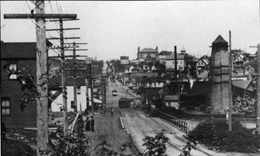
The early Fremont Bridge was a wooden trestle. This 1903 view to the north as we cross the bridge into Fremont shows the lumber mill in the foreground and B.F. Day School on the horizon. Photo courtesy of HistoryLink Essay 3309.

Fremont in Seattle was officially founded as a separate area, like a suburb, with its own name in 1888.  Its boosters were real estate men who, in addition to selling lots, also made sure that it was easy to get to Fremont — they controlled the earliest electric streetcar system in Seattle and they built a line to Fremont.

Fremont was soon settled by people who worked in lumber mills, carpentry and railroad work, and many of them were Scandinavian immigrants.

Swedish immigrant Emil Nelson worked in Fremont at the Bryant Lumber & Shingle Mill Company in the early 1900s.  In 1905 Emil Nelson and George Nordquist who had been a foreman at Bryant Lumber, left the company and went into business together.  They established Nordquist & Nelson which produced sash (window frames), doors, moulding and interior finishes for houses.

The house at 4407 2nd Ave NW was built in 1908 by Swedish immigrant Emil Nelson.

In 1908 Emil Nelson built a home for his family at 4407 2nd Ave NW in the Palatine Hill plat.  Perhaps Nelson intended the house to be a showcase for wood products from Nordquist & Nelson.

Nelson’s house has unusual arched windows on the second floor, and decorative porch railings.  The barge boards and knee braces under the eaves are highlights of Arts & Crafts finishes to this Craftsman-style house.

In the early 1900s as Fremont was developing, it was very common for a carpenter-builder to buy all of the lots on a block, build his own house and then begin building and selling additional houses.  The name of Emil Nelson was listed on the construction permits for other houses on his block which filled up with Swedish immigrants.

The house-histories of Fremont convey a sense of their time period in their architectural interest and in the description of the early residents.

Posted in Fremont neighborhood in Seattle, Houses | Tagged , | 1 Comment