Who Named the Wedgwood Neighborhood in Seattle?

Who gave the name of “Wedgwood” to this northeast Seattle neighborhood?

Henry R. Hansen lived in Wedgwood for only a few years, but he left a legacy: the naming of the neighborhood.  He didn’t do this on purpose, though.  Circa 1945 he changed the name of Hansen’s Tavern to the Wedgwood Tavern in a new building he had built on the same site, at 8517 35th Ave NE.

Continue reading

Posted in name of the neighborhood, Neighborhood features, taverns | Tagged , | Leave a comment

House-Moving from the Freeway to Wedgwood

A house built in 1929 in classic style was saved from the path of freeway construction.

Throughout its history Seattle has attracted migrants from all over the USA.  This blog article will trace the journeys of families who came to Seattle, and the story of a house, ending with the migration of the house itself.

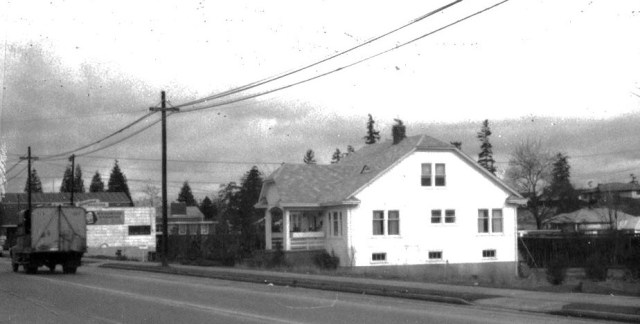
In 1967 a house at 7731 4th Ave NE had to be moved to get out of the path of Interstate 5 freeway construction.  The house was moved about two miles to the northeast, to 8512 30th Ave NE in the Wedgwood neighborhood of Seattle.

Continue reading

Posted in Civil War, Houses, Immigrant heritage | Tagged , , | 1 Comment

Lumbermen of Lake City in Seattle

The plan for the new Victory Way — today’s Lake City Way NE. The dotted line is the old Gerhard Erickson Road.

Northeast Seattle, including Lake City, really began to grow in the 1920s because of the rise of the automobile and the creation of more roads.  A highway called Erickson Road had opened in 1913 but its winding, narrow passage from Seattle to Bothell soon became inadequate.

One section of the Erickson Road went along the west side of today’s Nathan Hale High School (including the present Ravenna and 30th Avenues NE) to a stop sign at NE 110th Street.  Drivers then had to take a right-turn going eastward along NE 110th Street, turn left onto 35th Ave NE, then continue northward to Kenmore and Bothell.

In 1922 a new highway was completed, northbound out of Seattle, called Victory Way: today’s Lake City Way NE.  This new highway literally created Lake City by shifting its main intersection westward, over to where Victory Way crossed NE 125th Street.

Continue reading

Posted in businesses, Neighborhood features, Seattle History | Tagged , , | Leave a comment

The Ohland Family and the Meadowbrook Golf Course

Nathan Hale High School in Seattle is on a large field at NE 110th Street, bounded on either side by the arterials 30th & 35th Avenues NE.  The South Branch of Thornton Creek flows eastward across the school site.  The neighborhood is called Meadowbrook, a name derived from a golf course which was on the site from 1931 to 1961.

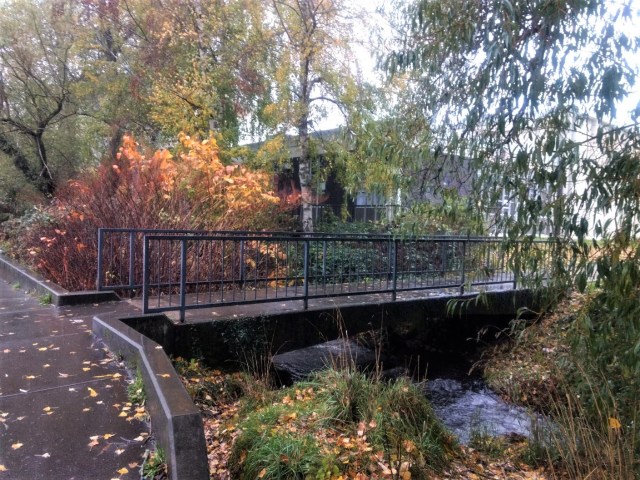
The south branch of Thornton Creek runs parallel to the Nathan Hale High School building. Bridges link the student parking lot to the building.

Continue reading

Posted in Meadowbrook neighborhood, name of the neighborhood, School histories | Tagged , , | 1 Comment

Tachell & Burns at the Meadowbrook Golf Course in Seattle

James Tachell (1862-1944) was born in England and came to the USA with his parents and siblings in 1866.  They lived in Calumet, Houghton County, Michigan, where James met his wife Charlreane and they started their family.  In the 1890s James, Charlreane and their children began a western migration which would bring them to the Seattle area in the early 1900s.
Greenwood Memorial Park & Funeral Home

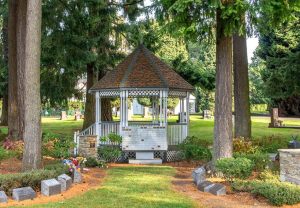
The family lived for a few years in Butte-Silver Bow, Montana, where James Tachell worked as an undertaker.  By 1910, the family was in Renton, Washington where James Tachell became the founder of the Greenwood Memorial Park & Funeral Home, now famous for the gravesite of musician Jimi Hendrix.

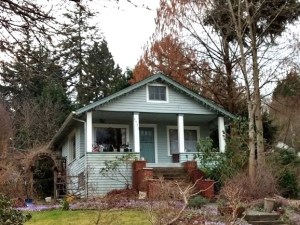
In 1910, eldest son Grover Tachell was 25 years old and living on his own in Seattle.  He married later that year and had a good job at Seattle Hardware.  Thus it was not surprising that Grover and his bride, Lydia, were able to establish their home in Morningside Heights, a development on land owned by Burwell & Morford, owners of Seattle Hardware.
Tachell home at 2533 NE 92nd Street

Morningside Heights was the plat name for an early-1900s housing development in the northwest quadrant of today’s Wedgwood neighborhood.

Morningside Heights is between NE 90th to 95th Streets on the west side of 35th Ave NE.  It is the site of some of the oldest houses in Wedgwood.  Grover & Lydia Tachell and their children were among the earliest residents of Morningside Heights in the decade of 1910-1920.

Grover & Lydia Tachell completed their family of six children with the birth of twin boys, Richard & Robert, in 1921.
The Maple Leaf School at 3212 NE 100th Street was completed in 1926.

Richard & Robert Tachell grew up in the lively Morningside community where things were happening.  By the time the Tachell boys were old enough to attend school, the boys could go to the nearby Maple Leaf Elementary, newly constructed in 1926 on the corner of NE 100th Street and 32nd Ave NE.  The community had pulled together to form the Maple Leaf School District, and the contractors for the new school building were Morningside Heights residents Bill Lovell & his son Ellsworth.

In 1931 another big happening in the neighborhood was the opening of a golf course on former farm fields at NE 110th Street.

Continue reading

Posted in Meadowbrook neighborhood, School histories | Tagged , , | Leave a comment

Immigrants in Morningside Heights in Seattle

Sixteen-year-old Veto Clarizo sailed from Italy to the United States in 1908, sponsored by his sister & family in Chicago.  After a few more years Veto continued westward and worked at picking fruit in Wenatchee, Washington.

The United States entered World War One in 1917 and the call went out for men to enlist as soldiers.  An enticement for immigrants was the promise of help in obtaining U.S. citizenship as part of their military service.

According to the U.S. Citizenship and Immigration Service, “The U.S. entered World War One amidst a peak period of immigration…. almost one in five draftees, and more than 18 percent of the total U.S. Army, was foreign-born.”

“To help “Americanize” the men, the War Department instituted English language classes for immigrant soldiers in wartime training camps; these often included lessons on civics and citizenship. Many immigrants proudly viewed their World War One service as a transformational event in their lives and a key part of their identities as new Americans.” — quote from USCIS page, “The Immigrant Army: Immigrant Service Members in World War One.”

To speed up soldier naturalizations, the Bureau of Naturalization dispatched examiners to military bases. Judges traveled to bases to hold large, open-air naturalization ceremonies.

Italian immigrant Veto Clarizo enlisted in the U.S. Army, serving from July 1918 to September 1919 and completed his military service with his American citizenship in hand.

A few years later the Clarizo family became residents of Morningside Heights in northeast Seattle where many immigrants and first-generation Americans achieved home ownership.

Continue reading

Posted in Houses, Immigrant heritage, name of the neighborhood, Neighborhood features | Tagged , , | 1 Comment

Fremont in Seattle: Public Art at Troll’s Knoll

Fremont in Seattle is a lively, art-filled neighborhood with volunteers in projects such as the Troll’s Knoll Forest on North 36th Street.  Volunteers maintain the site and are asking for contributions to restore the recently-damaged artwork.  Here is a message from the group:

Dear FOTK (Friends of Troll’s Knoll) Supporters:

Lanterns at Troll’s Knoll Forest in Fremont, Seattle.

On Saturday, March 8th when visiting Troll’s Knoll Forest, we found that a mushroom lantern sculpture (third one as you head south) had been violently damaged. The mushroom cap was split horizontally and the cradle that supported the cap had been crushed and removed from the structure (see attached photo). The four mushroom lantern sculptures on site are a collaboration between artists Michiko Tanaka and HaiYing Wu. They were installed in 2023.

HaiYing and Michiko visited the site to survey the damage. It was determined the mushroom can be repaired but will cost in the neighborhood of $2,000. The work will consist of repairing damage, reproducing a silicone mold, cement casting and installation.

We are very honored to have this work by HaiYing Wu and Michiko Tanaka and are reaching out to the community to help fund the repair as this was not an expenditure we anticipated having.

Fremont’s Troll underneath the Aurora Bridge on North 36th Street.

While it is disappointing having art vandalized, our group is committed to maintaining the art and nature of the site. If you have visited the site lately you may have noticed all of the daffodils and tulips we planted are coming up. We expect even more visitors to the site next year because of 2026 FIFA World Cup.

We hope you can make a donation to help with this repair and keep up the momentum at Troll’s Knoll. (Friends of Troll’s Knoll is Seattle Parks Foundation Community Partner, and a 501(c)(3) nonprofit organization. Tax ID: 91-1998597).

Thank you.

Leo Griffin
President
Friends of Troll’s Knoll
fremonttrollsknoll@gmail.com


Posted in Fremont neighborhood in Seattle | Tagged , , , | Leave a comment

John Terlicher of Morningside Market in Seattle

This blog article will tell of an Italian immigrant who fulfilled his American Dream in Seattle.  John Terlicher was able to find work, learn English, marry, own a home and have his own business.  He was mostly successful in American life, while also experiencing difficult economic times and personal tragedies.

Coming to America

Italian immigrant Giovanni Terlicher arrived in New York Harbor in March 1910.  As he sailed past the Statue of Liberty, he dreamed of all the things he wanted to do in America.

Giovanni continued his journey across the USA until he reached Seattle in June 1910, having celebrated his sixteenth birthday along the way.  In Seattle Giovanni hit the streets looking for work.

Today we would not expect a sixteen-year-old to be out of school and working, but in the early 1900s in Seattle it was quite usual.  There was only one high school (in downtown Seattle), and few people went on to more education beyond sixth or eighth grade.

But things were changing, and some people wanted Seattle to move on from its frontier origins and become a real city with more resources, including education.  Events of the years 1907-1917 caused the growth of north Seattle as people moved toward areas where new schools, roads and utilities like electricity were being put in.

Continue reading

Posted in businesses, Immigrant heritage, Neighborhood features, Seattle History | Tagged , , | 1 Comment

Street Trees in a Storm

In the autumn season a canopy of color is created by the flame ash trees which line the arterial 35th Ave NE in Wedgwood.   The trees extend from NE 84th Street in the Wedgwood shopping district, northward through Meadowbrook to where 35th Ave NE merges with Lake City Way NE at NE 137th Street.

Street trees in Wedgwood’s business district on 35th Ave NE.  Photo by Valarie.

These flame ash street trees were planted circa 1971 in a citywide program which put different species along different arterials.  Along 35th Ave NE, the flame ash trees have grown very tall.  After fifty years’ growth, some of the trees have begun to lean or deteriorate so that, in recent years, some of the flame ash trees have had to be removed.

Continue reading

Posted in Neighborhood features, streets, trees | Tagged , , , , | 1 Comment

Lake City’s Landmarked Buildings

Lake City in northeast Seattle has two historic buildings landmarked for preservation, which represent the neighborhood’s long record of community activism.

Lake City began forming as a community in the early 1900s and one of its first organizing efforts was to provide a school for its children.   In 1912 residents collected signatures on a petition to the King County Superintendent of Schools to form their own Lake City School District.

Classes met in temporary locations until the new wood-frame school building opened in January 1914, on the north side of NE 125th Street between 27th to 28th Avenues NE, present site of the Lake City Branch Library.

In 1919 two more classrooms were added but by 1926 the Lake City School building was again too small.  Lake City was growing, and with it, there were lots of children.

Lake City started its own school in 1912 on the present site of the library, NE 125th Street between 27th and 28th Avenues NE.

Continue reading

Posted in Architecture, Neighborhood features, parks, School histories, Seattle History | Tagged , , , | Leave a comment