
Seattle’s home-grown railroad, the Seattle, Lake Shore & Eastern Railway, began running in 1887. Railway stations and post offices were opened as the train passed through population centers, and these gave names to the neighborhoods. This blog article will trace the rise and fall of neighborhood names near Fremont in Seattle.
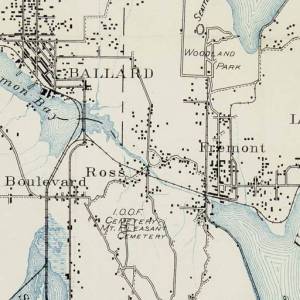
McKees Correct Road Map of 1894, courtesy of Seattle Public Library.
Just north of Seattle’s Queen Anne hill, the Ross family had land claims on both sides of a stream called The Outlet, which flowed from Lake Union westward out to Puget Sound. The Ross family gave permission for the new railroad to cross their property, and the railroad planners named a station in their honor. This caused the area to acquire “Ross” as a place name.
Ross was located to the west of Fremont, bordered by 3rd Ave West, and it included land on the south side of today’s ship canal.
The earliest listings of “Seattle Seminary” (today’s Seattle Pacific University) in the City Directory of the 1890s gave its location as “Ross.” This also had to do with an actual post office for Ross, so that people could list it as their address. Starting in 1887 as the Seattle. Lake Shore & Eastern Railroad was being built and was advancing through these communities, rail stops and postal stations were established along the line. Over time, some of these names “stuck” and some, like Ross, faded away.
The Ross Post Office opens in 1888
The coming of the SLS&E Railroad gave rise to more commercial development wherever a railway station was built. There was a general store with a Ross post office which opened on July 30, 1888, at 318 Ewing Street, on the south side of The Outlet. Today that address is by the West Ewing Mini Park and the King County Wastewater building.
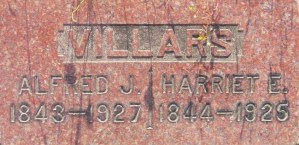
The first postmaster of Ross was Alfred J. Villars who had been born in 1843 in Clinton County, Ohio, and had served in the Union Army during the Civil War. As typical of many Civil War veterans, Alfred Villars married in 1865 after the war, and then the couple gradually moved westward across the USA. In 1885 in Iowa where he was working as a storekeeper, Alfred Villars joined the Union veterans organization called the Grand Army of the Republic.
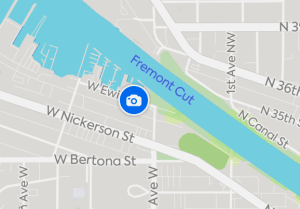
West Ewing Mini Park at the intersection of Ewing Street and Third Avenue West.
In 1888 Alfred Villars and his wife Harriet were listed in the Seattle City Directory as living in Ross where Alfred was postmaster. We know, however, that Harriet might have been the “default postmaster” because Alfred had another job.
Alfred Villars was a “title abstractor,” someone who researches property ownership so that sales of land can proceed. A title search ensures that there are no outstanding “encumbrances” such as liens against the property. This work would have meant that Alfred spent most of his time in the King County courthouse in downtown Seattle where records where kept.
In 1897 the Villars moved away from Ross when Alfred got a job at the downtown Seattle Public Library, where he worked for the next 23 years in the library’s “newspaper room.” In those days before radio, TV and the Internet, newspapers were vital sources of information. Newspapers were made available at the Seattle Public Library so that people could read them without a subscription.
The Ross Post Office closed on July 15, 1901. In 1902 the building at 318 Ewing was referred to as Old Post Office, in a list of polling places for elections.
Alfred & Harriet Villars spent the rest of the lives in Seattle and they are buried in the Grand Army of the Republic Cemetery, on the north side of Lake View Cemetery.
Growth of Fremont outstrips Ross
In the summer of 1888, the growth of Ross was eclipsed by the founding of the Fremont community. Fremont’s developers set up a lumber mill to help provide for housebuilding, and they advertised that the first hundred people to come to live in Fremont could buy a house lot for $1.
Fremont was centered around today’s North 34th Street & Fremont Avenue where there was a wooden trestle bridge across the stream called The Outlet. After its opening announcement in the summer of 1888, Fremont boomed with residential, commercial and industrial growth. In contrast with Ross which was not a planned community, Fremont had developers who planned and organized for growth, including promotion of Fremont in real estate ads in the newspaper.
The Fremont Post Office opens in 1890
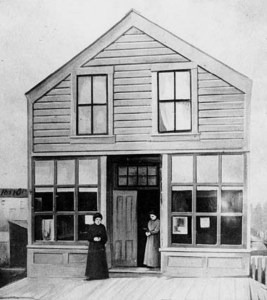
The Fremont Post Office in 1890. Photo #34466 of UW Special Collections.
Fremont’s post office opened on March 25, 1890. Like the Ross Post Office, it operated out of a home on the south side of The Outlet and the Fremont Bridge, probably to stay clear of the frenzy of building and lumber mill work on the north side of the bridge.
The first listing of the Fremont Post Office in the Seattle City Directory in 1890, gave the address as “west side Lake Ave (today’s Fremont Ave) between Dravus and Etruria.” In 1891 the address listing showed a move to the north side of the Fremont Bridge into the main commercial intersection. The address was “north side Ewing, residence same,” today’s North 34th Street.
The first postmaster of Fremont was Thomas C. Ralston, someone who had only arrived in Seattle in 1888. He had joined those coming to Fremont for jobs in that first year of the community. Though he obtained the job of postmaster, it is likely that his wife Ida was the one who was doing that work from their home, while Thomas worked at the lumber mill in Fremont.
Death of the postmaster
Thomas Ralston’s term as Fremont postmaster was brief. At age 37 on August 11, 1892, Thomas received a fatal injury while he was unloading logs from rail cars, using a chute to let the logs slide down into the water, at the site of the Fremont lumber mill. The King County Death Register recorded that Thomas had been struck by a log so that he had sustained internal hemorrhaging.
A Ralston family letter of August 23, 1892, tells that they had heard from Sylvester “Sil” Ralston, brother of Thomas, what had happened to Tom:
“. . .You ask me if I had heard any more from Sil and if Tom was in Washington yet. Poor man. He is there but under the sod. He was killed the 11th day of this month while unloading logs out of rail cars into the lake. He had unloaded one car… the logs begun to roll down the chute and one of them struck him in the breast and knocked him into the water. There was but one man there with him. He was a car repairer. He got Tom out on the bank and asked him if he was badly hurt and if he should go to get some help. Tom said, I’ll be all right in a minute. The man soon asked him again and Tom made the same reply, but he then closed his eyes in unconsciousness. The man laid Tom back on the ground and went for help.
They took Tom home. The doctor said several ribs were broken, and Tom soon breathed his last. They put a subscription in circulation and realized $102.25. It took $75.00 to pay funeral expenses and the rest was given to his wife. They had a petition going around asking that she be appointed postmistress in his place. It was being signed wherever it went.”
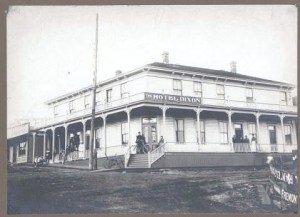
Hotel Dixon in 1901, at 3400 Fremont Avenue.
For the next year or more, Ida Ralston was listed as postmistress at Fremont but it is likely that there was not enough income to support her family. She was now a widow with four daughters under nine years of age. In 1894 Ida moved to downtown Seattle where she successfully ran a lodging house.
A later postmaster of Fremont was Samuel Dixon, who had become proprietor of the hotel & lodging house on the northeast corner of 34th & Fremont Avenue. Hotel Dixon was an ideal place for postal services, as people could stop by the front desk to ask if there was any mail.
Neighborhood names evolve
At times when there were gaps of service of postmasters, mail for Fremont was directed to the post office of a neighboring community such as Ross or Edgewater, which were also stops along the rail line. There was no home delivery of mail; people had to go to the post office to pick up letters. This was the reason why a “post office” might operate out of a storefront — the proprietor hoped that postal errands would help bring customers into his store. Since there was no home delivery, newspapers often ran lists of names of people to let them know that a letter was waiting for them.
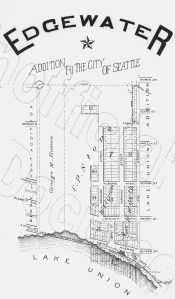
The Edgewater plat is to the east of Fremont, centered around Stone Way.
Edgewater was a plat name for a community to the east of Fremont. From May 20, 1889, to January 5, 1891, Edgewater’s postmaster was William Ashworth. He lived at the present site of the North Transfer Station, on North 34th Street just east of Stone Way.
The community names of Ross and Edgewater didn’t “stick.” Today the former Ross area is referred to as North Queen Anne. The ship canal, completed in 1917, changed people’s perception of the landscape so that Fremont was defined as on the north side of the canal only.
The community names of Edgewater, Latona and Interlake faded away as the name Wallingford gained in common use. No one knows exactly why the name Wallingford predominated. It may have been because of one of the main streetcar lines which traveled on Wallingford Avenue.
Today Stone Way is considered to be the boundary between Fremont and Wallingford. The closest post office which serves the area is in Wallingford on North 47th Street just east of Stone Way.
Sources:
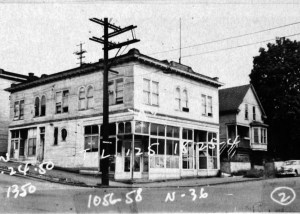
The Edgewater Building as seen in a 1938 photo of King County Tax Assessors office. The building has two addresses because it is on a corner: 1058 North 36th Street, and 3603 Woodland Park Avenue North.
“King County Post Office Chronology (1852-1905),” HistoryLink Essay #23388, by HistoryLink Staff, 2025.
Genealogy resources: Ancestry.com, Find A Grave and Washington Digital Archives.
Newspaper reference: “Retired Librarian Veteran,” Seattle Post-Intelligencer, January 25, 1920, page 24. Interview with Alfred J. Villars about his career, 1897-1919 in the Newspaper Reading Room of the Seattle Public Library.
Articles here on this blog:
Fremont in Seattle: Why the Name?
Fremont in Seattle: Street Names and Neighborhood Boundaries
Seattle’s Pioneers of Fremont: John Ross
Who Were Burke & Gilman? (organizers of the Seattle, Lake Shore & Eastern Railroad.)

 Wedgwood in Seattle History