The names of Seattle streets are worthy of a trivia contest to discern their origins and guess the meaning of the names. What does it mean when a street in Seattle is named “Aloha???”
Aloha — in Seattle?
The original meaning of some street names is not always clear, but we know that some of Seattle’s streets were named for family members or the business associates of property owners.
One way to sleuth out the names is by looking at the plat map with the layout of lots and streets. Names of the property owners who are filing the plat, and other contributors such as the surveyor’s name, are on the plat map.
This blog article will use a plat map for an area of North Capitol Hill to find the reason for the name of Hamlin Street.
Early Seattleites invested in property
In early Seattle, property owners would divide a section of land into lots for sale and would show a map of the street grid. They could give the streets in their plat, any names they chose, without recording the reasons for their choices.
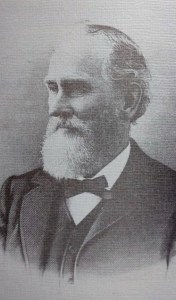
Arthur Denny 1822-1899 Leader of the 1851 group who came to Seattle from Illinois.
Pioneer settler Arthur Denny filed Seattle’s first plat, calling it “Town of Seattle. ” The plat map showed a grid of blocks with Front Street (today’s First Avenue) and streets named Jefferson, James, Cherry, Columbia, Marion, Madison and Spring.
Later, another plat filing would add Seneca, University, Union, Pike and Pine Streets. Arthur Denny’s granddaughter Roberta Frye Watt wrote, “Why Mr. Denny named the streets in alliterative pairs, no one knows.” (Page 107, Four Wagons West.)
We can only make guesses at the meaning of the downtown Seattle street names. We know, for example, that Arthur Denny’s brother next to him in age, James Marion Denny, died in Oregon in 1854, so we think the downtown Seattle streets of James & Marion are named for him.
In books written by Arthur Denny’s granddaughters Roberta Frye Watt and Sophie Frye Bass, they speculated on the street names. In their memory, for example, there really was a spring of water at what is now Spring Street.
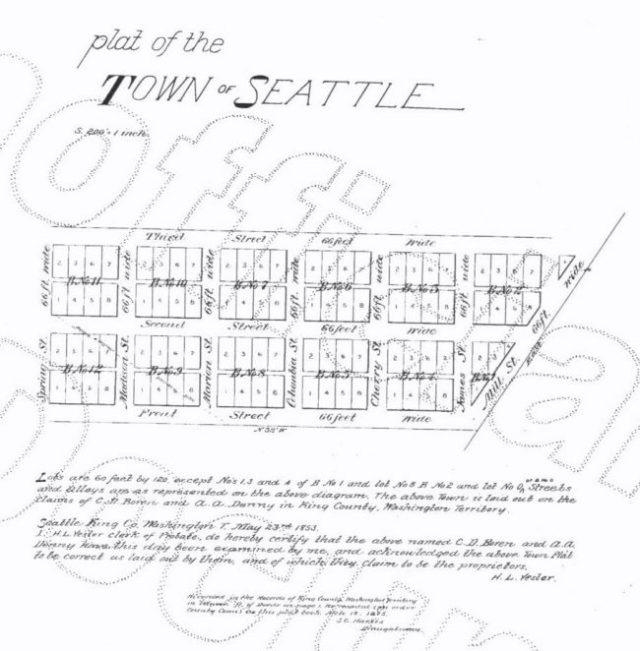
First plat of the Town of Seattle
Looking for the first use of a street name
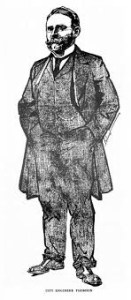
Did City Engineer R.H. Thomson rename the streets?
In the case of Aloha Street, I looked for the section of land where the name was first used. It was in a plat filed by David & Louisa Denny in 1875, in the area of 1100 Fairview Avenue where the Fred Hutchinson Cancer Research Center is located today.
After 1895, Seattle’s streets began to be regularized by giving them just one name along the street’s entire length, eliminating multiple names. The name “Aloha” was chosen, so that it is now used as a street name from Seattle Center, eastward across the south end of Lake Union, through Capitol Hill and as far east as the Arboretum.
In a humorous newspaper article in 1895, it was implied that City Engineer R.H. Thomson was singlehandedly renaming all the streets of Seattle. We don’t know if he did or not, but 1895 was the beginning year of reorganization of the street system of Seattle. It was at this time that north-south roads were designated as Avenues and east-west were to be called Streets.
Another plat filed by David & Louisa Denny, this one in 1890, was for land in the Roanoke Park-North Capitol Hill area. The plat is called the Denny-Fuhrman Addition to the City of Seattle, and the notations of the plat filing say that Henry & Carrie Fuhrman were co-investors.
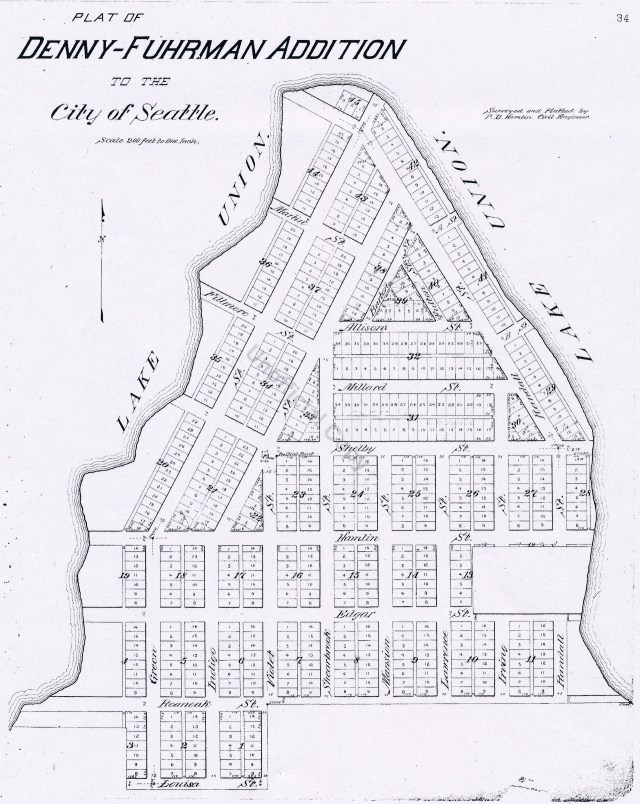
The Denny Fuhrman Addition filed in 1890, shows the north end of the Capitol Hill neighborhood.
Finding Hamlin
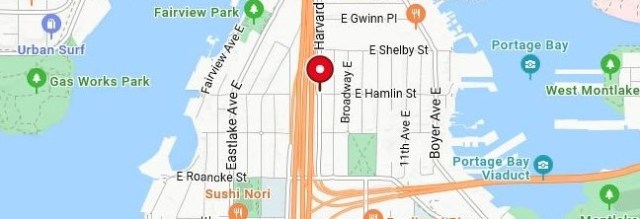
On the above plat map of the Denny-Fuhrman Addition, we see some street names that we recognize, as they are still used today. There’s Louisa, Roanoke, Edgar, Hamlin and Shelby Streets. Like Aloha, these streets (except Edgar) have been extended beyond this first plat which used the names. You can find Louisa, Roanoke, Hamlin and Shelby Streets in the Montlake neighborhood, to the east of the Capitol Hill site where these street names were first used.
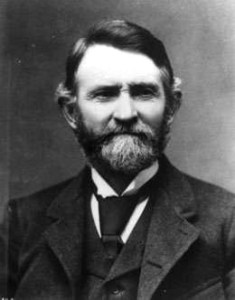
David Denny
1832-1903
It seems odd that on this original plat map there is no Fuhrman Street, to be named in honor of the Denny’s co-investors. Today, the north-south running Fuhrman Avenue has been substituted for Randall Avenue on the far right edge of the map. The Fuhrmans were early residents of Seattle and are among just a handful of Jewish residents who have Seattle streets named after them.
Louisa Street must surely be named for David Denny’s wife. The street names Edgar and Shelby don’t seem to be connected to any of the people in this plat filing. We may puzzle over Roanoke, as the only reference is the early American colony in Virginia.
Hamlin Street is a name which is easily identified. In the upper right corner of the plat map is written the name of the surveyor who measured and laid out the lot lines: P.D. Hamlin, Civil Engineer.
The life of P.D. Hamlin in Seattle
We can find out more about P.D. Hamlin by using genealogy and newspaper sources.
Philo Darling Hamlin was born in 1852 in Mifflintown, Pennsylvania. His father’s first name was Philo and his grandfather’s first name was Darling.
As a young man in Pennsylvania, P.D. Hamlin learned the skill of land surveying. At age 26 he traveled Out West to where white settlers wanted land to be surveyed, and property lines set for ownership.
A story told by Philo Hamlin’s wife Sarah was that P.D. had come to Seattle in 1879 to begin his career. He subscribed to the Seattle Post-Intelligencer newspaper and began mailing the newspapers to his sweetheart, Sarah, back in Pennsylvania. He returned to Mifflintown in 1883 to marry Sarah, and then they came to Seattle to spend the rest of their lives here.
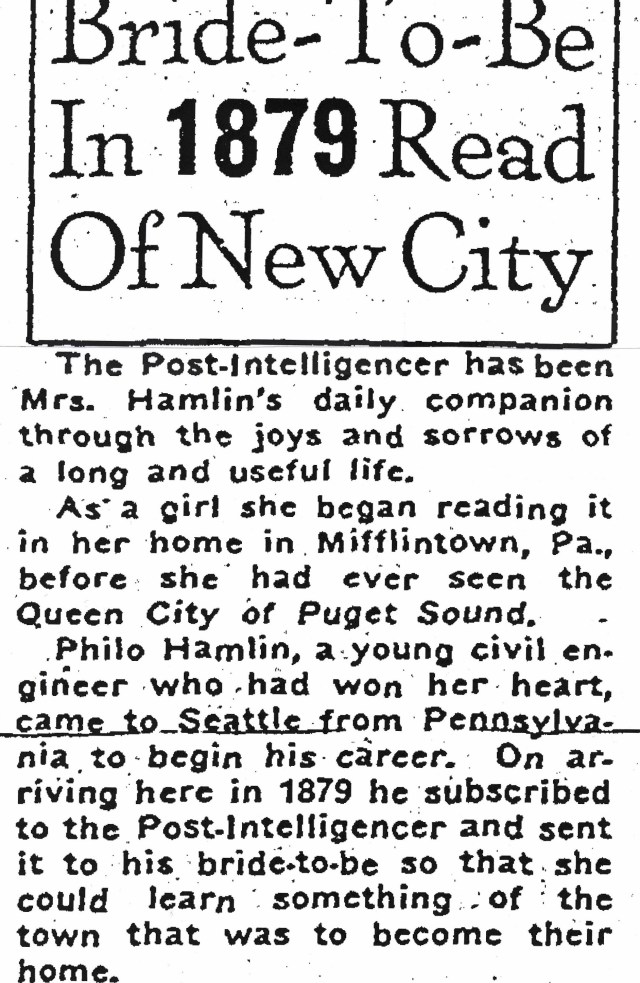
Seattle Post-Intelligencer article of August 8, 1931, page 4, gave tribute to Sarah Hamlin as one of the longest readers of the newspaper.
Seattle booms in the 1880s-1890s
P.D. Hamlin found plenty of surveying work in early Seattle. After the Great Seattle Fire in 1889, the city’s population boomed, and real estate developers increased their activities. Undeveloped real estate which had been held as an investment, began to be platted into lots for sale. Real estate companies like Denny-Fuhrman employed P.D. Hamlin on a regular basis to survey and produce plat maps.
City directory listings of the 1890s show that Philo had two brothers, Howard and William, who had joined him in Seattle and were working in real estate. The Hamlin brothers’ names are on record as owning a large section of land in what is now Shoreline and Lake Forest Park (Sections 3, 4, 9 & 10 of Township 26). When the property was platted as the Lake Forest Park Additon, all three brothers’ names were on the plat record as sharing profits.
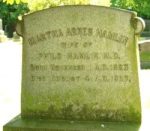
The Hamlin brothers brought their mother and sisters to Seattle and supported them.
The Hamlin brothers brought their widowed mother Martha and their two unmarried younger sisters to Seattle. The girls were sure to find husbands in the frontier town of Seattle where there were far more men than women. Mrs. Martha Hamlin, Laura Hamlin Quinlan, Janetta Hamlin Meloy, and the three Hamlin brothers spent the rest of their lives in Seattle.
Philo Hamlin was active in civic affairs in Seattle. He served as City Treasurer and as one of the directors at First Presbyterian Church in downtown Seattle. This church took an activist stance on social issues, with programs to help immigrants such as the Japanese, and the church operated a daycare for the children of single working women.
The Hamlins became namesakes of a street and a park
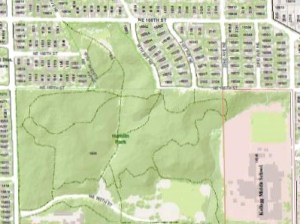
The northernmost section of Hamlin Park, from NE 165th to 168th Streets, was donated from the Hamlin brothers.
Philo Hamlin died in October 1926 while walking in the forested area that he and his brothers owned outside of Seattle, just east of 15th Ave NE at NE 165th Street.
Before Philo’s older brother Howard Hamlin died in January of that same year, he had been in talks with King County about donating this piece of property adjoining the prospective park’s larger portion which was between NE 158th to 165th Streets, which the County already owned. Then the third Hamlin brother, William, died in 1928. The executors of the Hamlin brothers’ estates donated the property from NE 165th to 168th Streets, which became a northern section of today’s Hamlin Park in Shoreline.
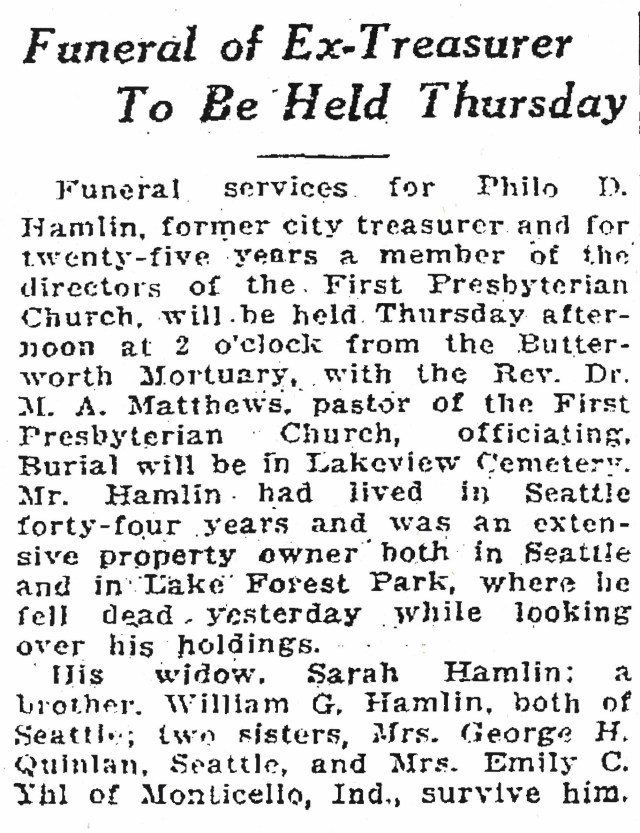
Seattle Daily Times, October 5, 1926, page 4, death notice of Philo D. Hamlin.
Resources:
To find the plat map of an area, put in an address like 1100 Fairview on the King County Parcel Viewer. On the right margin of the page, click on “scanned images of plats.” This shows the plat map with the date that the plat was filed, and the original street names.
Seattle historian Rob Ketcherside has created a searchable table of street names. From the plat map for 1100 Fairview, we see Aloha Street and next to it is Filbert Street. Using the conversion table, we find that Filbert is now called Valley Street.
 Books: Four Wagons West and Pigtail Days in Old Seattle, written by Arthur Denny’s granddaughters, can be found at Seattle Public Library only as copies held in the collection. The King County Library System has circulating copies.
Genealogy resources: Ancestry, HeritageQuest, Find A Grave and Washington Digital Archives.
History articles about Hamlin Park, posted on Facebook in 2016 by Vicki Stiles, then-director of the Shoreline Historical Museum.
Writes of Way: Searchable List of Seattle Street Names by historian Benjamin Donguk Lukoff.
Newspaper articles accessed via Seattle Public Library on-line research:
“Rites Today for Howard H. Hamlin,” Seattle Post-Intelligencer, January 20, 1926, page 13.
“Funeral of Ex-Treasurer to Be Held Thursday (Philo D. Hamlin),” Seattle Daily Times, October 5, 1926, page 4.
“Bride-To-Be in 1879 Read of New City,” Seattle Post-Intelligencer, August 8, 1931, page 4.
“Bank Is Thanked for Hamlin Park Site,” Seattle Daily Times, December 29, 1939, page 22.

 Wedgwood in Seattle History