In the 1950s Albert Balch, the developer of the Wedgwood neighborhood, was still building houses. He did not keep with the same styles as when he started out, as housing trends and architectural styles evolved in the 1950s. This article will tell about the group of houses called Country Club Heights which was built by a younger real estate agent who had started out working for Balch. He followed Balch’s pattern of finding a prominent architect to design a group of houses in a particular style.
Albert Balch, the developer of Wedgwood, was a “networker.” As a real estate salesman he knew that he must get his name known in the community. He wanted to build relationships and establish himself as a trusted name in Seattle real estate. He used several means to do this, including news articles about his projects, and he put shoe leather into getting out there to talk in-person with business owners.

8044 35th Ave NE, with its C-shaped sign, was Balch’s Crawford & Conover office. This building was demolished in 2018. Photo by Valarie.
Balch was interested in Washington State history. One of the groups he belonged to was the Pioneer Association of Washington, which was for people whose families had come to Washington before statehood in 1889.
By the 1960s Balch realized that many of the people in that early generation were gone, and so he worked with some oldtimers like Joshua Green and C.T. Conover, to track down the descendants of early Washington settlers. Balch served as president of the Pioneer Association from 1964-1967 and was credited with obtaining more than 3,500 new members for the Association. (Source: “Albert Balch Honored,” Seattle Times, July 23, 1967, page 99.)
His friendship with real estate pioneer C.T. Conover led Balch to purchase the right to use the business brand name, “Crawford & Conover” which Mr. Conover had established in Seattle in the 1880s. Balch hoped that this long-running business name would convey prestige and expertise in his real estate work. Balch’s real estate office at 8044 35th Ave NE had a C-shaped sign with the name Crawford & Conover.
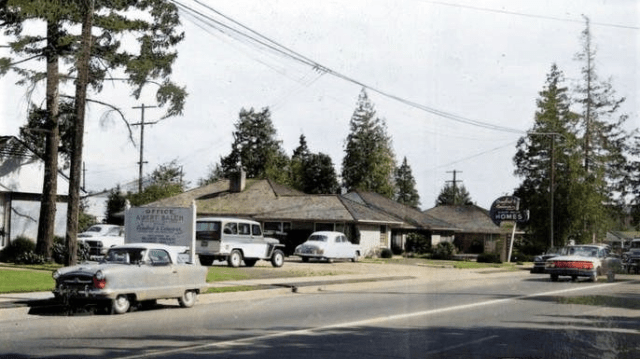
Balch office buildings as seen in 1962. At left is 8050 35th Ave NE which was Balch’s personal and administrative office. At right the C-shaped sign was at Crawford & Conover, Balch’s real estate outlet, at 8044 35th Ave NE. Photo #76719, Seattle Municipal Archives.
In the next generation of real estate work in the Wedgwood area, two younger men, Franklin Barth & Howard Watchie, followed Balch’s example of building a group of houses designed by a noted architect. Barth & Watchie’s Country Club Heights houses were on Wedgwood’s eastern edge of 45th Ave NE.
The next generation in real estate work in Seattle
After the end of World War Two in 1945, thirty-year-old Franklin Barth decided to follow in the footsteps of his father Edgar Barth, into real estate sales. It is very likely that real estate developer Albert Balch had known Edgar Barth or had at least heard his name in real estate circles. Edgar Barth had raised his family in northeast Seattle, had been a real estate salesman, and had come to Seattle as a child in the 1880s. Edgar’s wife Nellie May Barth had also come to Seattle as a child in the 1880s. Nellie May’s father, Frank N. Little, had been an early City Councilman, a well-known public official on the Board of Public Works, and Superintendent of Streets, Sewers & Parks of Seattle.
Perhaps when Edgar & Nellie May Barth’s son Franklin came looking for a job, Balch was happy to enroll him in the Pioneer Association as a descendant and also take the young man under his wing to begin a real estate career. In the 1950s Balch’s Crawford & Conover real estate sales ads in the newspapers would list open house times and the name of the agent who would be on-site that day, such as “Franklin Barth will greet you.”
By 1950 Franklin Barth, who was married and had three children, felt confident enough to buy his own house in Wedgwood at 8208 39th Ave NE. By 1953, Franklin had left the Crawford & Conover agency and established his own real estate office at 7337 35th Ave NE. We don’t know whether Balch considered this to be disloyal, or if Franklin Barth launched out with Balch’s blessing.

7337 35th Ave NE, where the Barth & Watchie real estate office was located in the 1950s. Photo by Valarie, October 2025.
The Barth & Watchie real estate office
The new real estate office was called the Barth & Watchie agency. Barth’s office partner, Howard C. Watchie, was an insurance agent. Homebuyers could work with him to get homeowners insurance and other kinds of policies.
Howard Watchie’s family had struggled greatly when he was growing up in Fargo, North Dakota, because his father had left them in 1912 when Howard was about twelve years old. He had twin sisters, Helen & Harriet, who were five years older, and they went to work to support the family. By 1920 Howard was working as a fire insurance agent in Fargo. In the early 1920s, Howard, his mother and one sister moved to Seattle.
Howard Watchie worked successfully in the insurance business in Seattle. He married in 1924 but his wife died in 1949, leaving Howard to finish raising his five children. He remarried and moved to a house on 33rd Ave NE in the Wedgwood neighborhood, where he was only a block from his new office at 7337 35th Ave NE.
Finally in 1958 Howard & his family reaped the benefits of the work in the real estate office. They were able to buy a house at 8620 45th Ave NE in the development called “Barth & Watchie’s Country Club Heights.”
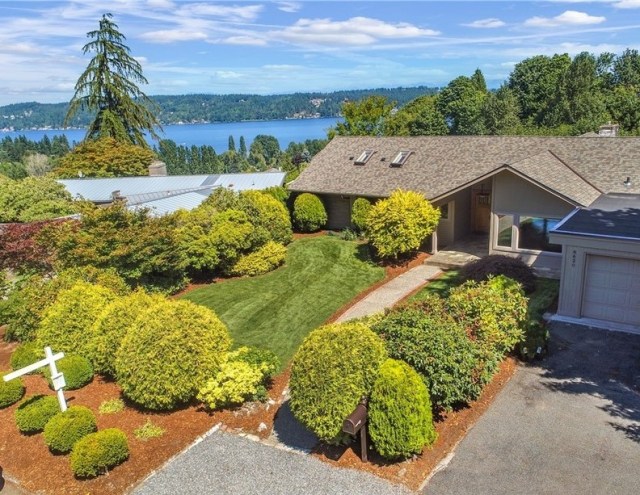
8620 45th Ave NE, photo courtesy of Northwest Multiple Listing Service.
Filing a plat and building houses
Barth & Watchie may have been following the “Balch plan” in their “Country Club Heights” venture.
In the 1940s Balch had started the Wedgwood real estate development by buying a section of land and “platting” it for house lots. Then he hired notable architects to design the houses. The first Wedgwood houses (on the west side of 35th Ave NE between NE 80th to 85th Streets) were designed by Clyde Grainger and Harlan Thomas, in Cape Cod and Colonial styles. These small cottage-style houses (two bedrooms, one bathroom) were financially accessible for World War Two veterans seeking their first home.
Over time, Balch did not keep building the same kinds of houses. In later sections of houses in Wedgwood, Balch built larger homes in a style called Pacific Northwest Modernist, designed by architects like James J. Chiarelli and Paul Hayden Kirk.

The house at 8606 45th Ave NE has an off-center, recessed entry. Houses designed by Gene Zema often had Asian-style pagoda-like doorways and plantings.
Barth & Watchie started by buying a section of land, having a surveyor lay out house lots, and giving the development a name. The name “Country Club Heights” seemed to imply that the houses were on a high point which would have a view, and that the houses were near a country club.
The plat map of Country Club Heights showed eight lots in the 8600 block of 45th Ave NE. Lot sizes averaged 12,000 square feet.
The houses at the north end of the group were on a crest and had a view out over to Lake Washington. The houses at the south end of the group backed up to the Sand Point Country Club & Golf Course. Ads for these houses mentioned the view of the golf green and the sixth tee.

The Barth & Watchie plat map of 1953 showed eight house lots arranged along 45th Ave NE (left side of the page). To the right is the Sand Point Country Club & Golf Course.
Pacific Northwest Modernist architectural design
Barth & Watchie chose architect Gene Zema (1926-2021) to design the houses in their plat. Zema’s style was “Pacific Northwest Modernist,” which emphasized natural materials like wood and stone, and the setting of a house in its environment. The houses in the plat were all “ramblers,” one-story houses set on very large lots. They all had large windows along the back of the house overlooking a patio and backyard, with an emphasis on indoor-outdoor living.
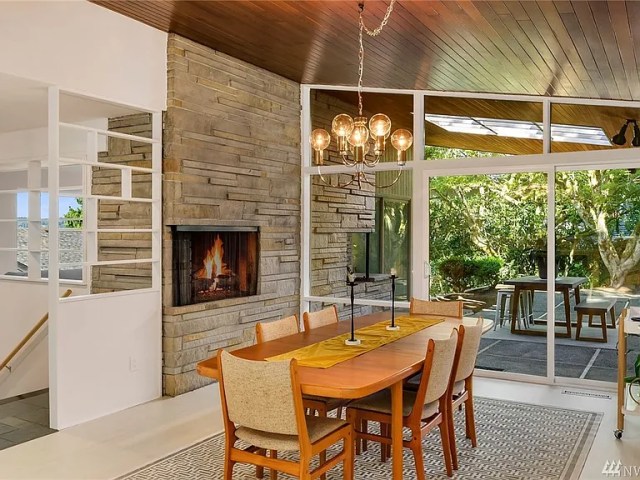
The house at 8606 NE 45th Street, designed by Gene Zema, brings the outdoors inside.
The houses had understated, off-center front entries, in contrast to a Colonial-style house whose entrance would be centered, framed by pillars and have a decorative motif over the door.
The houses in the Barth & Watchie plat have low-pitched roof lines instead of the steeply pitched gables of Craftsman and Colonial houses. The gentle roof slope which appears to be hovering, is one characteristic of Asian design influence. Later in his life, architect Gene Zema opened a Japanese antiquities gallery, part of his ongoing interest in Asian styles incorporated into the structures and landscaping of houses he designed.
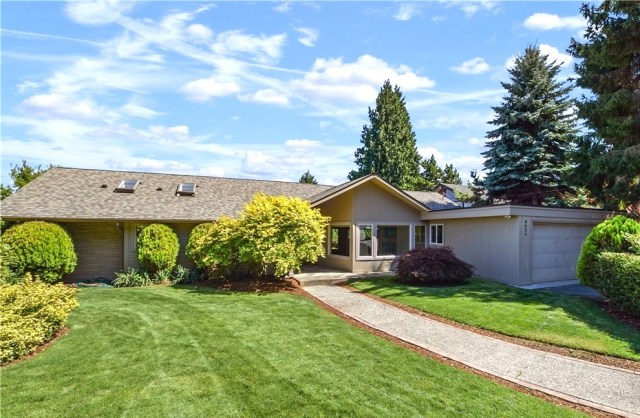
Front entrance of 8620 45th Ave NE. Photo courtesy of Northwest Multiple Listing Service.
Zema designed the Barth & Watchie houses to take the greatest advantage of the views out to Lake Washington from the lots where the houses were set. An “open floor plan” which is more common today, was used in these houses designed in 1954 so that from the entry, one could see all the way through the house to a wall of windows at the back.
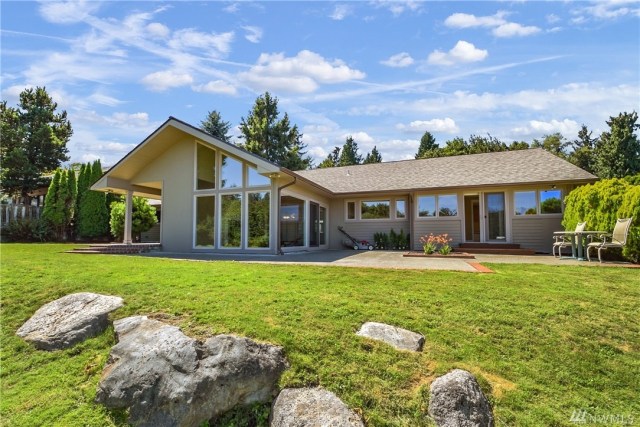
Backyard of the house at 8620 45th Ave NE shows the wall of windows to take advantage of the view. Photo courtesy of Northwest Multiple Listing Service.
As listed in real estate ads in 1955, the Country Club Heights houses sold for about $26,500. The Country Club Heights houses have held their value and today they sell between one to two million dollars.
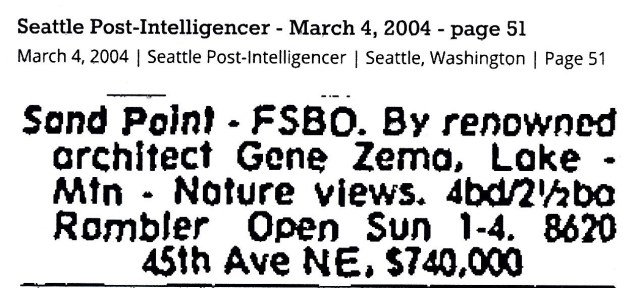
This ad of 2004 lists the house at 8620 45th Ave NE as For Sale By Owner for $740,000. In 1955 the list price of the house was $26,500. In 2021 the house sold for two million dollars.
Sources:
Genealogical resources: census and City Directory listings for the Barth, Kaufer and Watchie families; newspaper references; obituaries and Find A Grave notations.
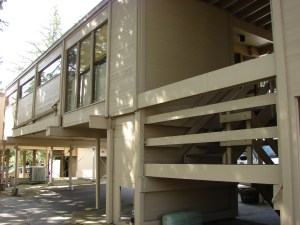
The medical/dental office building at 6850 35th Ave NE designed by Gene Zema, 1961.
“Gene Zema, architect,” biographical info. One of the other buildings in Wedgwood which was designed by Gene Zema is the medical/dental clinic at the southeast corner of 35th Ave NE and NE 70th Street (6850 35th Ave NE).
HistoryLink Essay #2952, “Pioneer Association of the State of Washington,” by Junius Rochester, 2001.
House photos from real estate sales listings, courtesy of Northwest Multiple Listing Service.
“Northwest Modern Architecture in Wedgwood,” includes descriptions of some other houses on 45th Ave NE designed by Gene Zema.
Plat map from the King County Parcel Viewer. The names of Leonard J. Kaufer & his wife Mabel are on the plat map; this may mean that they were co-investors in the project to build and sell houses. The Kaufer & Watchie families’ names were linked as members of the same church in Seattle, and participants in each other’s weddings.

 Wedgwood in Seattle History