
The plan for the new Victory Way — today’s Lake City Way NE. The dotted line is the old Gerhard Erickson Road.
Northeast Seattle, including Lake City, really began to grow in the 1920s because of the rise of the automobile and the creation of more roads. A highway called Erickson Road had opened in 1913 but its winding, narrow passage from Seattle to Bothell soon became inadequate.
One section of the Erickson Road went along the west side of today’s Nathan Hale High School (including the present Ravenna and 30th Avenues NE) to a stop sign at NE 110th Street. Drivers then had to take a right-turn going eastward along NE 110th Street, turn left onto 35th Ave NE, then continue northward to Kenmore and Bothell.
In 1922 a new highway was completed, northbound out of Seattle, called Victory Way: today’s Lake City Way NE. This new highway literally created Lake City by shifting its main intersection westward, over to where Victory Way crossed NE 125th Street.
A new highway for the new Lake City neighborhood
Businesses rushed to set up at this highly visible intersection of the new Victory Way highway, crossing at NE 125th Street. One of the first was McFarland Lumber Company in 1923 at the southeast corner of 125th & Victory Way.
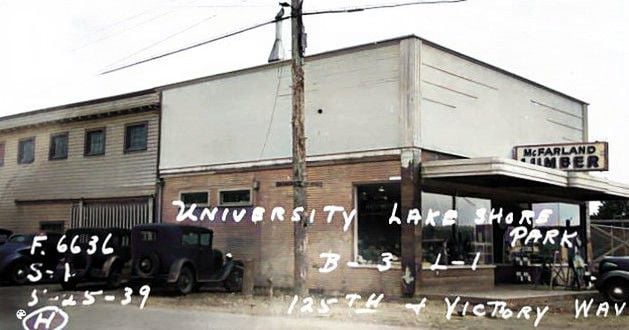
McFarland Lumber, established 1923, in a 1939 photo.
The founder of the lumber company, Charles A. McFarland, died in 1934 but his widow, Irma, continued to own the company until 1946.
The lively growing Lake City community
Clyde C. Chittenden (1860-1957) was the younger brother of Major Hiram M. Chittenden (1859-1917), the U.S. Army Corps of Engineers officer who came to Seattle to build the Lake Washington Ship Canal. The brothers had always been close, so in 1906 Clyde gave up his judgeship in Michigan and moved out to Seattle to be near his brother.
At age 45 at the time of his move to Seattle in 1906, Clyde Chittenden changed careers to become a “lumberman.” He bought tracts of land, logged the timber, and sold real estate.
Chittenden bought the property at the southeast corner of Lake City’s intersection of 125th & Victory Way and logged it off. In 1910 he platted the property, meaning that he created a map marked with lots for houses or commercial buildings. He was involved in Charles McFarland’s establishment of the first lumber yard at that corner in 1923.

Lake City School on the present site of the library, NE 125th Street and 28th Ave NE.
From earliest years, Lake City residents & businessmen were active in projects to develop the community. It was like a separate city, outside the Seattle City Limits.
Lake City activists formed their own school district in 1912. Temporary sites were provided by Clyde Chittenden, until a wood-frame schoolhouse was built in 1914 at the present site of the Lake City Library. A room in the school building was used as a public library, stocked with donated books and staffed by volunteers.
In the 1930s-1940s Lake City formed its own fire district, set up a community center and advocated for street improvements.
William Lohman, manager at McFarland Lumber, was active in the Lake City Commercial Club and was chairman of the Victory Way Commercial Club when it was organized in 1937. This group advocated for improved street lighting, a traffic safety program, caution signs and placement of a four-way stop at the intersection of 125th & Victory Way.
McFarland Lumber 1923-1946

Lohman house
William Henry Lohman was born in Germany and immigrated to Canada. At age 32 in 1923, he and his family moved to Seattle where William became a manager at McFarland Lumber at NE 125th Street & Victory Way.
The Lohman family built a house at 2759 NE 94th Street in the Morningside Heights development. It is likely that William Lohman might already have known other people who lived there, because many building contractors, lumber & hardware salesmen also lived in Morningside.
Braman Lumber 1946-1956
In 1946 J.D. Braman, a lumber salesman, filed articles of incorporation with two co-investors: another lumberman, William L. Feely, and Feely’s married daughter Phyllis Taylor, to “acquire and operate a lumber and hardware business.” They bought McFarland Lumber in Lake City and renamed it Braman Lumber.

James D. Braman had been born in 1901 in Iowa, just before his parents moved to Bremerton, Washington, where his father managed a lumber yard. James would later become well-known in Seattle by his nickname, “Dorm” Braman, mayor of Seattle 1964-1969.
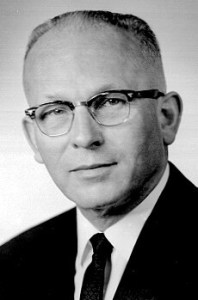
J.D. Braman, Mayor of Seattle 1964-1969
James “Dorm” Braman grew up in Bremerton and was a businessman there until he moved to Seattle in 1946. In his biographical info, Mayor Braman confessed that he’d never finished high school; he’d dropped out at age fifteen and began working as a truck delivery driver at his father’s lumber yard.
We might guess that young James Braman was interested in establishing himself in business so that he could afford to get married. At ages eighteen in 1920, James and his high school sweetheart Margaret got married. The young couple were supported by the successful cabinetry business in Bremerton which James had started.
Life in Bremerton revolved around the naval shipyard where Margaret’s father was a metalworker. At the outbreak of World War Two, in 1942 James was recruited to manage the Navy’s lumber supply yard in Bremerton. At the conclusion of the war, James Braman left the Navy and made the decision to move to Seattle. This could have been because, as of 1946, the Braman’s two sons had attended the University of Washington in Seattle, had married and settled in Seattle, so James & Margaret might have wanted to move to be near them.
We don’t know for sure how James Braman connected with his Seattle co-investors, William L. Feely and Feely’s daughter Phyllis Taylor. Braman had lived in Bremerton until 1946; Feely had been a lumberman in Seattle since the early 1900s, and he was fifteen years older than James Braman.
 William Feely was very familiar with northeast Seattle as, over the years, he’d lived in Wallingford, Lake City, and then Laurelhurst. In the 1920s the Feely family had lived next door to Clyde Chittenden in Lake City, so they would have known of the development activities in Lake City.
As of 1946, William Feely may have advised J.D. Braman that housing growth was moving out through northeast Seattle in the post-World-War-Two years. A lumber yard & hardware store in Lake City would likely be successful because of the demand for materials to build houses.
A “puff piece” promoting Lake City appeared in the Seattle Post-Intelligencer newspaper on May 17, 1946, which said,
“Most amazing of all the many community expansions is at Lake City….. the rapid growth of this suburban area, bisected by the Bothell Highway, is the subject of comment in Seattle banking and real estate circles…… New dwellers by the thousands have flocked to Lake City…..500 new homes are under construction right now…… Lake City merchants and residents boast their business community now has everything….. There are super-duper markets, a new post office which opened its doors only last week, a motion picture theater, medical clinic, bowling alley….”
Lake City comes into the City of Seattle on January 4, 1954

January 3, 1954, ad in the Seattle Times newspaper.
In 1953 the Associated Clubs of the North End discussed a candidate for the new city council position to represent them, when Lake City would officially become part of Seattle on January 4, 1954.
J.D. Braman, lumber company owner, agreed to be the North End candidate, and he was elected. J.D. Braman served on Seattle City Council 1954-1964 and then was elected mayor of Seattle, serving 1964-1969.
Ads ran in the Seattle Daily Times Sunday newspaper of January 3, 1954, welcoming Seattle to Lake City businesses in celebration of “joining the City” on January 4 when the Seattle City Limits would be set at NE 145th Street, to include Lake City.
In 1956, after having served on City Council for a couple of years, Braman decided it was becoming too much to try to manage his lumber business as well as the busy City Council work. His co-investor W.L. Feely died in 1956 and this may have been a contributing factor, if perhaps Braman wanted to distribute the business assets for the benefit of Feely’s family.
Lake City Lumber & Hardware Store 1956-1970
Jack Kinne and John W. Sims bought the Braman Lumber store and changed the name to Lake City Lumber & Hardware. Kinne & Sims were in their early forties and had worked in sawmills and in lumber procurement before buying the store.

A billboard expressed the feeling that everyone was leaving Seattle. Photo by Greg Gilbert, Seattle Times newspaper, May 9, 1971.
As of 1956 when Kinne & Sims became owners, northeast Seattle was still growing with new houses being built, so their lumber & hardware store was successful at first. But the economy slowed down in the late 1960s with the disastrous Boeing Bust, in which Boeing Aircraft reduced production so sharply that the population of the region fell, as people lost their jobs.
In 1970 the population of Seattle was less than it had been in 1960, and new housing construction was at a standstill. The Lake City Lumber & Hardware Store closed in 1970.
Shoreline Savings Association
In 1953 the Shoreline Savings Association opened for business in a small office building on the west side of Lake City Way NE. In addition to running his Braman Lumber & Hardware store business and becoming a candidate for Seattle City Council, J.D. Braman was one of the organizers of Shoreline Savings.
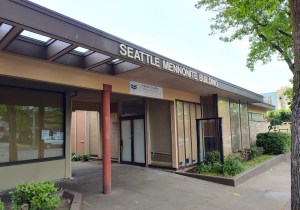
3200 NE 125th Street, built in 1955 for Shoreline Savings Bank.
Shoreline Savings was a “thrift,” meaning that it encouraged people to put money into savings accounts, and the bank would loan money for people to buy homes.
This first branch of Shoreline Savings in Lake City was successful and in 1955 they moved to a new building at 3200 NE 125th Street, which they had commissioned to be built. The bank occupied one of the spaces, with some spaces leased by medical and other offices.
This building, which still stands today, is next door to the former Lake City Theater which was built in 1944. Today both buildings are owned by the Seattle Mennonite Church and are used for their meetings and offices.
In 1972 Shoreline Savings moved again, to a new building at 12360 Lake City Way NE called Shoreline Tower, the first “high rise” building in Lake City.

Shoreline Savings at 12360 Lake City Way NE, built in 1972. Sign for Claire’s Pantry restaurant is at right.
J.D. Braman had been away from Seattle for a year, 1969-1970, working for the federal government. In 1970 he returned to Seattle where he was still on the board of Shoreline Savings. We don’t know whether he regretted seeing his old Braman Lumber & Hardware building demolished, or if he was mainly looking ahead to the new Shoreline Tower building which would have the home office of Shoreline Savings.

Former bank entrance of Shoreline Savings, now owned by Akin. Photo by Valarie, 2024.
J.D. Braman died unexpectedly at age 79 in 1980. Braman had been known for astute financial management, and perhaps if he had lived, the story of Shoreline Savings might have been different.
In 1984 Shoreline Savings unwisely loaned too much money to a developer, and when the developer declared bankruptcy, Shoreline Savings didn’t recover the $17 million in loans. Shoreline Savings’ reputation was damaged as they were accused of “unsafe and unsound business practices.”
Shoreline Savings struggled on for a few more years until they were acquired by Washington Mutual in 1988. For a few years the former-home branch office of Shoreline Savings at 12360 Lake City Way NE, functioned as a branch of Washington Mutual (later acquired by Chase Bank).
Today in Lake City
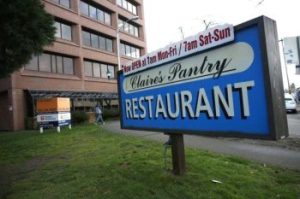 The Shoreline Tower building had as one of its first tenants, the Claire’s Pantry restaurant. After a forty-year run, the restaurant closed in February 2013. The ground-floor space of the restaurant stood vacant for most of the next ten years. The bank space was later vacated and empty, as well.
In 2021 the former Children’s Home Society of Washington purchased the Shoreline Tower building and began renovations of the ground floor to become their offices. The renovations were completed in 2024.
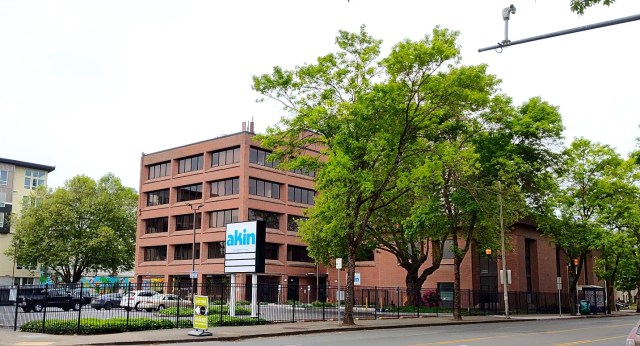
Now called the Akin building, there is a parking lot on the east side of the building, shown at left, looking across NE 125th Street. Photo by Valarie, May 2025.

Remodeled interior lobby and bank space now used as a community meeting room, as of 2024. Photo by Valarie.
The agency, now called Akin, has their offices in the former restaurant space. The former bank space is a meeting room. Akin has generously opened this room for community meetings, a much-needed service after the loss of the Lake City Community Center in 2023, destroyed in a fire.
The evolution of this corner site at 125th & Lake City Way NE, from lumberyard to modern office tower building, represents the changes in Lake City over the past one hundred years.
Beginning as a frontier outpost on newly-logged-over land, the Lake City community grew with the new Victory Way highway. Lake City was characterized by the suburban ideal of family housing around a vibrant commercial district.
Today Lake City has a busy business district with restaurants, banks, a library, post office, hair salons/barbers and many kinds of stores, including hardware, auto supply and groceries.
Lake City has active community groups and an annual festival event which began as Pioneer Days in the 1940s and is now called the Lake City Summer Festival and Parade. The Enjoy Lake City organization coordinates activities, including monthly street clean-ups in the spring through autumn. Many activities and meetings are held at the Akin building.
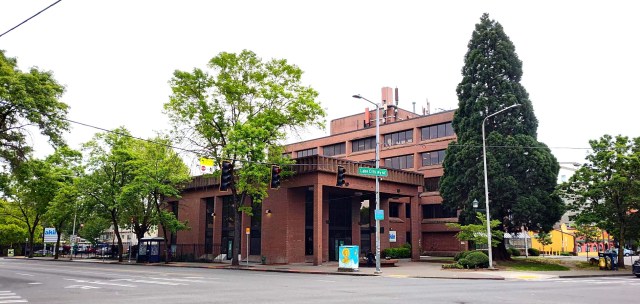
The Akin building occupies a prominent corner at NE 125th & Lake City Way NE. Photo by Valarie, May 10, 2025.
Sources:

Chittenden wedding anniversary note, Seattle Daily Times, December 26, 1949, page 17.
Census, City Directory, newspaper search and other genealogical info including Find A Grave.
City Limits: The north Seattle City Limits were finally set at 145th Street as of January 4, 1954. It was a gradual process through the 1940s and 1950s when election precincts voted themselves into the city. At the end of my blog article about Election Districts is a source list to the dates and a map of precincts. Info about the inclusion of separate cities, such as Ravenna, is in this article about annexations. Info about the system of Seattle street names is in this article. The “directional designations” of Seattle streets changed in 1961 so that East 75th Street, for example, became NE 75th Street.
“How Did Lake City Get Its Name?” by Vicki Stiles, former director of the Shoreline Historical Museum.
Property photos: from the Puget Sound Regional Archives, Bellevue, WA. The PSRA has the collection of photos which were done in a survey of taxable properties of King County in 1937-1940.
Newspaper articles:
“Formal Opening of Golf Course Set for Sunday,” July 24, 1931, Seattle Daily Times, page 15. Column includes advertisement for McFarland Lumber which supplied all lumber & building materials for the Meadowbrook Golf Course and its clubhouse.
“Lake City Club Plans Fire District,” November 26, 1935, Seattle Daily Times, page 11.
“Club Organized on Victory Way,” July 27, 1937, Seattle Daily Times, page 13.
“Five committees representing the Associated Clubs of the North End appointed to serve on county commissioner’s advisory council. Highway safety: W.H. Lohman of 2759 NE 94th Street, representing the Lake City Commercial Club.” December 30, 1939, Seattle Daily Times, page 7.

McFarland ad, July 24, 1931, Seattle Daily Times, page 15.
“Amazing Expansion.” May 17, 1946, Seattle Post-Intelligencer, page 1.
“Notice of incorporation: J.D. Braman, W.L. Feely and Phyllis Taylor, to acquire and operate a lumber and hardware business.” July 19, 1946, Seattle Daily Times, page 16.
“Chittendens Married for 65 Years,” December 26, 1949, Seattle Daily Times, page 17.
“Shoreline Savings Opens Doors Monday,” February 27, 1953, Seattle Post-Intelligencer, page 23. Gene Bryant, executive secretary of the Lake City Commercial Club, was appointed manager of the Shoreline Savings Association.
“Representatives of sixteen organizations in the North End annexation area decided to support J.D. (Dorm) Braman, a lumber firm owner at Lake City, as candidate for City Council.” December 8, 1953, Seattle Daily Times, page 25.
“Braman Lumber advertisement,” January 3, 1954, Seattle Daily Times, page 25.
“Braman Candidate for City Council,” February 10, 1954, Seattle Daily Times, page 33. Contains biographical info – Braman dropped out of high school, worked at his father’s lumber yard and then opened a cabinetry business in Bremerton. He sold this business in 1942 when he went to work for the Navy’s lumber procurement yard in Bremerton. In 1946 the Bramans moved to Seattle.
“You are invited to visit our new location,” April 23, 1955, Seattle Post-Intelligencer, page 2. Advertisement for Shoreline Saving’s second location at 3200 NE 125th Street.
“It’s Lake City Way NE,” October 27, 1967, Seattle Times, page 23. Victory Way — Bothell Way – Lake City Way NE: Victory Way opened in 1922. After some widening and straightening, in 1939 it was called Bothell Way. Like the Northgate Mall which petitioned for a name change to “Northgate Way” on an adjacent road, Lake City merchants applied to have the highway name changed to Lake City Way NE on that portion inside of the Seattle City Limits. Today’s Lake City Way NE is technically also called State Route 522.
“What Kind of a Guy is Braman?”, by Mike Conant, Seattle Post-Intelligencer, March 23, 1969, page 55. Contains biographical info at the time that Mayor Braman was going out of office and was being honored for his service.
Death notice, J.D. Braman, outline of Braman’s career, noting his death on August 21, 1980: Seattle Daily Times, August 22, 1980, page 19.
“Braman’s ‘Third Career,’” September 7, 1980, Seattle Daily Times letter to the editor, page 19. In recognition of the death of Dorm Braman on August 21, 1980, a letter writer told of Braman’s volunteer work with Scouts. The letter-writer characterized Scouts as Dorm Braman’s third career after business and civic service. Braman first became a scoutmaster in Bremerton in 1935. Even while serving as a Seattle City Councilman, Braman chaired the Scout Council camping committee and developed funding. In 1975-1977 Braman was president of the Chief Seattle Council, Boy Scouts of America, and served to firm up the council’s financial base.

 Wedgwood in Seattle History