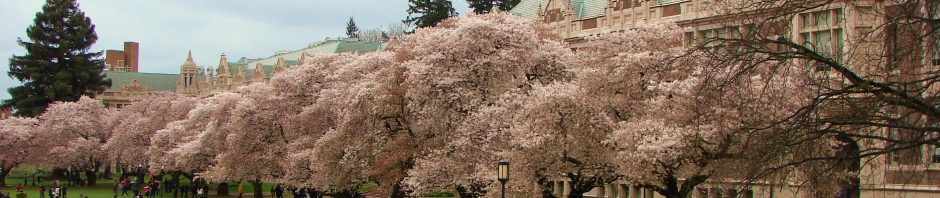
This blog article will tell of an Italian immigrant who fulfilled his American Dream in Seattle. John Terlicher was able to find work, learn English, marry, own a home and have his own business. He was mostly successful in American life, while also experiencing difficult economic times and personal tragedies.
Coming to America
Italian immigrant Giovanni Terlicher arrived in New York Harbor in March 1910. As he sailed past the Statue of Liberty, he dreamed of all the things he wanted to do in America.
 Giovanni continued his journey across the USA until he reached Seattle in June 1910, having celebrated his sixteenth birthday along the way. In Seattle Giovanni hit the streets looking for work.
Today we would not expect a sixteen-year-old to be out of school and working, but in the early 1900s in Seattle it was quite usual. There was only one high school (in downtown Seattle), and few people went on to more education beyond sixth or eighth grade.
But things were changing, and some people wanted Seattle to move on from its frontier origins and become a real city with more resources, including education. Events of the years 1907-1917 caused the growth of north Seattle as people moved toward areas where new schools, roads and utilities like electricity were being put in.
The growth of north Seattle
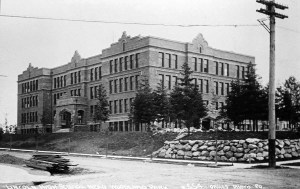
Lincoln High School is at 4400 Interlake Ave North in the Wallingford neighborhood of Seattle. It opened in 1907.
In 1907 Lincoln High School opened in the Wallingford neighborhood, chosen for its convenient access to streetcar lines and as the center of expanding population. Lincoln was only the second high school in Seattle and as soon as it opened, it was immediately overcrowded.
In 1910 Seattle was still patting itself on the back for the successful world’s fair event in 1909, the Alaska-Yukon-Pacific Exposition which had been held on the campus of the University of Washington in northeast Seattle. This was the event which finally brought the university campus into viable condition as it had languished with only two buildings before the AYP. Seattle boosters knew that a university would give the city prestige. The AYP also stimulated creation of a residential community called the University District where streets and electric lines had been put in.

The University Bridge as it looked in February 1932. Photo 5441, Seattle Municipal Archives.
North Seattle began to grow rapidly as of 1910, due to the expansion of streetcar lines to communities like Wallingford and the University District. Neighborhoods like Ravenna and Laurelhurst were beyond the reach of the streetcar system but were annexed into the City Limits in 1910. This gave the neighborhoods some advantages such as City street work and utilities.
More events which stimulated the growth of northeast Seattle were the creation of the ship canal in 1917 and bridges to cross over, such as the University Bridge in 1919. Car ownership had greatly increased, and people began looking for places to live farther out to the northeast where they could live less expensively and be able to drive to work.
Immigrant Giovanni Terlicher grew along with city trends and in the 1920s he became a resident of a northeast Seattle neighborhood called Morningside (the future Wedgwood).
Becoming an American in Boomtown Seattle
In his first decade in Seattle, 1910-1920, Giovanni became John and he did other things to become American. John submitted a Declaration of Intention form stating his intent to become an American citizen, a process which he completed in 1917. The witnesses on his final Petition for Naturalization form in 1917 were two men who stated that they’d known John since 1912 as they all worked together on one of the City’s garbage collection crews.

Terlicher Petition for Naturalization in 1917
In 1916 John married an American girl, Grace Miller, and in 1918 he joined the Army Reserves and served six months at the close of the World War One years. This gave him the status of a veteran. In following years John participated in the American Legion organization, a fraternal group for veterans where men could be involved in community activities such as promoting patriotic holidays.
Rough and tumble in early Seattle

Imperial Candy began producing in Seattle in 1906. Grace Terlicher’s job listing in 1917 was “chocolate dipper.”
John Terlicher was 21 and Grace Miller was 19 when they married in January 1916. The officiant was Justice Reah M. Whitehead, the first woman Justice of the Peace in Seattle. Eighteen months later, Grace was called back to see Justice Whitehead, this time on a legal matter.
Grace worked at the Imperial Candy Company (not now extant) on Western Avenue at the foot of Marion Street. On September 7, 1917, she decided to cross a picket line and go to work. Later in September Grace was brought before Justice Whitehead, charged with assault. It was alleged that she had brandished a revolver when approached by the workers at the picket line on September 7th.
In court Grace produced a toy water pistol and said she’d waved it around to prevent being accosted by the striking candy factory workers. For this reason, self-defense, Judge Whitehead dismissed the assault charge.

Grace Terlicher in court, Seattle Daily Times, September 21, 1917, page 3.
Grace’s husband did not get off so easily when it was his turn to appear in court. On January 18, 1922, John Terlicher pled guilty to “manufacturing moonshine” in violation of Prohibition (the period of time when all alcohol was banned in the USA). Terlicher received a jail sentence from the same judge in whose court, Terlicher had been sworn in to U.S. citizenship five years earlier.

Moonshiner Sentenced: Seattle Daily Times, January 19, 1922, page 2.
John & Grace Terlicher move out to northeast Seattle in 1920
In the early years of their marriage John & Grace had lived in areas near to downtown, such as Belltown, which would have been convenient to their places of employment. We don’t know what attracted them to the Morningside Heights neighborhood in northeast Seattle, but it could have been through other people they knew, who were moving farther out of the city. One of the Terlichers’ close neighbors in Morningside was Glen Pilgrim who had also served in the Army Reserves in 1917-20. In the 1920s-1930s the two men were active in an American Legion chapter along with other Morningside neighbors.
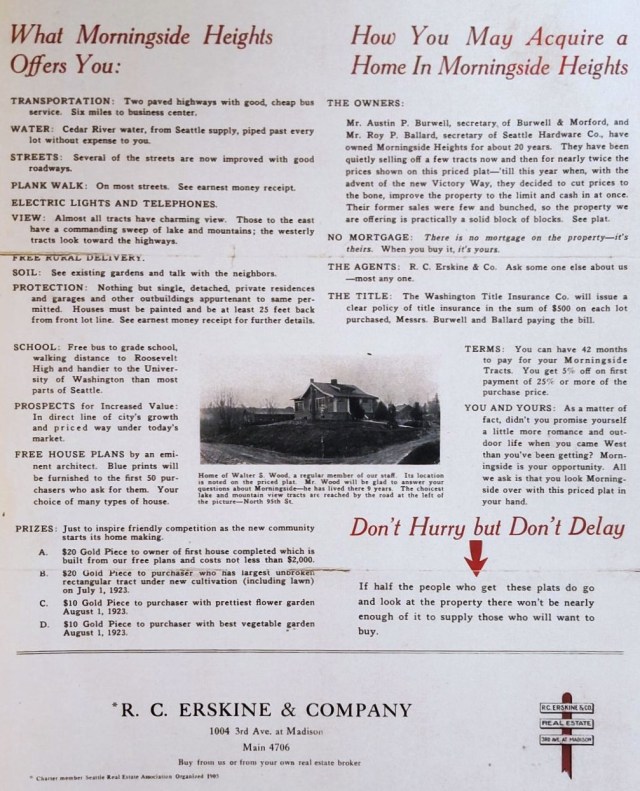
In 1923 the Morningside Heights development was advertised in a real estate brochure.
The City Directory listings for John & Grace Terlicher show that by or before 1920, they’d moved from the downtown Seattle area, out to the (future) Wedgwood area in northeast Seattle where a semi-rural lifestyle was possible. At first, the Terlichers lived nearest to NE 75th Street. Grace raised chickens and advertised them for sale.

Chickens for sale — Seattle Daily Times, February 22, 1920, page 80.
Guns seemed to be a continuing theme in the lives of John & Grace. This time, Grace handled a real gun (instead of a water pistol) with unexpected results.

Seattle Daily Times, July 8, 1921, page 7.
John Terlicher’s next court date ended with unexpected results. Up until 1928 he’d continued to work for a fellow Italian immigrant, Bert Narvonne, as a garbage collector. John brought suit against Narvonne, alleging that Narvonne was charging the City of Seattle for four workers on Terlicher’s truck, although there were only three men working. Narvonne pocketed the difference.
The City Attorney was already investigating corrupt dealings in the garbage-collection contract but could not pursue it because the suit had been dropped when it was settled out of court. Narvonne offered Terlicher a settlement of $700 (worth about $12,500 in today’s money).
John & Grace invest in the Morningside neighborhood
It may be that the money he received from the garbage-collection business owner enabled John Terlicher to become a business owner himself. In the 1920s John & Grace built their own house in Morningside, and they also became co-investors in a business, the Morningside Market at 9118 35th Ave NE. John & Grace gave up their other jobs and began running the Market themselves, with the help of Grace’s widowed mother, Vina Miller, who was now living with them.

Morningside Market as it looked in 1939.
Armed robbery at the Morningside Market
On May 27, 1935, two armed men entered the Morningside Market, held Grace Terlicher at gunpoint and robbed her of $40 (equivalent to about $921 today). John Terlicher waited until the men left the building, then he came out and shot at the fleeing robbers with a .30-caliber rifle. A bullet penetrated the rear of the car, killing the man in the back seat.
An hour later, an unidentified man phoned Swedish Hospital and said, “If you go outside the hospital entrance and look in an automobile with the lights on, you’ll find something.” Three hospital orderlies went out and found the body in the car.

Report of the robbery at the Morningside Market in the Seattle Daily Times, May 29, 1935, page 7.
The robbery case was not solved until 1939 when a man, James Terry, confessed that he had been the driver of the car. He claimed that the other two men had asked him to stop at the Morningside Market to get something while the three were on their way to a party. He claimed that he didn’t know of their plans to do a hold-up. He confessed to having made the anonymous phone call to the hospital and said that he didn’t know the name of the man who had also fled when Terry parked the car at Swedish Hospital.
The Terlichers begin another life transition
Economic conditions were difficult during the 1930s and small groceries like Morningside Market were sometimes forced to post a sign, “purchases by cash only.” They had found that some people would charge their groceries but never come back to pay. Conditions of economic hardship sometimes led people to commit armed robberies, as well.
Perhaps the 1935 armed-robbery at Morningside was a trauma which was the beginning of the end of the Terlichers time there. In 1939 the Terlichers listed their Morningside home, where they had lived for fifteen years, for sale for $4,750.
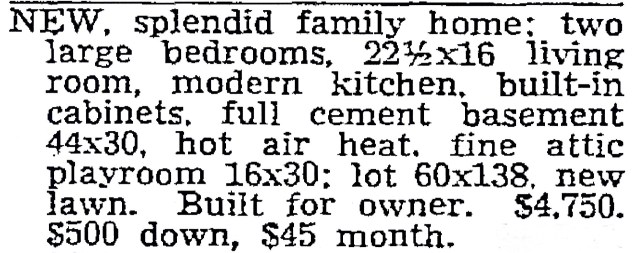
The Terlichers listed their house for sale in the summer of 1939. Advertisement in the Seattle Daily Times, June 24, 1939, page 14.
Grace Terlicher had been born by the Duckabush River at Hood Canal, where her father, Frederick Miller, had a sawmill. It may be that Grace’s widowed mother Vina Miller still owned property in that area or together they were able to purchase property. The three of them, John, Grace and Grace’s mother, moved to the Olympic Peninsula in 1939 and John took a job as a truck driver for Weyerhaeuser Lumber.
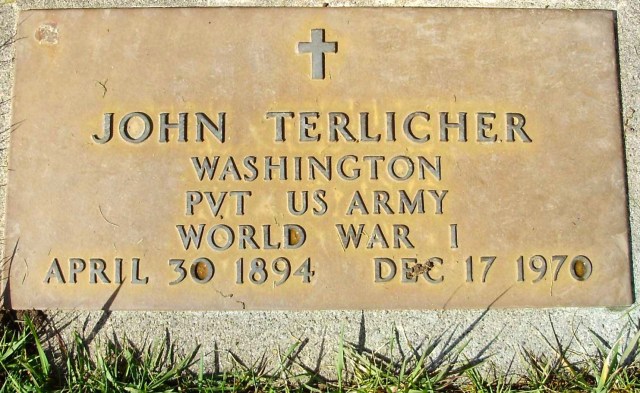
John & Grace Terlicher separated, and, on the census of 1940, Grace was shown living in Oregon where her occupation was listed as “farming.” Grace’s mother Vina Miller stayed with her son-in-law until her death at age 92 in 1947. John Terlicher died in 1970.
Sources:
Genealogical records including census, marriage & death certificates; Find A Grave shows the location of gravesites.
Newspaper search (as noted on captions.)
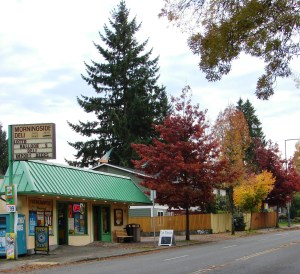
Morningside Market at 9118 35th Ave NE
Morningside Heights plat: The Morningside Heights plat is in the northwest quadrant of Wedgwood between NE 90th to 95th Streets on the west side of 35th Ave NE.
Morningside Heights was the first development to be advertised in the (future) Wedgwood area, although the real estate company did not build the houses. They sold lots and gave away sets of house plans which is the reason why there are more Craftsman-style houses there, than in other parts of Wedgwood. John & Grace Terlicher may have seen the advertisements or perhaps they knew others who had moved to Morningside. The Morningside Market, built in 1926 is still open today.
From Morningside to Wedgwood — neighborhood identity: the Morningside name which had been used for the future Wedgwood area, faded from use after the 1940s. The name “Wedgwood” was originally a development of houses from NE 80th to 85th Streets, and the name caught on in popularity. Developer Albert Balch provided for stores and business offices at the NE 85th Street intersection on 35th Ave NE as it is today. This caused the center of the neighborhood to shift to NE 85th Street. Wedgwood’s Boundaries and Neighborhood Identity is another blog article I have written about the fading-away of the Morningside name.
Property records: Puget Sound Regional Archives in Bellevue, repository of the property records of King County. The PSRA holds the collection of house photos done in the first survey of all taxable properties in King County, in the years 1937-1940.

The Terlichers house, built in 1924 in the Morningside Heights section of what later became Wedgwood. Photo of 1939, courtesy of the Puget Sound Regional Archives.
“Reah Whitehead, pioneer woman justice of peace: Seattle History Vignettes,” by David Suffia, Seattle Times January 3, 1975, page 13. Ms. Whitehead was elected as Justice of the Peace in 1914, the only woman judge in Seattle. She served until 1941. Her position was next taken by Evangeline Starr.
“Sweet Innovations, Bitter Markets, and a Rich Recovery: A Bite-Sized History of Seattle’s Chocolate Industry,” by Robin Klevansky. Columbia Magazine/Washington State Historical Society, Winter 2024, pages 18-27. Imperial Candy Company operated in Seattle from 1906-1974. Their Societe-brand chocolate won a gold medal at the Alaska-Yukon-Pacific Exposition of 1909. In the Seattle City Directory of 1917, Grace Terlicher was listed as a Chocolate Dipper at Imperial Candy Company.

Imperial Candy Company ad in the Seattle City Directory of 1921.

 Wedgwood in Seattle History
Thanks for sharing. The bit about John Terlicher trying to shoot a rat but hits wife instead is hilarious.