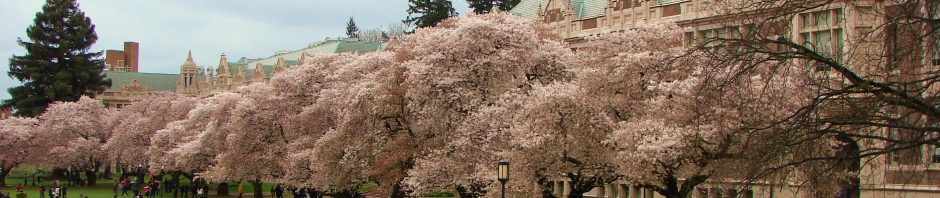
 Magnuson Park in Seattle with its entrance gate at 7400 Sand Point Way NE, is the former site of an airfield which first began to be developed in the 1920s.
In September 2024 we are celebrating the First World Flight, the planes which took off from Sand Point in April 1924 and returned in September that year. Visit the First World Flight Centennial Celebration page for news of the commemorative events.
The story of how Sand Point on Lake Washington became the site of an airfield is that of citizen activists in Seattle.
Civic activists worked to create the airfield at Sand Point
Claude C. Ramsay ((1865-1930) was a 24-year-old post office clerk in North Carolina when he read about the Great Seattle Fire of June 6, 1889. Ramsay closed his affairs in town as soon as he could and traveled out to Seattle to see what opportunities would be available for him in this city which was rebuilding itself.

Claude Ramsay, cartoon portrait circa 1906, Argus magazine.
Ramsay became a Seattle businessman who was very involved in civic life. He joined the Chamber of Commerce and helped in the preparations for the Alaska-Yukon-Pacific Exposition of 1909.
Ramsay served one term in the Washington State Legislature where, in 1907, he helped to secure passage of Good Roads Laws. This was Washington State’s earliest legislation to establish highways.
From 1917 to 1923 Claude Ramsay served on the King County Board of Commissioners. At the close of The Great War (World War One) in 1918, the commissioners understood that the airplanes which had been used in war, had many peacetime applications such as mail delivery and passenger travel. At that time there was no such thing as an airfield in Seattle.
The commissioners solicited input from local flyers, government experts, army and navy flyers, who all recommended Sand Point on Lake Washington as an ideal location for an airfield. The commissioners purchased the Sand Point site and deeded it to the government on February 1, 1921. Ramsay went to Washington, D.C. and personally handed the deed to the Secretary of the Navy, but the transaction wasn’t completed until after Congress formally accepted it on March 8,1926.
From wagon trains to airplanes
Clarence B. Bagley (1843-1932) was nine years old when he traveled with his parents in a wagon train from Illinois to Oregon in 1852. Other members of the party were Dexter Horton and Thomas Mercer, who would become well-known early settlers in Seattle.
When Clarence was seventeen years old he and his parents moved from Salem, Oregon, to Seattle, Washington, reuniting with their wagon train contacts in Seattle. Clarence Bagley became the premier historian of Seattle’s growth from a tiny village to a city with roads and airports.

Clarence B. Bagley, 1843-1932, Photo courtesy of MOHAI.
In his History of King County published in 1929, Bagley wrote that “Lake Washington has played an important part in the history of King County.” He recognized the importance of the Lake Washington Ship Canal completed in 1917, which opened the area for travel and trade.
Bagley wrote of the visionary work of the King County Board of Commissioners who established the airfield at Sand Point on Lake Washington. Their efforts began during World War One when airplanes first came to prominence in war use.
Development of an airfield in Seattle was finally taken up by the federal government in 1926, when a naval air station was officially created at Sand Point in northeast Seattle. Bagley marveled that in his lifetime he had seen travel progress from wagon trains to airplanes.
Clearing the way and taking flight

Douglas World Cruiser airplane parked at the Sand Point airfield in 1924, photo courtesy of MOHAI.
Bagley wrote that Claude C. Ramsay, Chairman of the King County Board of Commissioners, led the fight to have the federal government establish the airbase at Sand Point.
Ramsay was sent to Washington, D.C. by resolution of the board, and Ramsay succeeded in convincing officials and Congress of the importance of this site on Lake Washington. The Senate agreed but it took six more years to get any money from Congress.
Taking action themselves, the King County Commissioners cleared a small flying field, a 500-foot dirt strip. Claude C. Ramsay rode as a passenger on the first plane to set down on Sand Point on June 19, 1920, as part of a tree-felling ceremony marking the start of the development of the airfield.
Creation of the airfield made it possible for the Round the World Flight to start and end at Sand Point in 1924. It was only after that achievement that the federal government was convinced of the importance of a military air base at Seattle.
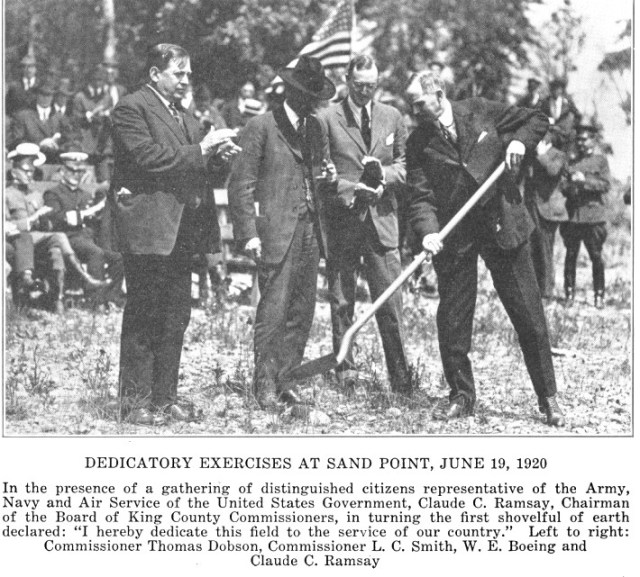
Claude Ramsay at far right, turning the first shovel of dirt at the new airfield in 1920. Photo from page 505, Bagley’s History of King County.
Sources:
Bagley, Clarence B., History of King County, 1929, pages 502-509.
“Magellans of the Sky,” National Archives Prologue magazine, Summer 2010, Volume 42, No. 2.

The entrance gate at 7400 Sand Point Way NE to the former Naval Air Station, now Magnuson Park.
History of the Sand Point area: article here on this blog, “From Pontiac to Sand Point.”
HistoryLink Essays:
Essay #2242, “Military airplane lands at Sand Point for the first time,” by David Wilma, 2000.
Essay #2303, “King County transfers 413 Sand Point acres to the United States Navy on March 8, 1926,” by Greg Lange, 2000.
Essay #3470, “the Bagleys,” by Junius Rochester, 2001.

Douglas Air Cruiser at Sand Point before the flight in 1924. Photo courtesy of MOHAI.

 Wedgwood in Seattle History
Thank you for sharing this interesting history, overlooked by so many of us a century later. I’m so glad the airfield grew into a navy base and then a park instead of a regional airport!
Until your post I never realized that the Feds didn’t own Sand Point when the Cruisers flew the World Flight in 1924.