It has been said of early Seattleites that no matter their original vocation, once they got to Seattle they went into the business of real estate. Land was available in and around Seattle so that those who invested in property in early years, were later able to reap profits as the land increased in value.
One example was Dr. E.C. Kilbourne who practiced dentistry in Seattle until he became one of the developers of the Fremont neighborhood in 1888, and an investor in streetcar lines.

W.W. Beck at the gate of Ravenna Park
Rev. William W. Beck came to Seattle as a minister with the Cumberland Presbyterian denomination. The Becks, William, Louise and their two sons, settled in northeast Seattle in 1889.
The Becks created Ravenna Park and established the Ravenna neighborhood, with advertising in the newspaper of plats of land for sale. Today’s Candy Cane Lane is on land where the Becks lived and was later developed by the Beck’s son.
Another minister who came to Seattle in early years was Rev. John C. Norton of Minnesota. He was commissioned and sent out by the Free Methodist church denomination in 1890 to help organize the Christian school now called Seattle Pacific University. Rev. Norton then left his original vocation to become involved in the business community and real estate sales in northeast Seattle. Real estate originally purchased by Rev. Norton’s wife in the 1880s, before their marriage in 1892, is today the site of Bryant School on NE 60th Street, with houses on the surrounding blocks.
This blog article will trace the stories of Rev. Norton and his wife Minerva Widger in Seattle beginning in the 1880s. We will see how the Norton’s activities paralleled the growth of Seattle and we will consider how the Norton’s influence is still being felt today.
Life in early Seattle
The first white settlers of Seattle in the 1850s had to obtain consumer goods, such as fabric, from San Francisco. Four Wagons West, the chronicle of early days in Seattle, wrote that,
“When a ship brought bolts of cloth there was little joy for the pioneer woman in having a dress of the new material, for everyone in town would have one from the same bolt…. Even in those days of privation, the feminine love of the beautiful and personal adornment could not be entirely quenched. One day, Mrs. Bell appeared in a lace cap trimmed with new blue ribbon. Where did she get the blue ribbon? ….After enjoying the women’s amazement and admiration for a while, she told them she had taken some of the paper that lined the sugar barrel, cut it into strips, and put it under the lace.” (pages 100-101, Four Wagons West)
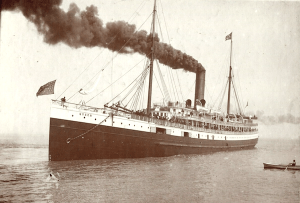
Queen of the Pacific, built 1882
As late as the 1880s Seattleites would travel to San Francisco like people today go to the shopping mall. By ship from Seattle, people went to San Francisco to order machinery to be made and to buy consumer goods such as furniture, fabric and foodstuffs.
In 1886 the Seattle Daily Intelligencer newspaper printed a list of those boarding at Seattle on the steamship Queen of the Pacific, bound for San Francisco. Among the dozens of passengers were Cyrus Walker of the lumber mill operation at Port Gamble; Captain DeWitt C. Kenyon (a Civil War veteran) & his wife Viola; and Miss Minnie Widger of Seattle.
A dressmaker in Seattle
Minnie Widger had arrived in Seattle in the early 1880s and, along with her younger sister Cordelia, the two worked as dressmakers. We may imagine that the Widger sisters wanted to obtain better fabrics from San Francisco so that they could compete as dressmakers in the increasingly prosperous young city of Seattle.
Additionally, the sisters had branched out into operating a boarding house, so it may be that on her 1886 trip Minnie was tasked with buying furniture, linens or other household supplies to be brought from San Francisco. An item in the Seattle Daily Intelligencer newspaper said that “Miss Minnie Widger has taken charge of the house next to the Grand Central in Seattle, over MacCulsky’s flour & feed store, where she intends to supply nicely furnished rooms.” The Grand Central was in the heart of the business district on South Washington Street, prior to today’s Pioneer Square District.
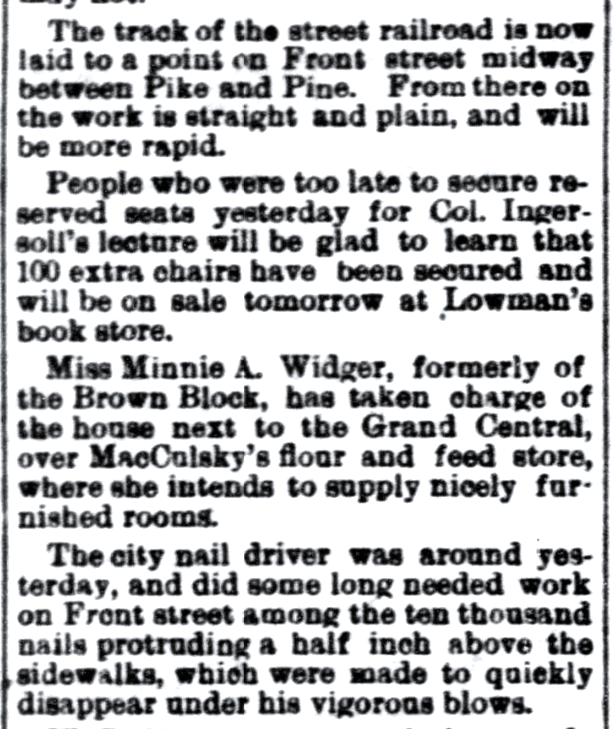
Seattle Post-Intelligencer, August 24, 1884.
The Daily Intelligencer newspaper printed lists of land transactions and it was interesting to see that in the 1880s many women were buying and selling property in Seattle. In 1888 there was a notation that Minnie Widger had bought three lots in the Ross Addition, for $325. (about $10,000 in today’s dollars)

Seattle Post-Intelligencer, March 1, 1888.
The Ross Addition was west of Fremont and included some of the area south of Ross Creek, as far as Ewing Street. Minnie Widger had a house built on this property with her address in the City Directory listed as “Ross, north of Ewing at Jesse Street.” Today Minnie Widger’s homesite is under the water of the new, wider ship canal created in 1916.
Minnie’s sister Cordelia married in 1887 and with her husband she ran a boarding house at 809 Third Avenue (northwest corner of Columbia Street). Both moves, Minnie’s to Ross and Cordelia’s to Third Avenue downtown, were of providential timing. The conflagration known as the Great Seattle Fire took place on June 6, 1889, and neither Minnie nor Cordelia suffered loss.

The northwest corner of Third Avenue & Columbia Street in downtown Seattle was once the site of Cordelia’s boarding house. In the background is the Wells Fargo Bank building in the next block at 999 Third Avenue. Photo by Valarie.
Incredibly, Cordelia’s establishment on Third Avenue survived the Great Seattle Fire, though the buildings to the west on First and Second Avenues were burned. We can only imagine how busy Cordelia’s boarding house must have become in the months following the Fire, with people needing a place to live and with newcomers converging on the city to get in on the rebuilding boom.
Just prior to the Fire of 1889, and prior to getting a house at Ross, Minnie had been advertising herself with an occupation other than dressmaking, using a room at Cordelia’s boarding house as her office. Minnie was now listed in the City Directory as a Portrait Artist. As a dressmaker, Minnie would have employed artistic skills to sketch out what the customer wanted. Minnie’s artistic ability and her contacts with customers wealthy enough to have clothing custom-made for them, seemed to have evolved into a business of family portrait painting.
Minnie Widger: from New York to Seattle
When I write about early Seattleites I always wonder and speculate on their reasons for coming out to Seattle. Most especially for a single woman like Minnie Widger, I am amazed by her boldness and confidence that she could be successful in an unknown place.
Minnie was born in 1839 of a farm family in Chenango County, south-central New York State. The census of 1860 showed that Minnie, age 21, was an itinerant dressmaker, meaning that she would stay with a family while sewing clothing for them. The census of 1880 listed Minnie as dressmaker at the home of her older married sister, Julia Hollister, in Audubon County, Iowa.
Minnie’s father died in 1879, his farm property was sold and the proceeds of the estate distributed, with Minnie included in the bequests. Perhaps it was this inheritance along with her own earnings which gave Minnie the seed money to travel out to Seattle and set up in business. She was soon joined by her younger sister Cordelia and their widowed mother Betsey.
Minnie Widger in the 1890s in Seattle
When Minnie Widger and her mother, Betsey, moved to Ross on the north slope of Queen Anne hill, Ross was a small residential community on the western edge of the more vigorous district of Fremont.
Ross had originally been the homestead claim site of John Ross. By the 1880s the land had been sold and real estate investors filed plats, one named Ross First Addition and one named Ross Second Addition, on the either side of the small creek (which later became today’s ship canal.)
Ross developed more in the early 1890s, just as some other neighborhoods also did because of the explosive population growth of Seattle following the Great Fire of 1889. Ross had stores and a post office, and it benefited from the growth of Fremont with a streetcar line traveling along Westlake Avenue to downtown Seattle.

McKees Correct Road Map of 1894, courtesy of Seattle Public Library.
Up until the early 1890s a Norwegian immigrant family, Nils & Karen Peterson, had a vegetable garden at about Bertona Street and Third Avenue West in the Ross neighborhood. The Petersons attended the First Free Methodist Church in downtown Seattle and became friends with another couple, Hiram & Mercie Pease, who shared the same vision of establishing a Christian school in Seattle. The Petersons determined to donate their property on north Queen Anne as the site of this school.

Although we don’t know whether Minnie Widger attended the First Free Methodist Church or if she knew the Petersons, within a few years of her move to Ross she would have become aware of the plans to establish this new school on the Peterson’s property nearby.
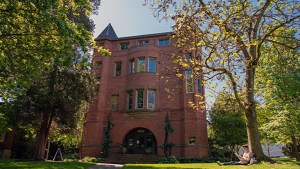
Alexander Hall at SPU
Perhaps Miss Widger met Rev. John Norton during the “subscription drive” when businesspeople of Seattle were asked to donate to get the school going. Finally in 1892 there was a classroom building under construction for classes to begin in 1893.
In the 1890s Minnie Widger’s life would change drastically not because of the school itself, but because of coming to know one of the founders of the school, Rev. John C. Norton.
Seattle booms in the 1890s
After the Great Seattle Fire of June 6, 1889, newcomers poured into Seattle for the rebuilding, and every sort of civic effort gained momentum with people of influence. In just one year after the Fire, in 1890 the population of Seattle had more than doubled from about 20,000 people to nearly 43,000.

The campus of the University of Washington moved from downtown in 1895.
In the 1890s the streets of Seattle were being reorganized, neighborhoods such as Fremont were being officially annexed into the City and major institutions, including schools, expanded their campuses.
Seattle had had a struggling university since the 1860s which had closed three times for lack of funding. In the 1890s the decision was made to move the university from its original location (Fourth & University Streets in downtown Seattle) out to a new site with room for growth, which is the present University of Washington campus in northeast Seattle.
Other educational efforts which got underway in the 1890s included the establishment of Seattle University by the Jesuits, and a Christian school called Seattle Seminary organized by the Free Methodist church denomination.
A new school is founded at Ross/north Queen Anne
In 1890 two dynamic Seattle businessmen & their wives began to work for the fulfillment of their vision of a Christian school. Hiram & Mercie Pease did not have any children; Nils & Karen Peterson had eight children.
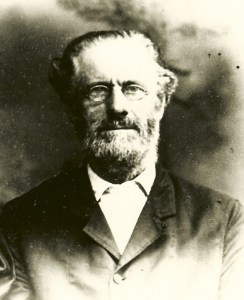
Hiram Pease, one of the founders of Seattle Pacific University
In his youth Hiram Pease had been greatly impacted by his attendance at an academy of the Methodist church in Pennsylvania. Pease credited this school not only with a good education but also for a life foundation with Christian principles of integrity and concern for others. Pease was a successful businessman in Pennsylvania but in 1873 he and his wife Mercie decided to “go West.”
In Seattle Hiram Pease was a businessman and an investor in real estate. He used his profits to support causes he cared about. He helped form the First Free Methodist church in downtown Seattle and supported it by paying the salary of the pastor. He was a major donor to the Christian school (Seattle Seminary) which was to be built at the site of land owned by the Petersons at north Queen Anne.
Nils & Karen Peterson were immigrants from Norway and had lived in Minnesota before coming to Seattle in 1878. Their children had attended Ross School, then B.F. Day Elementary School in Fremont, and then finally were able to attend the new school called Seattle Seminary which was built on the Peterson’s property at Third & Bertona Streets.
In modern-day usage the term “seminary” means a graduate school where candidates study for full-time Christian service such as becoming ministers of churches. When Seattle Seminary was organized in 1891, the term simply meant a Christian school, and in fact Seattle Seminary started as an elementary school. When it opened in April 1893 there were 34 students of grade school age.
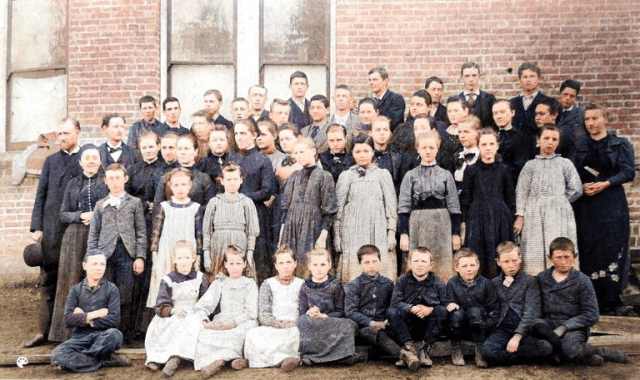
Seattle Seminary students in 1893
In 1860 the Free Methodist group was organized in the state of New York, having split from the denomination over the slavery issue. In 1890 the Oregon-Washington district of the Free Methodist Church held a conference and one of the topics was the organizing of this Christian school. The conference had a representative who came from the Minnesota & North Iowa Conference, Rev. John C. Norton, who had been sent out to help in establishing a school in Seattle.
Another member of the school establishment committee was Hiram Pease, and Rev. Norton stayed at the Pease home in Seattle. Undoubtedly Mr. Pease began to introduce John Norton to Seattle itself and to business contacts, including the Petersons who wanted the school to be located on their north Queen Anne property. Hiram Pease and John Norton started a subscription drive to underwrite the costs of establishing Seattle Seminary, starting with at least one building for holding classes.
Rev John C. Norton: from Minnesota to Seattle

Rev. John Norton, one of the founders of Seattle Pacific University
In 1869 twenty-three-year-old John Norton of Minnesota was newly married, had his own farm property and obtained additional income by teaching school in the wintertime. As his religious convictions deepened, by 1872 he entered a course of study like an apprenticeship with another minister, to become ordained as a minister in the Free Methodist church denomination. In 1877 John Norton was officially ordained as a minister at Osage, Iowa, where he was pastoring a church.
Sometime during this period of the late 1870s, John Norton’s wife Georgianna left him. Taking their little daughter Lillian Rose with her, Georgianna returned to the home of her parents, Will & Henrietta Runnels, proprietors of a hotel. Census and other records show that Georgianna & Lillian stayed with the Runnels until Lillian became an adult and married. After the deaths of the Runnels, Georgianna lived the rest of her life with Lillian and her husband who was a prosperous grain merchant in Chicago. We don’t know whether John Norton kept in touch with his daughter or if he ever saw her again.
Churches expect a pastor to “set a good example” and when there is a divorce, accusations of blame are sometimes made as to which of the couple, the pastor or his wife, was “at fault.” During this difficult time, John Norton was left without a church assignment, and he returned to teaching school.
Once enough time had passed, or perhaps under a different regional director, John Norton was reinstated to ministry in Minnesota. Then because of his experience as an educator, in 1890 John Norton was sent out to Seattle to help organize the new school sponsored by the Free Methodist denomination. Perhaps the Minnesota-Iowa conference thought that as a single/divorced man without family obligations, John Norton was a good candidate, able to take this cross-country transfer assignment. John Norton might also welcome a fresh start in a city where no one knew him.
Meeting and marrying Minnie

Minerva Widger married John Norton in 1892 in Seattle.
John Norton and Minerva Widger were married in Seattle on May 8, 1892. We may speculate on how they met. Perhaps Minnie Widger attended the downtown Free Methodist church or perhaps she met John Norton during the campaign to raise funds for the Seattle Seminary at Ross. Perhaps, as a businesswoman of Seattle since before the Fire of 1889, Mr. & Mrs. Hiram Pease knew Minnie, and we may wonder whether they played Cupid to introduce John Norton to Minnie.
Similarities between John Norton and Minnie Widger were that both were from large farm families. Each of them had an eldest brother who had served in the Civil War. Minnie’s eldest brother survived the war but her second-oldest brother was killed in battle. John and Minnie each had one sister who had married a Civil War veteran.
Other similarities between John and Minnie were that they had each traveled across the USA to Seattle, where they wanted to stay. As a minister John Norton knew that he would be expected to move around to different church assignments and perhaps he felt that this had been part of the reason for the failure of his first marriage. In discussing the blending of their lives, John Norton & Minnie Widger seemed to agree to stay in Seattle.
Upon marriage to Minnie in 1892, John Norton withdrew from ministry, but he continued helping to administer the new Seattle Seminary program, as he was chairman of the Board of Trustees. Although he did not teach at Seattle Seminary, he and Minnie lived conveniently nearby at the house on Jesse Street in Ross, along with Minnie’s mother Betsey.
Plans for the ship canal
From a tiny creek, today the ship canal is a major waterway which can handle large boat traffic.
We might have expected John & Minnie Norton to stay long-term at this convenient location in Ross, but changes came which may have motivated them to move away.
In the 1890s Seattleites continued to talk about cutting a ship canal through from Lake Washington to Lake Union to Puget Sound, just as Seattleites had been talking about since the 1850s. In 1895 the King County Board of Commissioners passed a resolution authorizing the acquisition of the canal right-of-way. This meant that Ross residents living close to the existing Ross Creek might need to vacate for the construction of a ship canal.
Little did Seattleites know that the wrangling over the canal route & funding would continue for fifteen more years, until construction finally began in 1911. But in Ross in 1895 it might have seemed like a good time to get out.
From Ross to Ravenna-Yesler in 1895
 In the City Directory of the year 1895, John Norton’s occupational listing was “Secretary, Seattle Seminary.” His home address listing was “residence ½ mile north of Yesler.” This meant that he, along with Minnie and her mother Betsey, had moved to property in northeast Seattle which Minnie had bought in the 1880s. Their house (not extant now) was at the intersection of NE 60th Street & 30th Ave NE.
The Town of Yesler was a sawmill site where today there is the Center for Urban Horticulture at 3501 NE 41st Street in Laurelhurst. As of the 1890s there were no roads to the site. Two ways to get there were via the railroad (along the line of today’s Burke-Gilman Trail) or by taking a boat from the Madison Street dock on Lake Washington, up into Union Bay where the dock of the sawmill extended out in the water.

The Union Bay Natural Area is the site of the former Yesler sawmill.
The federal census of the year 1900 described this enumeration district as the Yesler Precinct which included some of what is now Ravenna (such as the W.W. Beck family), Laurelhurst (David Ferguson; William Surber) and Hawthorne Hills (Dr. Harrison Stillson). John Norton was the “enumerator” of this census, meaning that he was the one who went house-to-house and recorded the names of residents.
In the early 1900s John Norton ran sales ads in the newspaper for agricultural products he had grown, such as apples, strawberries, and chickens. He was an active member of the Ravenna-Yesler community, appearing at meetings to organize a community club and as part of a delegation to the Seattle Electric Company to appeal for extension of a streetcar line to Yesler.
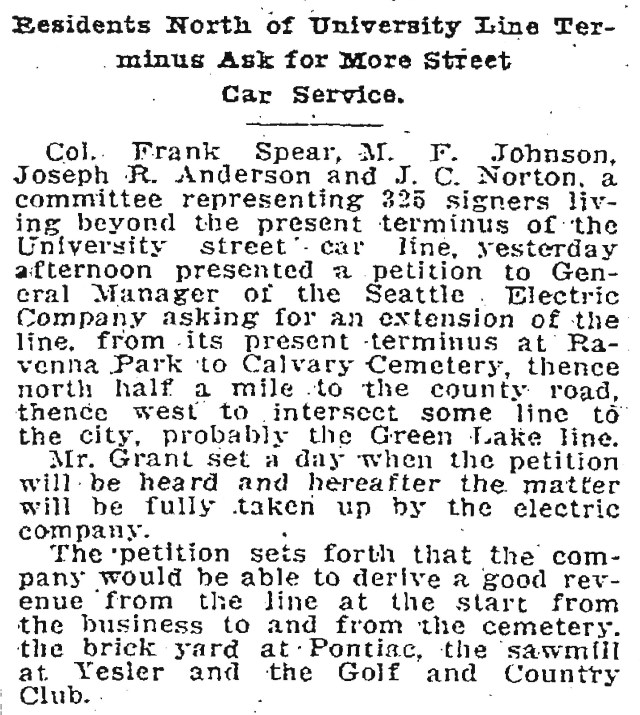
Seattle Times newspaper, February 4, 1904.
Ravenna, Yesler and Bryant neighborhood names
As of 1901 the Norton’s address listing in the City Directory was “East Ravenna, two blocks north of Calvary Cemetery.” Calvary Cemetery’s northern border was NE 55th Street. The Norton’s designation of their home as at Ravenna showed that the community’s identity was strengthening. The designation of “Yesler” now meant only the area south of NE 45th Street which was to become Laurelhurst.
The designation of “Bryant” as a neighborhood name north of NE 55th Street did not come into existence until the first Bryant School was built in 1918, on NE 57th Street. The present brick Bryant School on NE 60th Street, was built in 1926.

John Norton continued to serve on the Board of Seattle Seminary in Ross/Queen Anne for the first ten years after the school opened in 1893. He’d submitted his resignation at least once, but the Board refused to let him go, because of his unusual gifts of discernment, wise administration and forward-thinking. Finally in 1903 Norton was released from the Board and his occupation in the Seattle City Directory began to be listed as “real estate.” He was beginning to sell property that he owned in “East Ravenna” and he was transitioning into becoming a member of the business community of today’s University District.
The Nortons in the University District in 1906
Although the University of Washington moved to its present campus in 1895, the university continued to be small and struggling because the state legislature refused to provide funding for campus development. This logjam was broken upon the announcement of a world fair event which was proposed to be held on the campus in 1909.
 The Alaska-Yukon-Pacific Exposition of 1909 was the event which caused development of the UW campus and caused the Village of Brooklyn, as the district had been known, to become the University District.
Frantic activity began in 1906 to get the district ready for the AYP Exposition. Streets had to be paved, water & electricity installed, and streetcar lines built to bring visitors from downtown to the gates of the Exposition on the campus of the University of Washington.
Business development began along 14th Ave NE (later called University Way NE) in anticipation of the crowds who would visit Seattle for the AYP Exposition. In 1906 John Norton was among the group of businessmen who organized the first bank in the University District. Their first, biggest customer was the University of Washington. The UW needed a bank to deposit money and for UW employees to cash paychecks.
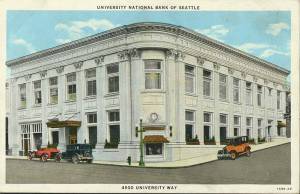
4500 University Way NE
By 1907 Norton’s occupational listing in the City Directory was that he was president of the University State Bank. Norton was about sixty years old at this time and he and Minnie moved to a house at 4548 17th Ave NE (not extant, now the site of a sorority building).
At first the University State Bank operated in the 4100 block of University Way. In 1912 a beautiful new bank building opened at 4500 University Way NE. Though the bank closed in 2018 (at that time, Wells Fargo), the bank building is historically landmarked for preservation. The building has been purchased by Hunters Capital.
The Norton’s University View plat in 1906
 Another event of the year 1906 was that John & Minnie Norton filed a plat for the land they owned between NE 55th to 60th Streets which had been described as “1/2 mile north of Yesler” and later described as “East Ravenna.” Their house (now not extant) was at NE 60th Street and 30th Ave NE, top left corner of this plat map. Today Bryant School (founded in 1918) occupies all of Block 2.
To file a plat means to register a section of land with a name, marked out with lots and streets. Filing a plat usually indicates that the owner wants to sell lots for houses or commercial buildings.
As of 1906, when the Nortons began to advertise lot sales, they knew of events which would enhance the value of their properties. The area was about to officially be annexed into the City of Seattle which would mean greater access to services. This took effect in the Ravenna area in 1907. Then as part of the infrastructure improvements for the AYP Exposition, the streetcar line was extended eastward on NE 55th Street all the way to the corner of 35th Ave NE. This was a great convenience for residents to take the streetcar to shopping or employment.
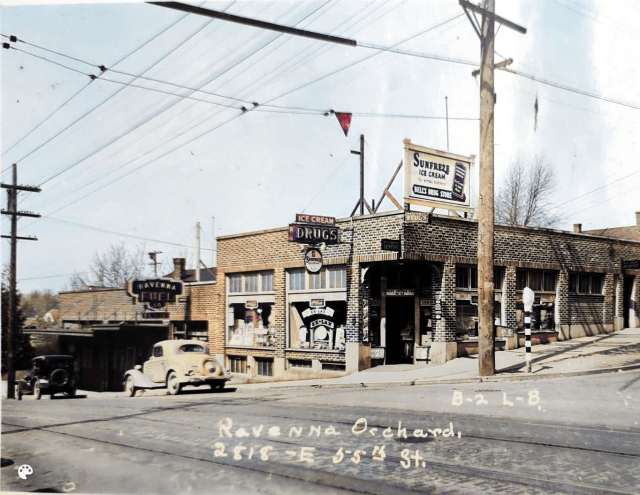
Bell’s Drugstore built 1924 at 2818 NE 55th Street, shown here in a property tax assessors’ photo of 1937. Streetcar tracks are visible in the street.
The Nortons named their plat the University View Addition, showing that in 1906 they were aware of the increased real estate activity near the University of Washington, due to preparations for the AYP Exposition on the campus. Naming their plat “University View” implied a convenient location not far from the UW. A nearby plat of 1907 filed by the Crawford & Conover real estate agency was named Exposition Heights for the same reason.
Another nearby plat, filed by the Bentons in 1906 for 28th & 29th Avenues NE, was named Ravenna Orchard because of the apple trees on the site. We don’t know who planted the apple trees but the Ravenna Orchard plat was contiguous with the Norton’s property which also advertised apple trees.
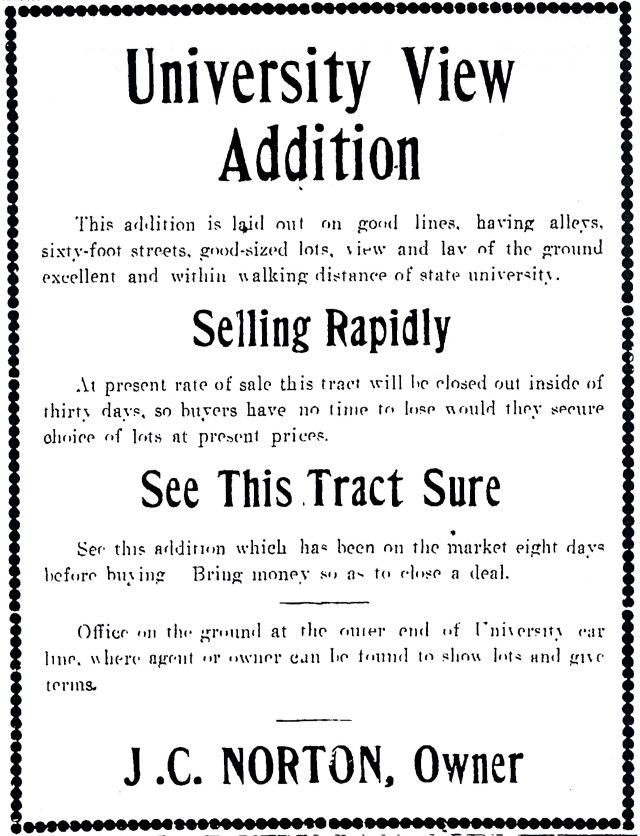
Seattle Post-Intelligencer, October 25, 1906.
The farmer’s harvest

Ravenna Methodist congregation at the Little Brown Church circa 1921, courtesy of church records.
In the years following John Norton’s 1903 resignation from the Board of Seattle Seminary, it might seem that he was no longer involved in supporting Christian programs, but that was not the case.
As of 1911 a fledgling Free Methodist church group was meeting at the former Seattle Female College building, 5702 26th Ave NE in Ravenna. Although we don’t know whether the Nortons were a part of this group, when the building burned down the Nortons offered the church a place to rebuild on property that they owned. By the end of 1911 the Ravenna Methodist group had constructed a new church building on NE 60th Street & 33rd Ave NE in Norton’s University View Addition.
At NE 57th Street, at the southern end of that same block of 33rd Ave NE, the school district acquired land from the Nortons and built a new wood-frame building in 1918. It was named Bryant School, which was the first use of the name in place of Yesler School. The Yesler name had faded from use because developers had renamed the area south of NE 45th Street “Laurelhurst.”

Bryant is the neighborhood along the southern portion of 35th Ave NE, northeast of the University Village area.
The new Bryant School on NE 57th Street soon gave its name to the neighborhood. Then in 1923 the Ravenna Methodist Church built its new brick building across 33rd Ave NE on the southwest corner of NE 60th Street, and a new brick Bryant School, built 1926, took its place on the southeast corner of NE 60th. Both structures still stand today and the neighborhood is referred to as Ravenna-Bryant.
John Norton’s bequests
John Norton died at age 67 in 1913. His bequests showed his intention to dedicate his resources to support Seattle Seminary (Seattle Pacific University) and other Christian outreach. Rev. Norton reserved the property he owned first for the support of his widow, Minnie, but he wrote that the profit from lots sold in the University View plat (the land around today’s Bryant School) were to go for the support of Seattle Seminary and other Christian ministries.
Like farmers who sow seeds and expect a harvest, John & Minnie Norton had invested in land in northeast Seattle which turned into a good harvest of support for the ministries which were important to them. The legacy of this early Seattle couple is still felt in the school they supported (Seattle Pacific University) and in the attractive community built on the Norton’s University View properties around Bryant School.
Sources:
Blog article: “The Lesser-Known Leaders,” in “Response,” the Seattle Pacific University blog, by SPU President Daniel J. Martin, 2016.
Census & City Directory listings; genealogical records: Ancestry.com; FindAGrave.com; Polk’s Directory of Seattle; Washington Digital Archives.
Books:
 Four Wagons West, by Roberta Frye Watt, 1931.
History of Seattle from the Earliest Settlement to the Present Time, by Clarence Bagley, 1916. Page 138, “John C. Norton.”
Rooted in Mission: The Founding of Seattle Pacific University 1891-1916, by Howard A. Snyder, 2016.
UniverCity: The Story of the University District in Seattle, by Roy Nielsen, 1986.
HistoryLink essays:
#2707 Street Railways in Seattle by Walt Crowley, 2000. A synopsis of how streetcars service began in 1884 in downtown and how service was gradually expanded by developers.
#494 Ross Post Office opens July 30, 1888, by Greg Lange, 1998.

Peterson Hall, built in 1905 at Seattle Pacific University
#504 Ravenna Post Office opens on January 8, 1890, by Greg Lange, 1998.
#5427 Seattle Seminary opens April 4, 1893, by David Wilma, 2003.
#10186 King County Superior Court approves condemnation of land along a proposed route for Lake Washington Ship Canal, by Jennifer Ott, 2012.
#8774 Seattle races to complete infrastructural improvements – AYP Exposition 1909, by Jennifer Ott, 2008.
Newspaper references: The Seattle Daily Times and Seattle Post-Intelligencer accessed on Chronicling America and via Seattle Public Library.
Property records and plat filings: Puget Sound Regional Archives, repository of the property records of King County.
Seattle Facts/Quick Information page on the Seattle Municipal Archives.

On NE 55th Street at the corner of 35th Ave NE, the line of streetcar tracks can still be seen. In about 1908 the end point of the route was at this corner with a wye turnaround where there is now the mausoleum building of Calvary Cemetery. The streetcar was extended due to the efforts of John Norton and other neighborhood activists. Photo courtesy of Feliks Banel.

 Wedgwood in Seattle History