Those of us who grew up in the 1950s and 1960s in northeast Seattle lived in a world of shopping malls like University Village, fast food outlets like Taco Time, drive-ins like Burgermaster, and multiple gas stations which seemed to thrive in commercial districts. The block of NE 45th Street from 25th Ave NE eastward to Union Bay Place NE was like this. University Village Shopping Center opened in 1956, and to the east of it there were gas stations, a car wash, Taco Time and Burgermaster.

In February 1957, workers on the NE 45th Street Viaduct looked out over University Village and the Carnation Dairy plant. Seattle Municipal Archives item #54114, Engineering Dept., colorized photo.
Our 1950s-1960s memories of NE 45th Street are of the second phase in its development. Its first phase began in the 1920s when the site of University Village was farmland, and to the east was a gas station and a corner market. In a photo of the NE 45th Street Viaduct under construction in 1939, looking eastward, we see the farmland and a couple of gas stations and stores beyond it.

In 1939 during the original construction of NE 45th Street Viaduct, we look out over the farmland which became University Village in 1956. Photo of May 1939, colorized; Seattle Municipal Archives item #38898.
From then-to-now on NE 45th Street
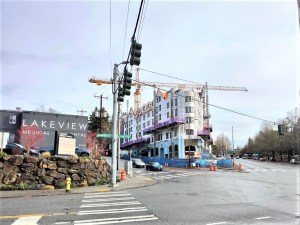
Aegis Laurelhurst senior living, under construction at the former Baskin-Robbins corner of Union Bay Place NE. Photo by Valarie, December 2022.
In a previous article on this blog, I highlighted the changes at the Union Bay Place intersection of NE 45th Street. Union Bay Place once had gas stations and a well-remembered Baskin-Robbins ice cream store. Today at the Baskin-Robbins corner, a seniors assisted living residence is being built, Aegis Laurelhurst, to open in 2024.
This blog article will trace the commercial development along NE 45th Street between University Village on the west end of the block and the corner of Union Bay Place on the east end of the block. We will note the next phase of development, coming as of the years 2024-2025, when some more of the present buildings, including Safeway and Burgermaster on NE 45th Street, may be replaced by a big new complex.
Northeast Seattle was late in development
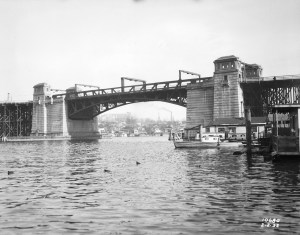
The University Bridge as it looked in February 1932. Photo 5441, Seattle Municipal Archives.
Northeast Seattle was late in development in Seattle history, in part because the area was difficult to reach by land.
Events which helped open up northeast Seattle were: the move of the University of Washington campus to its present site in 1895; a world’s fair event, the AYP Exposition, held on the campus in 1909; the creation of the ship canal completed in 1917; and the creation of bridges across the canal including the University Bridge (1919) and the Montlake Bridge (1925). These events all attracted attention to the undeveloped northeast areas, and made it easier to travel there via bridges and roads.
The plat map below was created by the well-known real estate agency, Crawford & Conover, in 1907. They thought that the world’s fair event on the university campus in 1909, the Exposition, would cause nearby land areas to open up and that lots for houses and businesses would sell well.
At the lower left corner of the Exposition Heights plat map of 1907, NE 45th Street is sketched as partly underwater. This was because it was not until 1917 that the ship canal project and associated flood control lowered the levels of Union Bay and other bodies of water.
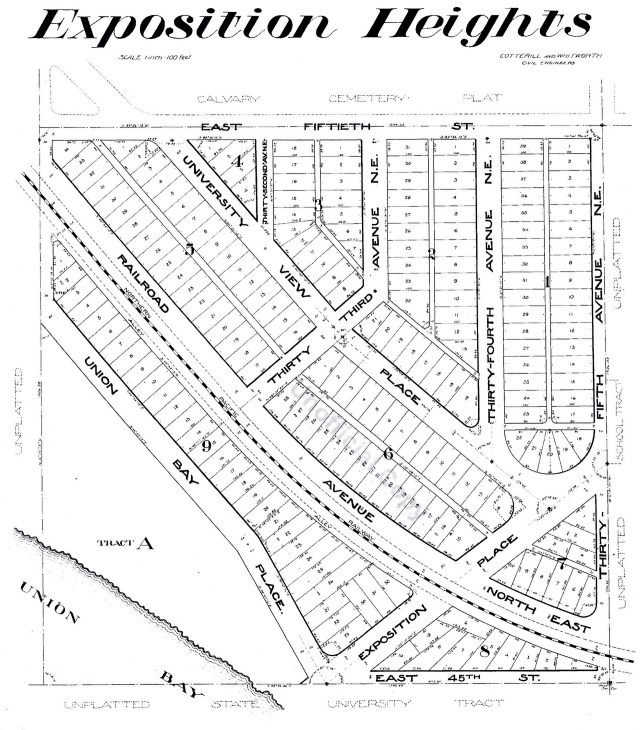
Pat map filed in 1907 by the Crawford & Conover real estate agency. They marked lots for houses and businesses, but the development of this area was very slow, partly because of lack of utilities such as water and electricity. Railroad Avenue marked here, is now Blakeley.
NE 45th Street’s first phase of development: the 1920s
Up until 1917 the present site of University Village Shopping Center at 2500 NE 45th Street was partially underwater. Once the water receded, in the 1920s the land was leased to Japanese tenant farmers.
East of the farmland, in the 1920s that block of NE 45th Street began to acquire commercial development. In that time period several gas stations were built, as NE 45th Street was becoming a conduit to other northeast Seattle regions, and residents would go past these gas stations on their way to and from work. As early as the 1920s, northeast Seattle residents drove cars because there was no streetcar or bus service out to areas like today’s Wedgwood neighborhood.

A 1939 property tax assessors photo of a gas station on NE 45th Street.
The 1950s and 1960s on NE 45th Street
Later, during the second phase of development along NE 45th Street, University Village was built in 1956 on what had been farmland.
Construction of the shopping center caused an increase in gas stations, shops and food outlets along NE 45th Street as businesses hoped to capitalize on customer traffic to University Village.
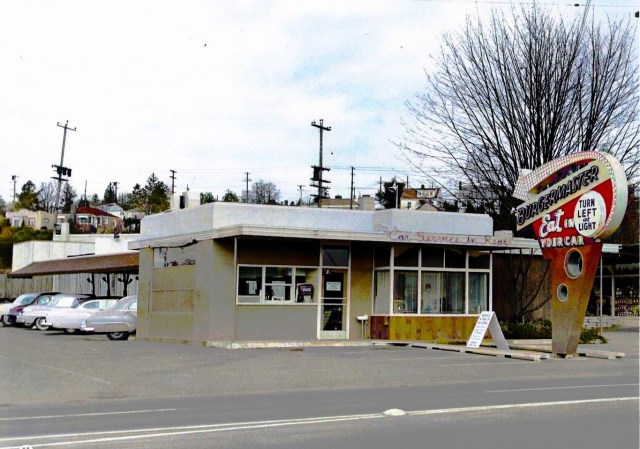
Burgermaster in 1952
The original branch of Burgermaster was built in 1952 at 3040 NE 45th Street and was enlarged in 1960 to become an eat-in restaurant. Other branches of Burgermaster in suburbs of Seattle have carhops to bring orders, for customers to eat in their cars.

The 1960s and 1970s
Small shops and gas stations gave way to a large grocery store, Safeway, at 3020 NE 45th Street, built in 1975, and other commercial buildings like the Wells Fargo Bank and a FedEx office at 3046 NE 45th Street, on the corner of Union Bay Place NE.
The Safeway store, built on more than two acres of land, took the place of several small buildings including Taco Time and the above-pictured auto services.

Burgermaster remained after the businesses next to it were replaced by a Safeway grocery store in 1975. The re-development plan being implemented in 2023 will replace the Safeway and the Burgermaster with a new complex of buildings.
The third time period of development on NE 45th Street
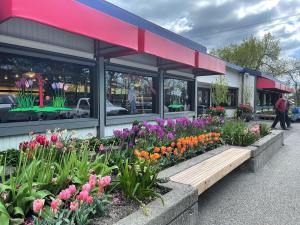
Burgermaster at 3040 NE 45th Street
A developer has bought the sites of 3020 and 3040 NE 45th Street (Safeway and Burgermaster). For that reason, on June 24, 2023, the Safeway store closed. The closing of Safeway, and the potential closing of Burgermaster for a new development, represents the third time period in the business history of NE 45th Street.
The developer filed a plan which will not include a grocery store; the new cluster of buildings will have some retail shops with apartments on the upper floors (conceptual drawing below.)
The Safeway store was shuttered as of 2023 while the developer continued to go through the design review and permitting process. The large Safeway parking lot was used for special-event parking such as for UW Husky football games.
The Burgermaster stayed open, until finally a closing date in February 2025 was announced. The building was demolished in April 2025. This means that the developer will start going ahead with plans as pictured below.

Re-development concept by Quarterra, for the present site of 3020-3040 NE 45th Street. The low-rise building at right is the present Wells Fargo & FedEx at 3046 NE 45th Street, corner of the Union Bay Place intersection.
Source list
Bridge histories: Seattle Department of Transportation.
“King County Land Use Survey,” HistoryLink Essay #3692 by Paula Becker, 2002. In 1936 to 1940 King County undertook to photograph all taxable structures; aerial photos were part of the survey.
Puget Sound Regional Archives, Bellevue, WA: repository of the property tax records of King County.
Seattle Now and Then: the 45th Street Viaduct, by Jean Sherrard, 2010.
Seattle Municipal Archives – online exhibit, the NE 45th Street Viaduct.
The development project at 3020-3040 NE 45th Street, replacing Safeway and Burgermaster, is by Quarterra, with Encore Architects.
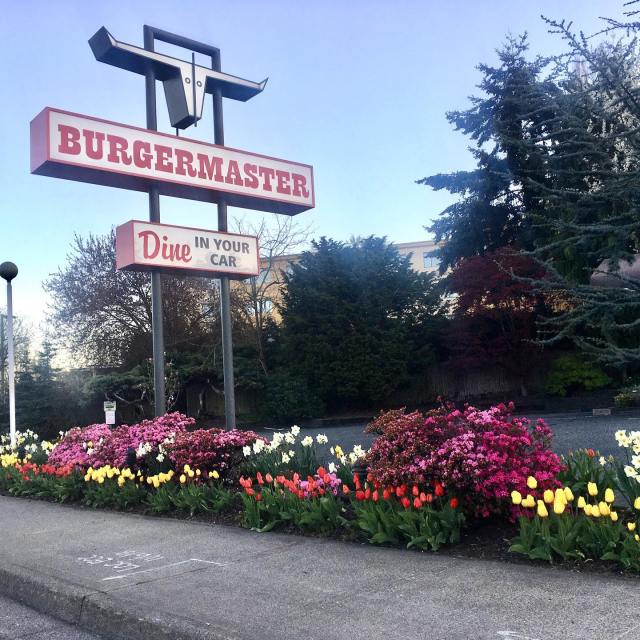
Burgermaster at 3040 NE 45th Street

 Wedgwood in Seattle History