
Benton’s Jewelers street clock was located at 3216 NE 45th Street just east of the Union Bay Place intersection.
In May 2020 a street clock called Benton’s Jewelers was removed from its location, packed and sent for restoration.
The clock at 3216 NE 45th Street was located east of the University Village shopping center and east of the five-way Union Bay Place NE intersection. The clock had originally been on the sidewalk in front of Benton’s Jewelers on University Way NE, and moved with the company to the Union Bay Place location in 1986. This was the only remaining street clock originally associated with a jewelry store in northeast Seattle.
The Benton’s Jewelers street clock was removed by a professional clock restoration service. The clock-servicing company gave the Benton’s Jewelers clock a needed rehabilitation and brought the clock back into to working order again.
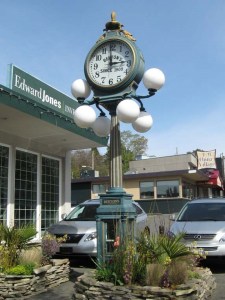
Benton’s Jewelers street clock. The buildings in the background are gone now.
The Benton’s Jewelers clock was removed for safety reasons because the clock was in a construction zone. The new owners of the clock, Aegis Laurelhurst, received approval from the Seattle Landmarks Board to send the clock for restoration and storage, and then bring it back to its location.
In December 2023 the Benton’s street clock was set up at the corner of the Union Bay Place intersection where the Baskin-Robbins used to be. Construction of a new building on the site, Aegis Laurelhurst at 3200 NE 45th Street, is to be completed in early 2024.
Aegis Laurelhurst is a senior living building. This new construction has consumed the entire corner at Union Bay Place NE at the corner where there had been a Baskin-Robbins ice cream shop and other buildings.

Benton’s street clock is in place of the former Baskin-Robbins site, now Aegis Laurelhurst. Photo by Valarie, December 2023.
Tracing Seattle history through its clocks
The journey of the Benton’s Jewelers street clock represents the changes in the Seattle business environment over the past one hundred years. In the 1920s street clocks were a signal of jewelry stores which also did watch repair, most prominently in downtown Seattle. Today there are a few clocks remaining in downtown Seattle and some have been moved elsewhere.
Business pressures as well as changes in the built environment caused Seattle street clocks to move from one location to another along with the owners, then fall into disuse when businesses closed. Benton’s Jewelers closed in 2008, just short of the hundredth anniversary of the company. The Benton family retained ownership of the clock until purchase of it by the Aegis company.

In May 2020 the Benton’s Jewelers street clock was removed for restoration. Photo courtesy of the Laurelhurst Blog.
The Benton’s Jewelers street clock was in a block of now-demolished small buildings, including a beloved Baskin-Robbins ice cream store at the point of the triangular-shaped block at the intersection of Union Bay Place NE. The new owner of the block has built a type of business new to the neighborhood, a large senior-care residence, Aegis of Laurelhurst.
Historic preservation of street clocks
Seattle street clocks are protected under a City historic landmarking ordinance. Part of the historic landmarking ordinance for Seattle’s street clocks is the requirement that clocks be placed in public view.
The owners of the Aegis Laurelhurst senior-care building applied to the Seattle Landmarks Board for approval to remove, restore, and re-set the Benton’s Jewelers clock in place at the new building. As of December 2023, with construction fencing still enclosing the site, the clock was already set up at the Union Bay Place corner.
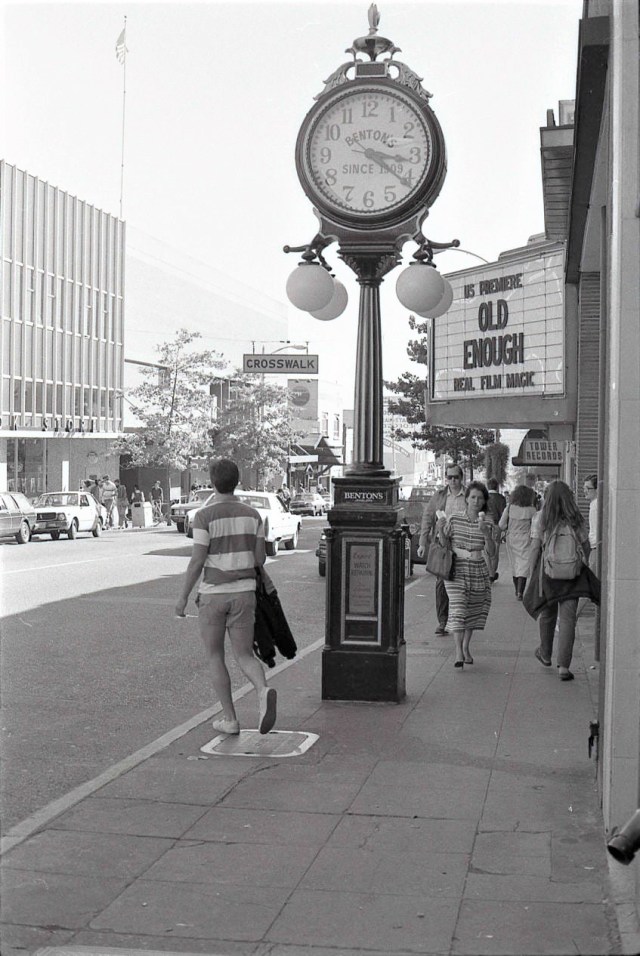
Benton’s clock as seen on University Way NE, its original location, circa 1984. Next door was the Varsity Theater; across the street is the University Bookstore. Photo courtesy of Seattle Public Library Special Collections.
Joseph Mayer, the ClockFather of Seattle
Joseph Mayer immigrated from Germany to Seattle in 1883 and although he was only fifteen years old, he obtained work as a watchmaker. A few years later, Joseph was joined by his brothers Albert & Markus. In 1897 they formed Mayer & Brothers, a manufacturing jewelry company.
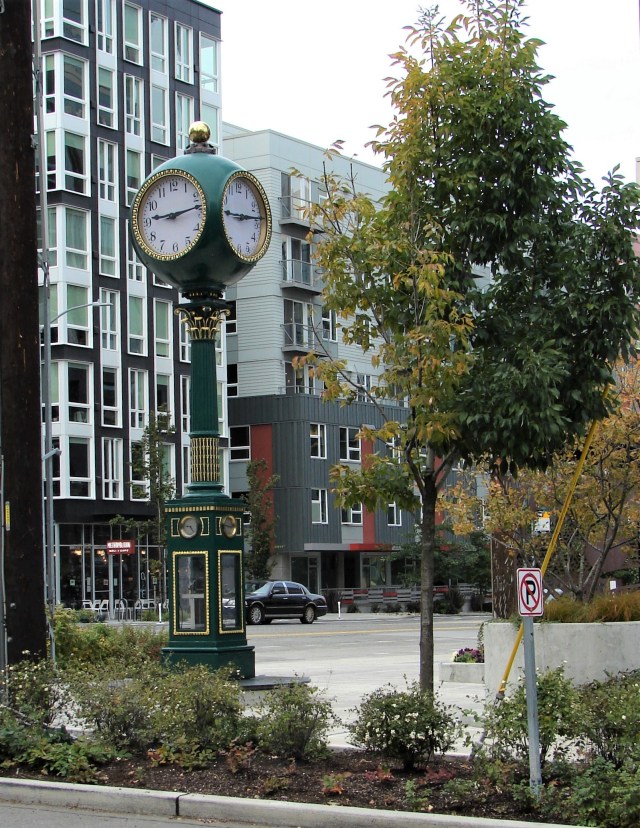
The clock at 406 Dexter Avenue North (northeast corner of Harrison Street) marks the former site of Joseph Mayer’s factory. Photo by Valarie.
The Klondike Gold Rush began in July 1897 with a steamship of miners who arrived in Seattle with “a ton of gold.” The news set off a flood of people coming through Seattle on their way to the gold fields. Seattle businessmen launched a national publicity campaign for gold-seekers to come to Seattle as the place to buy supplies before going north, and as the place to return with riches to deposit. The gold rush was a kick-start to the Seattle economy and it created a market for fine jewelry and other symbols of prosperity.
The Mayer brothers rode the wild wave of the gold rush Seattle economy to become employers of 150 people and become the premier name associated with Seattle’s street clocks.

The Joseph Mayer street clock at 406 Dexter Avenue North has visible clockworks.
The Mayer & Brothers company was categorized as a manufacturing jeweler which, in addition to street clocks, also created jewelry, sterling silver tableware, household clocks and a variety of pins, medals, and souvenir spoons. The Mayers got the contract to make street car tokens for the City of Seattle.
Starting in about 1906, Mayer & Brothers became representatives for a Boston manufacturer of street clocks, the E. Howard Company, and in addition to handling sales, Joseph Mayer did some enhancements of the Howard clocks.
It was because of Joseph Mayer’s street clocks that Seattle began to be called the City of Clocks. There was a boom in jewelry shops and banks in Seattle after the 1897 gold rush and jewelers began marking their locations with street clocks. A news article of 1930 said that from Fourth & Pike streets in downtown Seattle, a person standing at the corner could see sixteen street clocks within a block in every direction. All of these had been created by Joseph Mayer. Mayer & Brothers created hundreds of street clocks which were shipped to other cities, as well.
The tall Mayer Clock at 406 Dexter Avenue North (northeast corner of Harrison Street) commemorates the former site of the Mayer factory.
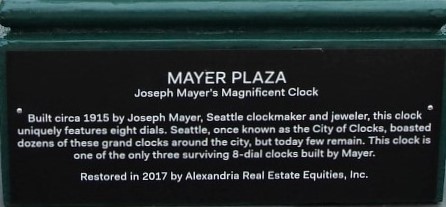
Mayer Plaza commemorative plaque.
Surveying Seattle’s Street Clocks

Ben Bridge Jewelers street clock at 409 Pike Street. Photo courtesy of Joe Mabel.
A street clock typically stands about fifteen feet high and has a cast-iron pedestal, very often painted dark green. The upper casing houses the dial and the hands. The upper casing may have ornate crests with globe lights.
Within the pedestal base is the movement gears which keep the clock running. Some, like the Benton’s Jewelers clock, have a glass case in the pedestal so the the motion of the clock movement is visible. In later years in some clocks, the original weight-driven drive trains were converted to electricity so that no one needed to wind the clock.
By 1953 there were so many Seattle street clocks which were not in good repair, that Seattle’s Board of Public Works entertained a ruling to banish street clocks. After a public outcry the City instead passed an ordinance requiring clocks to be kept clean and in good running condition, including showing the correct time. This ordinance caused some businesses to remove their street clocks.
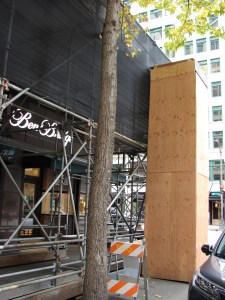
The Ben Bridge Jewelers clock at 409 Pike Street was boxed up in the year 2020 to protect it from surrounding construction.
By the 1960s and 1970s many of downtown Seattle’s historic sites were being demolished and there was even a proposed plan to clear away the Pike Place Market. The preservation movement which arose in response, led to the creation of Seattle’s historic landmarking ordinance.
In January 1981 the Seattle Landmarks Board approved preservation of a group of Seattle street clocks. Some of these clocks are still in their original locations but many, like Benton’s Jewelers, have been moved once or more than once.
The street clock at Ben Bridge Jewelers, 409 Pike Street, was removed and put into storage on September 1, 2022. In 2023 the Ben Bridge store is at a new location, Fifth & Pine, and the clock was brought there.

Photo courtesy of the Facebook page of Ben Bridge Jewelers. On September 1, 2022, their street clock was removed for storage. It was placed at a new Ben Bridge store location in 2023.
Preserving Seattle’s street clock history

In December 2023 the Ben Bridge street clock was brought to the store’s new location at Fifth & Pine.
The 1981 preservation ordinance was a thematic-group nomination of Seattle street clocks as historic landmarks. The clocks were described along with the history of Joseph Mayer and Seattle’s gold rush prosperity which created a Diamond District in downtown. As prominent features of the streetscape, the clocks convey their significance as part of Seattle’s history and personality. The legacy of Joseph Mayer still graces Seattle streets.
The Ben Bridge Jewelers clock is the only Seattle street clock still in possession by its original owners.
On September 1, 2022, the Ben Bridge clock was removed from Fourth & Pike Streets and put into storage. On December 12, 2023, the clock was brought to the new location of the Ben Bridge store at Fifth & Pine, and set up.
The clock at the former F.X. McRory’s at King Street & Occidental Ave, one block west of the Amtrak station, was also in a construction zone as of 2020. The clock’s owner, Mick McHugh, donated it to Seattle University, where the clock was set up in October 2025.
Locations of Seattle street clocks
The Benton’s Jewelers clock is the only street clock in northeast Seattle. The Benton’s Jewelers clock was rehabbed and stored during construction of the new seniors-residential building at the site, 3200 NE 45th Street.

Street clock at 7910 Greenwood Avenue North.
There are two clocks in the Greenwood business district which are maintained by the local Masons group. One clock called Greenwood Jewelers is at 129 North 85th Street, a few steps west of Greenwood Avenue. The other is at 7910 Greenwood Ave North, in front of the Masons Lodge building and next to a bus stop (convenient for bus travelers to check the time!)
North of downtown/proper, in the South Lake Union area, is the Mayer clock at 406 Dexter Ave North (northeast corner of Harrison Street), former site of the Mayer clock factory.
At the Museum of History & Industry (MOHAI) at South Lake Union is the former Carroll’s Jewelers clock which was donated to the museum; see photo at the end of this article’s source list. The clock is on the west side of the building (outdoors) near the historic ships dock.
In the heart of downtown Seattle is the Century Square street clock at 1529 Fourth Avenue (southwest corner of Fourth & Pine, across the street from Westlake Park.)
The Hong Kong & Shanghai Bank clock is at 720 Second Avenue, in front of the present United Way building just south of Columbia Street.

Century Square street clock at 1529 Fourth Avenue.
In Pioneer Square on First Avenue at the southeast corner of South Main Street is the Earl Layman clock which has been restored.
In the Columbia City district in south Seattle is a clock at 4873 Rainier Avenue South. It was moved from 1206 First Avenue in downtown.
There is a new ferry terminal on the downtown waterfront, which opened in October 2023. The Colman Dock clock will be restored to the site when preparations are completed in 2024, for setting up the clock in the new terminal.
Rob Ketcherside’s Clock Walk describes pedestal-type street clocks and others such as tower clocks like that at the King Street Train Station. The Clock Walk highlights Seattle’s many clocks which adorn places like store signs and the current transit tunnel. The clocks of Seattle hark back to the city’s history of economic boom and lively street life.
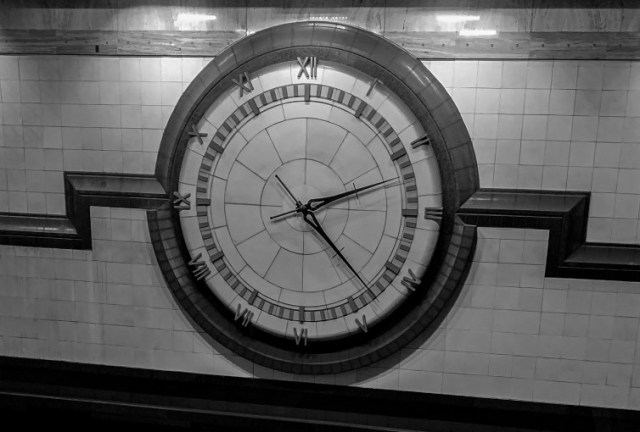
Clock in the transit tunnel at Westlake Station designed by architect Brent Carlson using terra cotta tiles. Movement for the clock was by Electric Time Company. Photo courtesy of Thoughts in Buttermilk blog.
Sources
Ben Bridge Jewelers, Facebook post of September 1, 2022. Photos of their street clock being removed for storage.
Benton’s Jewelers: my blog article about the Benton family who came to live in northeast Seattle in the early 1900s.
The historic landmark nomination report on Seattle street clocks can be read on the Seattle Department of Neighborhoods/landmarks site, or on Rob Ketcherside’s Seattle Clock Watch page. zombiezodiac.com/rob/ped/clock/landmark.htm
“Joseph Mayer Research Project.” National Association of Watch and Clock Collectors, Chapter 50 Puget Sound.
“Klondike Gold Rush,” HistoryLink Essay #687 by Greg Lange, 1999.

Lost Seattle by Rob Ketcherside shows the now-and-then of historic sites.
“Landmark Benton Clock Carefully Removed And Stored, Clock’s Community Long History.” Laurelhurst blog, June 18, 2020.
Lost Seattle by Rob Ketcherside, 2013. Pages 44-45, “Production of Street Clocks.” This book describes places which were part of Seattle’s cultural or economic heritage, and people who were important to Seattle’s history. Before and after photos show the original sites and what it looks like now.
Seattle, City of Clocks: In this November 2020 article, a Mayer family descendant tells about the legacy of his great-uncle, Joseph Mayer, who manufactured street clocks in Seattle.
Seattle Times newspaper feature article by Daniel Beekman, photos by Ken Lambert, June 2, 2024: Seattle’s Historic Street Clocks are Making a Mini-Comeback.
“Time Travel to Pike’s Forest of Street Clocks,” by Seattle historian Rob Ketcherside. He has documented the Seattle street clocks and has been a major influence on their preservation.
 Mr. Mick McHugh: former owner of F.X. McRory’s, Mr. McHugh now owns the 32 Bar & Grill at the Kraken Community Iceplex at Northgate. In a conversation on April 22, 2024, Mr. McHugh told me that he’d donated his street clock to his alma mater, Seattle University. In October 2025 Seattle University placed the clock at a new entranceway to the campus.
THANK YOU to everyone who helped me with this article, most especially Seattle historians Rob Ketcherside and Joe Mabel. Thank you to two bloggers, Feeding Squirrels and Thoughts in Buttermilk, who contributed photos. And a very big THANK YOU to the Ben Bridge folks for their stewardship of their clock, their warm greetings and courteous answers to questions.

Carroll’s Jewelers street clock was donated to the museum (MOHAI) and is placed at South Lake Union Park, where historic boats are docked. Photo of Seattle’s big snow on February 13, 2021, by Nikhil via Twitter @thenkcme

 Wedgwood in Seattle History
Wonderful article!
I remember the Benton’s Jewelers clock when it was still on the west side of University Way from the time when my age was still in single digits. And of course I more than once enjoyed ice cream at the Baskin-Robbins at “Five Corners” (where across the street, my father used to fill up the Dodge at one of the gas stations from the 1950s on)! Sad to see Seattle changing. I’m glad that the remaining clocks are being preserved though!
What a cool post! I never thought/noticed our street clocks before. And they’re all so beautiful! Thanks for this.
I went through the list and was amazed that I didn’t know about some of the clocks. Visited the clocks, talked to some owners, I left out the one in West Seattle because…. it’s in West Seattle!
This was fascinating! I walk by the Century Square clock all the time and have always wondered about its significance. Wonderful post!
Those are neat!! Thanks for sharing them.
Pingback: The Timeless Charm of the Ben Bridge Clock in Seattle