In the 1930s the (future) Wedgwood neighborhood was an unnamed area outside of the Seattle City Limits. Along 35th Ave NE, the three intersections of NE 75th, 85th and 95th Streets each had only one building: a tavern.
German immigrant John Herkenrath & his wife Freda built a house at 7724 35th Ave NE, present site of the Wedgwood Post Office. John was semi-retired and did some carpentry work. The Herkenraths owned the property from their house up to NE 80th Street, where today there is the Wedgwood Post Office, the Hunter Tree Farm lot at 7744 35th Ave NE, and the Grassy Lot on the corner owned by Wedgwood Presbyterian Church.
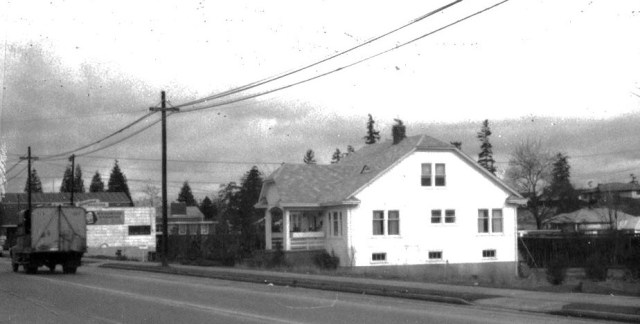
The Herkenrath house in 1958, present site of the Wedgwood Post Office at 7724 35th Ave NE. Seattle Municipal Archives photo #75875.
The 1930s in the (future) Wedgwood
In the summer of 1931, John Herkenrath was cutting down a tree on the present site of Hunter Tree Farm, when the tree fell and killed him. His wife Freda continued to live in the house at 7724 35th Ave NE until her death in 1936, and then the property passed to John’s nephew Frank J. Herkenrath.
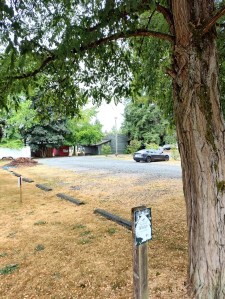
At NE 80th Street looking back southward at the Hunter Tree Farm. In the 1930s these two lots had Foster’s plant nursery business. Photo by Valarie, August 2025.
Frank & his wife Anna did not live on the property because it would have been inconvenient, too far away from Frank’s workplace at the Seattle shipyards. They rented out the house & property at 7724 35th Ave NE to Herbert Foster who started a plant nursery business there.
Herbert Foster was already seventy years old in 1937 when he moved to the Herkenrath house. Like John Herkenrath, he seemed to be in semi-retirement mode, and wanted something to do other than being fully retired. He’d worked many years at a wholesale plant nursery. He set up his new Foster’s Gardens as a retail outlet.
Foster’s Gardens was heavily advertised, with classified listings almost every week in Seattle newspapers. Some of the advertisements were for bedding plants which meant blooming plants like begonias and pansies which can be kept in pots or planted in the ground, and which will keep blooming. Other products at Foster’s Gardens were strawberry plants, tomato starts, carrots, onions and potatoes which were advertised for use in Victory Gardens during World War Two, 1941-1945, when the public was encouraged to grow more of their own food.
The first instance of Christmas tree sales in the (future) Wedgwood took place at Foster’s Gardens in 1943, in the same spot where Hunter Tree Farm is today.
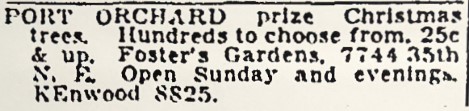
Foster’s Gardens 1943 advertisement for Christmas trees, in the Seattle Post-Intelligencer newspaper, December 16, page 22.
Developer Albert Balch would have seen Foster’s Christmas trees as he went by on his way to inspect his Wedgwood group of houses under construction on the west side of 35th Ave NE between NE 80th to 85th Streets. As a natural salesman, Christmas tree sales might have stayed in the back of Balch’s mind as a good idea. Some years later, Balch was approached by the Hunters about a place to sell their Christmas trees. Balch provided a place for the Hunter’s trees on property he had acquired, now the Wedgwood Shopping Center at NE 85th Street. That was Hunter’s first location in the neighborhood in the 1950s.
The Fosters retire
As of 1937 Foster’s Gardens was open seven days per week including evenings. By 1946, with Herbert Foster turning eighty years old, we may imagine that his wife Elizabeth put her foot down and said it was time to really retire. The couple sold Foster’s Gardens and moved to a house in the Victory Heights neighborhood.
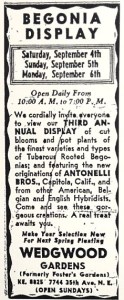
Seattle Post-Intelligencer newspaper, September 3, 1948, page 16.
The next proprietor of the plant nursery business changed the name to Wedgwood Gardens, as they saw this name which had taken hold in Wedgwood’s growing business district in 1947. Developer Albert Balch had a plat of houses named Wedgwood. A tavern owner, Henry Hansen at NE 85h Street, started the Wedgwood-naming trend in the business district by renaming his business the Wedgwood Tavern.
The new owner, as of 1947, of Wedgwood Gardens was Paul Mayer, a German immigrant. He’d been in the USA for about twenty years and had married an American, Marie Vultee. They came to Seattle with all of Marie’s family: her parents and her sister, Marguerite. The Mayers and Marie’s parents, Alfred & Amy Vultee, all worked at the plant nursery business while Marguerite kept house for them.
In these post-World-War-Two years the Mayers advertised, just as Herbert Foster had done, about bedding plants which would quickly dress up the yard of a house. They also hired a part-time worker who would help with landscaping projects. People could buy shrubs and trees at Wedgwood Gardens and have the worker come to put the plants into the ground at their home.
In the years after the end of World War Two in 1945, northeast Seattle boomed with housing growth. It would seem that Wedgwood Gardens would be successful in this business climate, but signs of trouble soon appeared. In the same year, 1952, that Wedgwood Gardens won grand prize at Seattle’s Spring Flower Show, news articles also told that the Wedgwood Gardens property might be made into a grocery store complex.
As of 1952, Paul Mayer was approaching sixty years of age and his father-in-law, Alfred Vultee, was nearly eighty years old. A developer wanted to buy their property, so they may have felt that this was a good time to take the opportunity to sell.
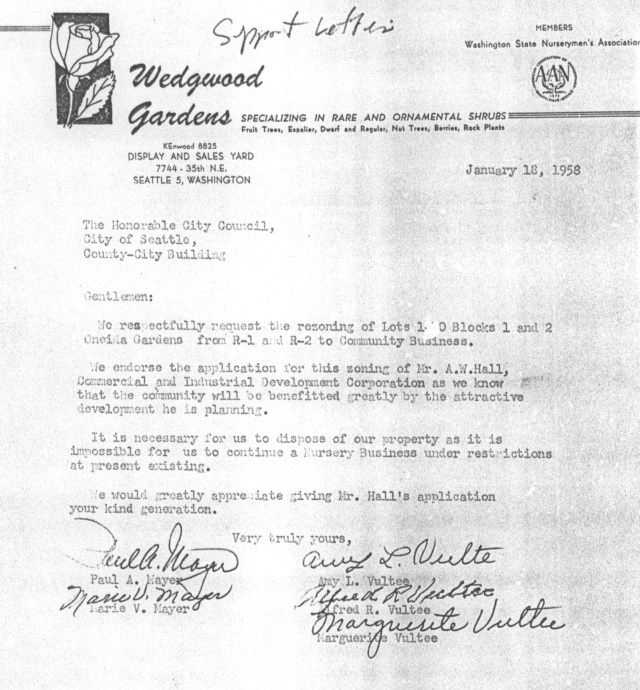
The rezoning issue
The rezoning controversy dragged on for six years until finally in 1958 the City of Seattle Planning Commission issued a ruling. In this letter, it was stated that there already were clusters of businesses at the intersections of NE 75th and NE 85th Streets. The City did not want to disrupt the surrounding single-family zoned area, by allowing “spot zoning” for a commercial business at the corner of NE 80th, site of the Wedgwood Gardens.
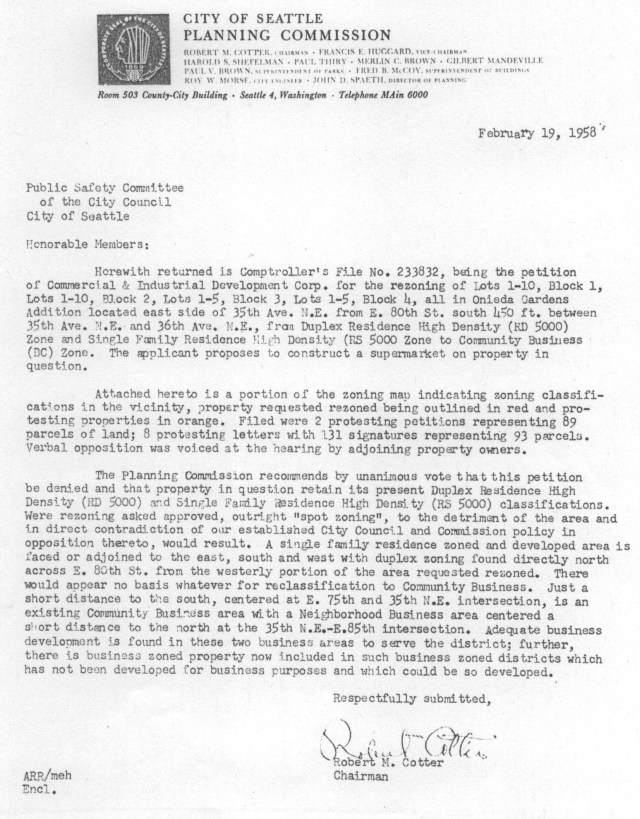
Wedgwood Gardens closes its business

Sales building at the present Hunter Tree farm dates from the earlier Wedgwood Gardens business. Photo by Valarie.
During the week that the final zoning decision came out, Paul Mayer’s sister-in-law, Marguerite Vultee, had been hospitalized, and she died two weeks later. This may have been the last straw for the family. The Mayers and Vultees had been in Seattle for about twelve years and after Marguerite’s death, they returned to Tampa, Florida, where they had previously lived.
The Wedgwood Gardens property was left derelict until the mid-1960s when it finally sold. The little building which is still used by Hunter Tree Farm, is the only relic of the former “garden days” on the site.
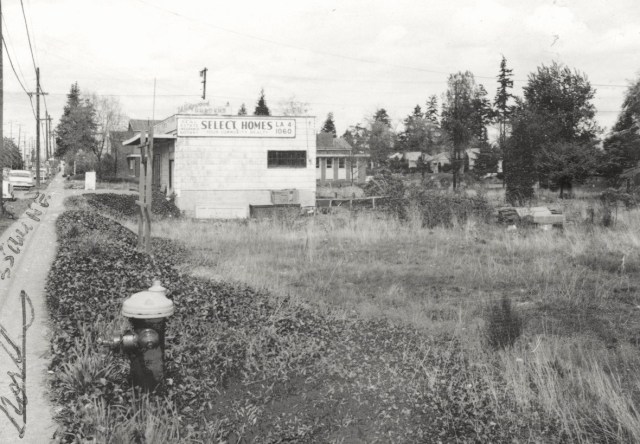
A 1962 view of the former Wedgwood Gardens site, looking northward along 35th Ave NE, today’s Hunter Tree Farm at 7744 35th Ave NE. As of this photo a realtor was leasing the sales building. In the background is Wedgwood Presbyterian Church at NE 80th Street. Photo #76716, Seattle Municipal Archives.
The Wedgwood Gardens property is sold
The former Wedgwood Gardens property was divided into three sections. The Herkenrath house was moved to 8004 36th Ave NE and the Wedgwood Post Office was built in 1967 at 7724 35th Ave NE on the former site of the house.
In 1963 Wedgwood Presbyterian Church bought two sections of the Wedgwood Gardens property. In 1973 they sold the middle section to the Hunter family, while retaining the lot at the corner of NE 80th Street. Today the Wedgwood neighborhood appreciates these areas of parklike open space.
Sources:
Genealogical and newspaper references.
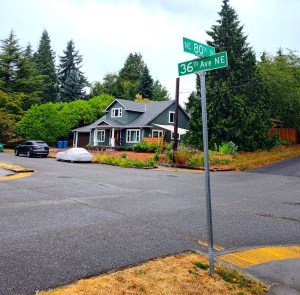
The Herkenrath house is now at 8004 36th Ave NE. Photo by Valarie, August 2025.
Photo #75875 and Clerk’s File 233832, “Petition of Commercial and Industrial Development Corporation for rezoning of Portion of Oneida Gardens Addition on 35th Ave NE and E. 80th,” Seattle Municipal Archives.
Wedgwood Presbyterian Church historical records. Wedgwood Presbyterian purchased the two south lots in December 1963, for $82,500. In September 1973 Wedgwood Presbyterian sold ½ of the property (the middle lot) to William & Carol Hunter for $60,000.
The History of Wedgwood’s Neighborhood Pubs: Today the Wedgwood neighborhood has the Wedgwood Public House at NE 85th Street and Fiddler’s Inn at NE 94th Street. Another, Ida’s Inn at NE 75th Street, closed in 1948.

 Wedgwood in Seattle History
Thanks Valarie! I’ll bet some of the heritage plantings around the neighborhood came from those nurseries. -Jim