In Autumn we observe the seasonal activities of birds. Like people, some birds fly out, migrating to a warmer climate for the winter. Some birds, and some people, stay in Seattle and make preparations for surviving winter conditions.
 Around Seattle we see Bonaparte’s Gulls which may stay for the winter.
Heermann’s Gulls are seen gliding and gulping fish while on their way to Mexico for the winter.
Local birder Joe Sweeney writes that it has become commonplace to see Anna’s Hummingbirds in Seattle even in winter, undoubtedly supported by hummingbird feeders.
In preparation for winter, Steller’s Jays seem to be frantically begging for peanuts which they cache for later consumption.

A Steller’s Jay collects peanuts for winter.
Naming the birds
The American Ornithological Society (for the study of birds) has a checklist with at least 150 birds named for people.

Anna’s Hummingbird
Sometimes it is puzzling as to why a name “sticks” when it doesn’t have local connections and may have lost its meaning. Anna’s Hummingbird, for example, was named in 1829 in tribute to a French courtier, the wife of an amateur ornithologist.
Hummingbirds are found exclusively in the West, not in Europe, and Europeans were fascinated by them. Specimens brought back to Europe were studied to try to find out if they were a bird, an insect or a combination of the two because of the hummingbird’s hovering flight.
Steller’s Jay is a bird which is native to western North America, while Blue Jay is the eastern variety. The Steller’s Jay was named after German naturalist Georg Wilhelm Steller, the first European to record seeing this bird in North America, in 1741. Steller traveled with Vitus Bering’s expedition to explore Kamchatka and the coast of Alaska.
Bonaparte’s Gull was named for Charles Lucien Bonaparte, a nephew of Napoleon. Charles came from Europe to live in the United States 1822-1826. He worked with John James Audubon in classifying collections of birds.

Townsend’s Warbler photo by Thomas Barbin, Macauley Library
Townsend’s Warbler, found throughout Washington State, was first named by naturalist John Kirk Townsend after an 1833 expedition across the Rocky Mountains to the Pacific Ocean. He saw this bird at Fort Vancouver on the Columbia River.
Like Charles Lucien Bonaparte, John Kirk Townsend wanted to work closely with Audubon in identifying and classifying birds. Arsenic had been used to preserve the bird skins which he studied, and Townsend died of arsenic poisoning at age 41 in 1851.
John Cassin (1813-1869) was another dedicated ornithologist who had a number of birds named after him. He served for the Union Army in the Civil War and spent time in a Confederate prisoner-of-war camp. His health was poor after the war and like Townsend, John Cassin died of arsenic poisoning from handling preserved bird skins.
Expeditions and collections
Like Bonaparte and Townsend, Alexander Wilson was an ornithologist who worked with collections of bird specimens which had been brought back by explorers.

Wilson’s Warbler photo by Joe Sweeney, July 2017.
Wilson was born in Scotland and came to the USA at age 27 in 1794. He was fascinated by bird species in the USA which he had not seen before. He did paintings of birds and secured subscribers to pay for the cost of publishing a nine-volume set of books containing 268 bird illustrations, published between 1808 and 1814.
Wilson’s Warbler, first described in 1811 by Wilson, was named in his honor. It is a bird which is found in northern climates, including Washington & Oregon.
It was said that Alexander Wilson died of overwork at age 47 in 1813. Wilson’s work preceded that of John James Audubon and inspired Audubon to do sets of illustrations.
Wilson was the first person to give American birds the names of people. Wilson had worked with the collections brought back from the Lewis & Clark Expedition of 1803-1806. In 1811 Wilson named the Lewis’ Woodpecker and Clark’s Nutcracker. William Clark of the Expedition had been the first to describe the nutcracker bird which he saw in 1805 along the banks of the Salmon River, a tributary of the Columbia River.

Clark’s Nutcracker photo by Ian Routley, Macauley Library
Birds, railroad surveys and the Civil War
After the Lewis & Clark Expedition of 1803-1806, the U.S. government continued to send exploration & survey teams to measure routes and resources Out West. Military men, including topographical engineers, looked for the best routes for railroads. Expeditions included naturalists who gathered specimens of plants and animals. Birds which were discovered, were sometimes named for men who later served in the Civil War, 1861-1865.
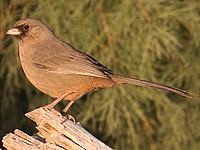
Abert’s Towhee
James William Abert (1820-1897) was among the many career military men called into service for the Union Army during the Civil War.
Abert’s Towhee was named in 1852 for Lt. Col. James William Abert, a U.S. Army officer in the Topographical Engineers who obtained the first specimen during a survey of New Mexico. He’d graduated from West Point in 1842 with this engineering degree so that he was appointed to be part of expeditions, including those of John Charles Fremont, to map the American West, inventory natural resources and survey potential railroad routes.

Couch’s Kingbird
Couch’s Kingbird is named for Lieutenant Darius Nash Couch (1822-1897), a naturalist and soldier who collected the first scientific specimen of this bird during a military expedition near San Diego, Nuevo León, Mexico, in 1853.
Lieutenant Couch also named Scott’s Oriole, a bird found in the deserts of the American Southwest, in honor of Couch’s boss, General Winfield Scott. French natural historian Charles Lucien Bonaparte gave the bird its scientific name, Icterus parisorum, in honor of the Paris brothers who underwrote the costs of French natural history expeditions in western North America.
Darius Nash Couch graduated from West Point in 1842 and served as a career U.S. Army officer, traveling out to do surveys of the American West. He became a general officer in the Union Army during the Civil War. Couch fought notably in major campaigns of the Civil War including the battles at Chancellorsville and Gettysburg of 1863. Militia under Nash’s command played a strategic role in delaying the advance of Confederate troops, preventing their crossing the Susquehanna River, critical to Pennsylvania’s defense.

Williamson’s Sapsucker
Robert Stockton Williamson (1825-1882) graduated from West Point in 1848 and was appointed a second lieutenant in the Corps of Topographical Engineers.
Williamson was assigned to conduct surveys for proposed routes for the transcontinental railroad in California and Oregon. He was then assigned to the staff of the commanding general of the Department of the Pacific and was the engineer in charge of military roads in southern Oregon.
Williamson’s party was surveying in 1855, near Klamath Lake, Oregon, when the expedition’s naturalist, John Newberry, spied a striking black, white, and yellow woodpecker. As was customary for the time, he shot the specimen, described it as a new species, and named it for his boss: Williamson’s Sapsucker.
Another man travelling with Williamson’s Pacific Railroad Survey was naturalist Adolphus Lewis Heermann, for whom Heermann’s Gull is named. During the expedition Heermann collected specimens of birds, animals, and plants and sent the specimens to the Academy of Natural Sciences of Philadelphia.
After returning from the Oregon survey, Lieutenant Williamson served in the Civil War under Colonel Burnside.
Changing the names
In November 2023 the American Ornithological Society announced that it will start changing the names of all American birds named after people. The purpose is to make birding less esoteric/more welcoming, and to remove problematic or offensive names.
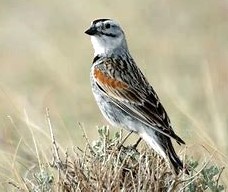
McCown’s Longspur now called Thick-billed Longspur
One such “problematic” name is McCown’s Longspur, a bird named for John Porter McCown who served on the Confederate side of the Civil War. He’d been an officer in the U.S. Army until the outbreak of the war in 1861, when he resigned his commission and chose to follow the Confederate cause.
John Porter McCown was born in Tennessee in 1815 and graduated from West Point in 1840. In the 1840s and 1850s while he was in the U.S. Army, he participated in many military actions in the Southwest. He was an amateur birder who made notes of birds that he saw.
McCown served along the Rio Grande River on frontier duty, and during this time, McCown collected birds in the area, most of which he sent to ornithologist George Lawrence. Three of these species were found to be new to science and one, the McCown’s Longspur, was named in his honor; it has since been renamed the Thick-billed Longspur due to McCown’s later connection to the Confederacy.
Sources:
The People Behind the Birds Named for People: John Cassin,” by Elizabeth Serrano, August 28, 2019, Cornell Lab All About Birds.
“The People Behind the Birds Named for People: Georg Wilhelm Steller,” by Alison Haigh, April 24, 2018, Cornell Lab All About Birds.
“The People Behind the Birds Named for People: Robert Stockton Williamson,” by Alison Haigh, September 18, 2017, Cornell Lab All About Birds.
“The People Behind the Birds Named for People: Alexander Wilson,” by Alison Haigh, January 8, 2018, Cornell Lab All About Birds.
“Steller’s Jay,” All About Birds, overview and ID info.
“What’s in a Name?, by Ian Owens, November 1, 2023, Cornell Lab All About Birds. Explains the reasons for name changes of birds and how the process will be done.

Scott’s Oriole photo by Ned Harris at All About Birds

 Wedgwood in Seattle History