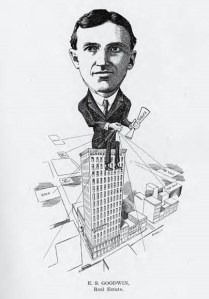
Ervin S. Goodwin, developer of Hawthorne Hills and Victory Heights.
In the 1920s, as developers began to build plats of houses in northeast Seattle, some attached property covenants specifying that no person of a race other than White, could own property in that neighborhood. One of the first to do this was Ervin S. Goodwin who bought and developed large tracts of land including Hawthorne Hills and Victory Heights.
On the east side of 35th Ave NE between NE 55th to 65th Streets, in the 1920s the Crawford & Conover Real Estate Company filed restrictive covenants on their plats called University Home Tracts and University Gardens, in what today is referred to as the Bryant neighborhood.
Like Crawford & Conover who had been active in real estate since the 1880s, there were other companies who held vacant land in northeast Seattle until such time as the population increased and more infrastructure (roads, electricity, etc.) was available. During the housing demand in Seattle during World War Two, the Mylroie family built houses on a section of land from NE 88th to 90th Streets. These traditional-style houses may have inspired developer Albert Balch who later built the original Wedgwood tract of houses.
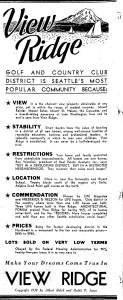 In the 1930s two young men quit their jobs as radio advertising salesmen and went into real estate. Ralph Jones and Albert Balch started with just one lot, built a house and sold it. They kept expanding and named their development View Ridge. Ralph Jones went on to build houses in the Sand Point Country Club & Golf Course.
In 1941 Albert Balch bought a forty-acre tract of land on the west side of 35th Ave NE between NE 80th to 85th Streets. He named it the Wedgwood Addition. The name “caught on” in popularity as businesses began to use it, until Wedgwood became the name of the neighborhood.
All of the above plats of land have restrictive covenants. Developers likely knew one another and kept track of how their developments were planned.
Although the restrictive covenants are now illegal, you can also apply to have a covenant completely removed from your deed records. Read on for more info.
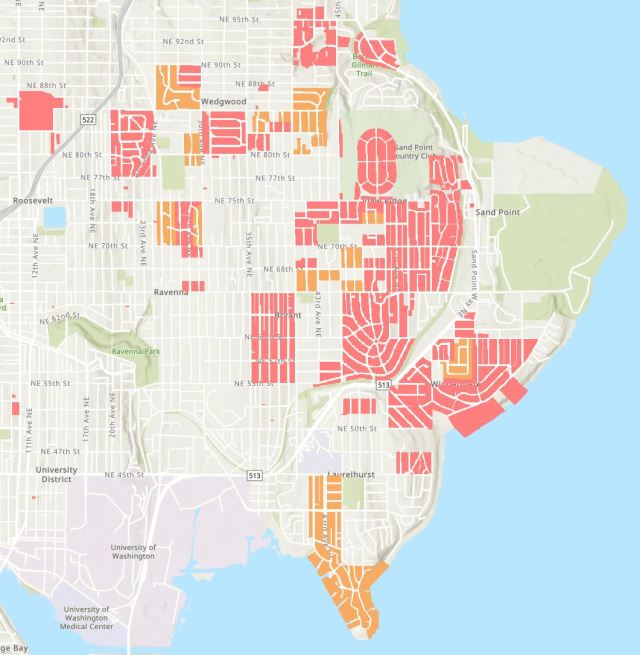
Map of northeast Seattle areas with restrictive property covenants. Map courtesy of the University of Washington’s Civil Rights and Labor History Project.
The map above shows real estate developments in northeast Seattle which have restrictive deed covenants specifying that only white people can live there. As Albert Balch expanded and built more sections of Wedgwood on both sides of 35th Ave NE, some had restrictive covenants attached and some did not.
Here is a link to the paperwork to be filled out for applying to have a racially restrictive covenant removed from your home records.

Entrance to the “original Wedgwood” on the west side of 35th Ave NE at NE 81st Street. The plat name “Wedgwood Addition” caught on in popularity and spread to become the name of the neighborhood.
To get the needed info of the legal description of your house, go to the King County Parcel Viewer. Enter your address and click on Property Report. On the next page, click on the Property Detail tab in the top right corner.
At the top of the Property Detail page is a ten-digit Parcel Number; this is the same number which is on your property tax assessment. Enter this number on the Covenants paperwork.
On the Property Detail page, the box containing Legal Description should say something like “Wedgwood Addition, Block 1, Lot 10.” This legal description of the plat name, block and lot number of your house is to be entered on the Restrictive Covenants Modification paperwork.
Don’t sign or date the paperwork until you meet with a notary. You can have your paperwork notarized at the Wedgwood branch of Homestreet Bank. All property owners whose names are on the deed (such as you and your spouse) must be present and must show a government ID such as Drivers License or passport.

Homestreet Bank in the shopping complex at 8200 35th Ave NE.
Call Homestreet Bank (now known as Mechanics Bank) in Wedgwood at 206-525-2840 to make an appointment to have your paperwork notarized.
Homestreet/Mechanics Bank is located at 8200 35th Ave NE in the shopping complex by the Wedgwood Broiler restaurant.
Another place to get your documents notarized is at Brown Study Coffee Space, 11003 35th Ave NE. Go to this link to learn about the hours of operation, what to bring with you and the fees. As is the case at Homestreet or at any notary, all property owners must be present and must show a government ID such as Drivers License.
Here’s more info from the King County Recorders Office on how to fill out and submit the paperwork.
For more info about racially restrictive covenants, go to the Seattle Civil Rights and Labor History page, a project of the University of Washington. Here is an account of the presentation on restrictive covenants in Wedgwood, in September 2024.

 Wedgwood in Seattle History
Wow. 2024, and we’re still cleaning up this mess.
When I moved from the Eastside out to Richmond Beach (circa 1990) I was shocked that the enclave of Innis Arden had, beneath the neighborhood placard, a smaller sign that read “A Restricted Community”. Today, I’m shocked that this language wasn’t stricken from all documentation ages ago. Makes me wonder about my own neighborhood. I know such language isn’t applied here, but I don’t even want my home to be associated with such language. Wow.
The problem with restrictive covenants has been, that it is legally difficult to remove them from an entire plat such as Innis Arden or others. A strategy which the University of Washington project has come up with, is for individual homeowners to apply for the covenant to be removed from their deed records. The paperwork has to be notarized and sent into the King County Recorders office.
Excellent info!
Fascinating stuff that this was even a thing in what is now considered a liberal minded city. Thanks for sharing!