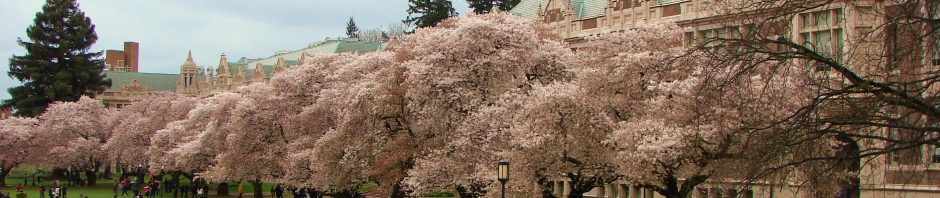
North Seattle neighborhoods like Pinehurst grew slowly from the 1920s until after 1945, when a post-War-Two housing boom began. Once the neighborhood really started to grow, residents knew they would have to preserve space for community resources such as parks and schools. Today Pinehurst has a variety of gathering places including a pocket park, playfield, and P-Patch.
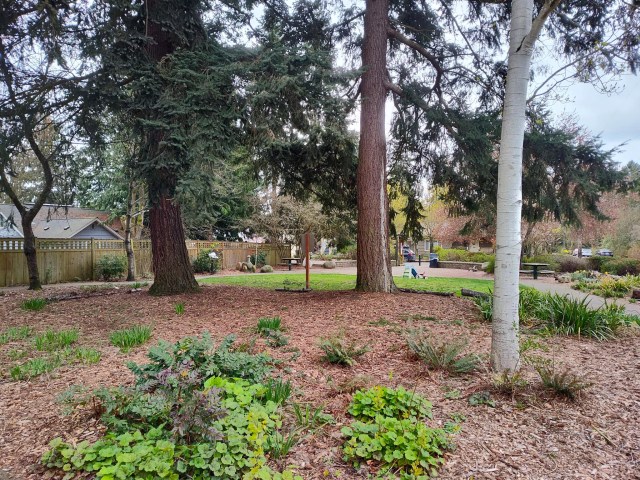
One of Pinehurst’s amenities is a pocket park at 11700 19th Ave NE. Photo by Valarie.
People of Pinehurst
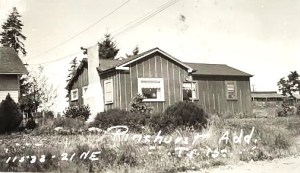
Hasenwinkle house in the 1930s. The street name was later changed to 20th Ave NE.
Pinehurst has a long history of strength in its community.
Early residents of Pinehurst formed a community club in 1935. They kept their eye on development issues such as street improvements, but mostly they enjoyed social gatherings, including holiday parties for the children of the neighborhood. One of the first all-community activities was a picnic on September 2, 1935, to be held at Kenmore Beach.
In the 1930s the center of Pinehurst Community Club activity was on 20th Ave NE where the residents of four houses on the street were the officers of the club.
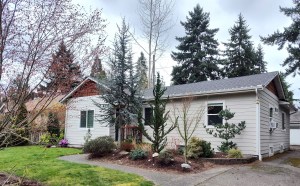
Hasenwinkle house today
Like many of his neighbors, club chairman Earl W. Hasenwinkle, 11533 20th Ave NE, worked in building trades. He was an electrician and some of the other neighbors were carpenters and cabinetmakers.
Living in Pinehurst put these tradesmen near to the customer base of the growing north Seattle neighborhoods where houses were being built.
Pinehurst grows in the 1940s and 1950s
Like many north Seattle neighborhoods, Pinehurst grew slowly in the 1930s and was still quite rural. In the 1930s many people kept chickens, like the Bach Family Farm on NE 120th Street.
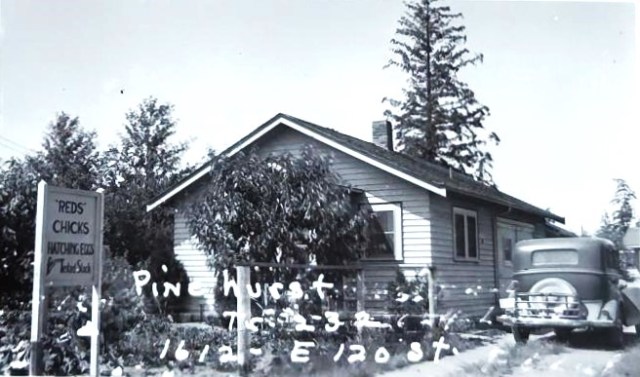
Bach Family Farm in the 1930s
The years of World War Two, 1941-1945, brought a big population increase of war workers to Seattle. Post-war, there was a housing boom as people married and started families. Young couples were attracted to north Seattle neighborhoods like Pinehurst which had a very suburban feel and where housing was less expensive. During this era, Pinehurst neighbors began to realize that they needed to set aside space for parks and playgrounds before it all got built up with houses.
Pinehurst Playfield
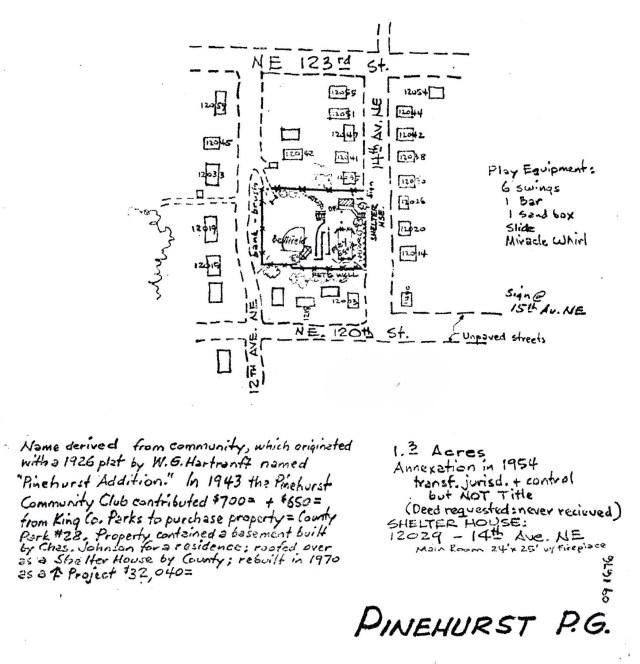
Don Sherwood Park History Page for Pinehurst Playfield
In 1943 the Pinehurst Community Club contributed $700 (equivalent to about $12,600 today) which, along with money from King County Parks, was used to buy property at 12029 14th Ave NE. Pinehurst Playfield is 1.3 acres with play structures, a baseball diamond and a shelter house.
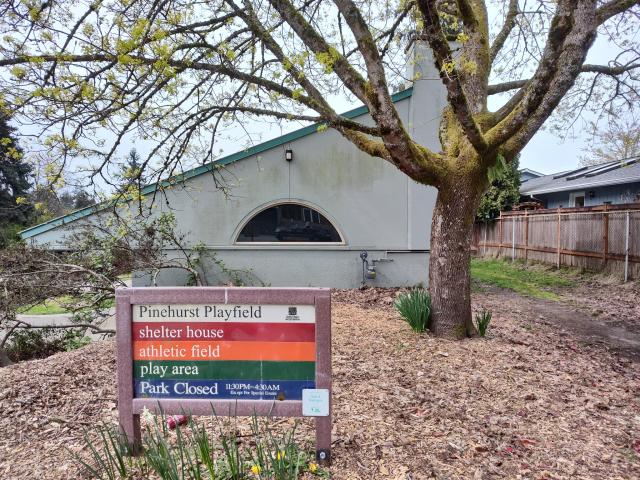
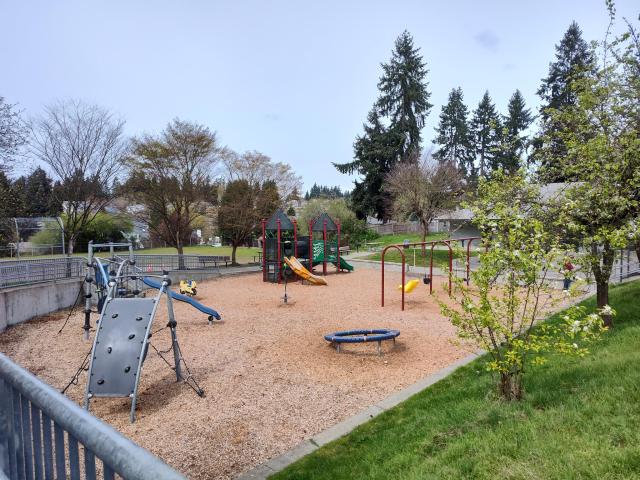
The playground at Pinehurst Playfield, with the baseball diamond in the background. Photo by Valarie.
Pinehurst P-Patch
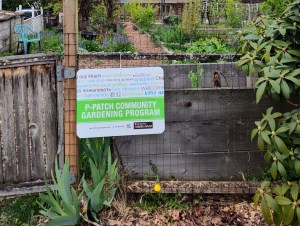
Pinehurst P-Patch at 11525 12th Ave NE
The Picardo Farm in the Wedgwood neighborhood of Seattle was sold to the City of Seattle in 1973. It was the first in the nation to be converted to a community gardening program supported by a city department created for it.
Pinehurst had long had an unofficial Pinehurst Garden at 11525 12th Ave NE, across from Pinehurst School. The garden had been nurtured by neighbors and by schoolchildren. Pinehurst Garden was officially established as a P-Patch in 1976 with 17 plots.
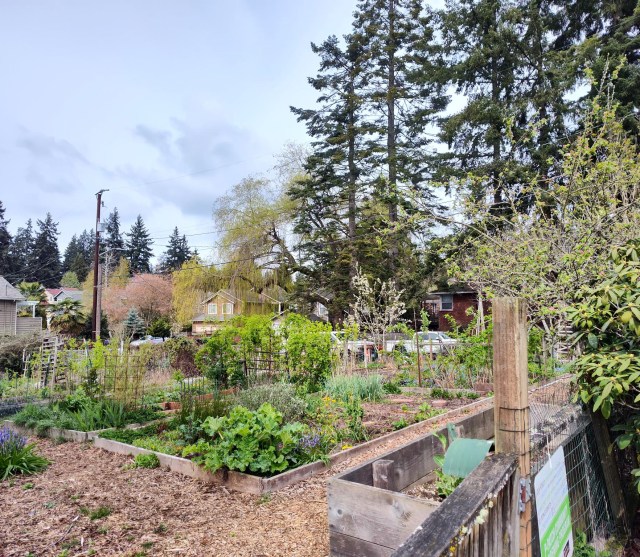
Pinehurst P-Patch
Pinehurst School
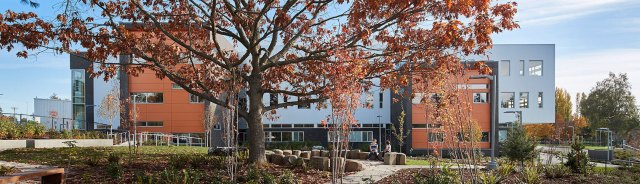
The new Hazel Wolf-Pinehurst School building as viewed from its north side on NE 117th Street.
Pinehurst School at 11530 12th Ave NE (original school building) was built by the Shoreline School District in 1950 during the last few years before the Pinehurst neighborhood officially came into the Seattle City Limits in 1953.
By that year of 1953, Pinehurst School attendance had grown so much that additions to the building had to be made. Twenty years later, the Seattle School District population of students had fallen so low that some school buildings, including Pinehurst, were closed for a time. Then in 1984 Pinehurst re-opened with an “alternative school” program emphasizing environmental education and accommodating different learning styles.
As the school reached its sixtieth birthday in 2010 the building was evaluated for safety and function, and the decision was made to build new. A new school building was designed by NAC Architects.
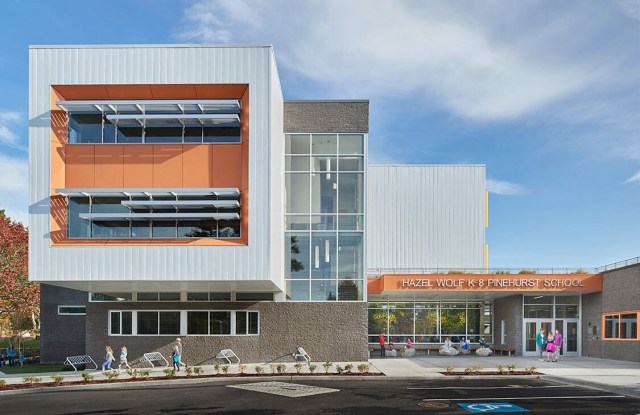
Hazel Wolf-Pinehurst School front entrance on 12th Ave NE. Photo courtesy of NAC Architecture.
The new school building opened in 2017 and was named Hazel Wolf-Pinehurst to recognize a noted Seattle environmentalist. The school building includes grades kindergarten through eighth grade and also has a preschool section. Hazel Wolf-Pinehurst is a “Choice School” which students opt to attend, with the curriculum based on environmental learning.
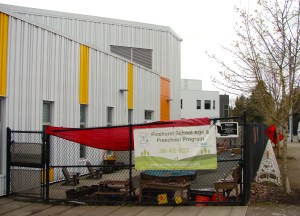
Separate entrance to the preschool at the Hazel Wolf-Pinehurst building.
The new school building is of Modernist architectural design which is perceived as “volumetric forms” (a collection of boxes). The design seeks to integrate the site into the learning experience by creating spaces for group activities as well as classrooms and other core academic areas.
In addition to a playground, the building has a central courtyard/outdoor space, and roof terraces as learning areas. The building design is meant to function as an “indoor/outdoor learning lab.”
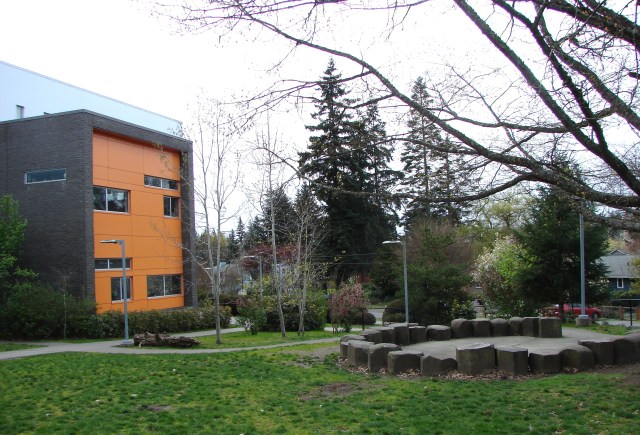
Outdoor gathering space on the north side of the Hazel Wolf-Pinehurst School. Photo by Valarie.
Pinehurst Pocket Park
Ervin L. Johnston (1900-1962) and his wife Mary (1905-1977) came to live in Pinehurst in the 1930s, perhaps because Mr. Johnston had started working for Earl Hasenwinkle’s electrical contracting company. The Johnston’s house was at 1910 NE 117th Street with an adjacent lot as a garden.
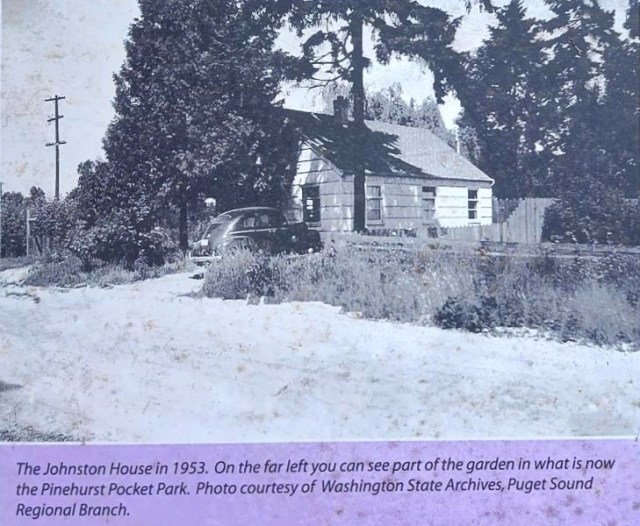
Photo of the Johnston’s house from the information kiosk in today’s Pinehurst Pocket Park
In the early days of Pinehurst it wasn’t unusual for people to own more than one lot where they might keep chickens or have an extensive garden. In the year 2000 the Pinehurst Community Council took action to obtain one of the last available lots, the garden next to the Johnston’s house, to become a “pocket park.”
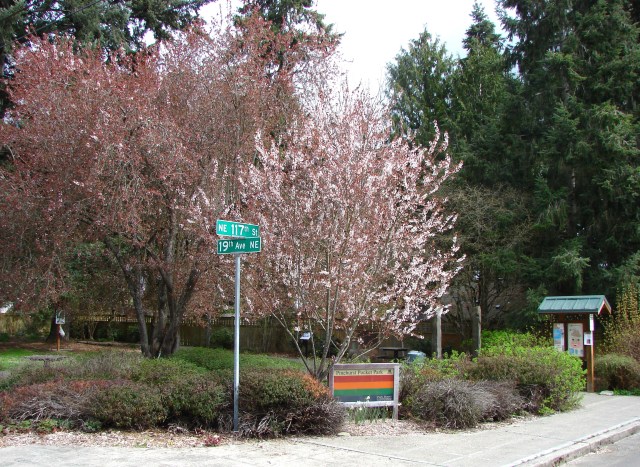
Pinehurst Pocket Park at 11700 19th Ave NE. Photo by Valarie.
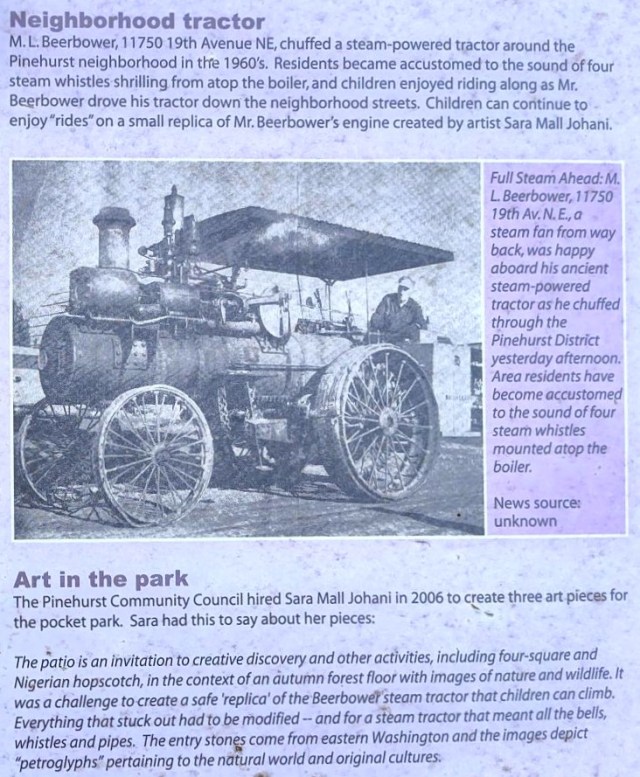
The Pinehurst Pocket Park, 11700 19th Ave NE, was constructed in 2006. Today it is an oasis in the neighborhood, a place for enjoying nature or for meeting for a chat with neighbors. Display boards in the park give tribute to the Johnstons and to Mr. Beerbower’s steam engine. The park also has a kiosk for posting neighborhood news notes.
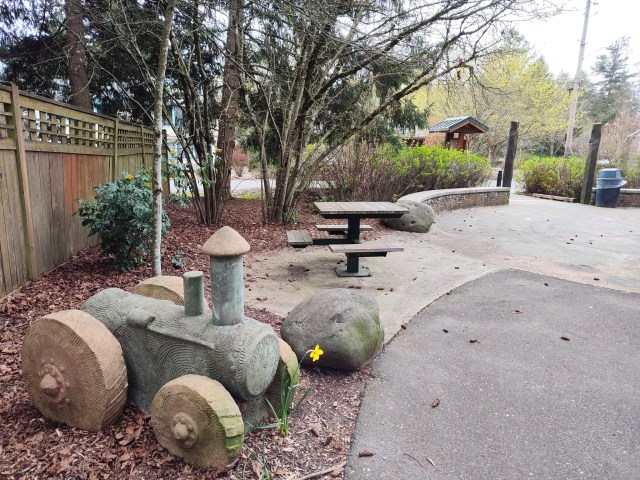
Art replica of Mr. Beerbower’s steam engine. Photo by Valarie.
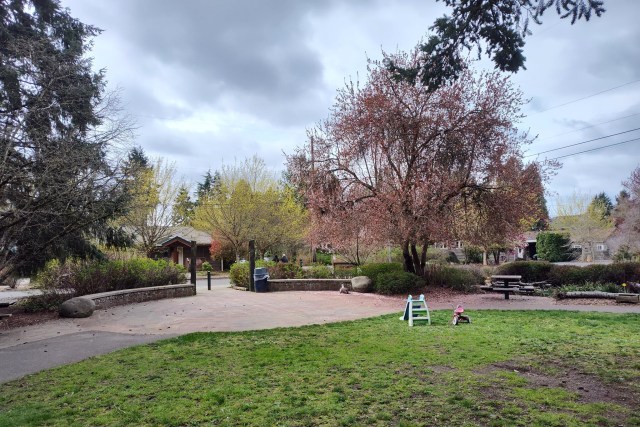
Looking southward through the entrance to the Pinehurst Pocket Park. Photo by Valarie.
For more on the history of the Pinehurst neighborhood, see the series of articles on this blog page: how the neighborhood was platted into house lots by real estate investors; the early stores and businesses; and the coming of Pinehurst Safeway, the first large store.

Entrance to the Pinehurst Pocket Park from NE 117th Street. Photo by Valarie.

 Wedgwood in Seattle History