One way to outline the history of a neighborhood is by studying its houses: the land areas which were platted, the pattern of population growth and the design of the houses.
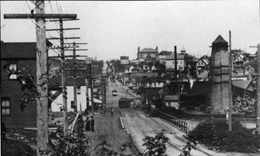
The early Fremont Bridge was a wooden trestle. This 1903 view to the north as we cross the bridge into Fremont shows the lumber mill in the foreground and B.F. Day School on the horizon. Photo courtesy of HistoryLink Essay 3309.
Fremont in Seattle was officially founded as a separate area, like a suburb, with its own name in 1888. Its boosters were real estate men who, in addition to selling lots, also made sure that it was easy to get to Fremont — they controlled the earliest electric streetcar system in Seattle and they built a line to Fremont.
Fremont was soon settled by people who worked in lumber mills, carpentry and railroad work, and many of them were Scandinavian immigrants.
Swedish immigrant Emil Nelson worked in Fremont at the Bryant Lumber & Shingle Mill Company in the early 1900s. In 1905 Emil Nelson and George Nordquist who had been a foreman at Bryant Lumber, left the company and went into business together. They established Nordquist & Nelson which produced sash (window frames), doors, moulding and interior finishes for houses.

The house at 4407 2nd Ave NW was built in 1908 by Swedish immigrant Emil Nelson.
In 1908 Emil Nelson built a home for his family at 4407 2nd Ave NW in the Palatine Hill plat. Perhaps Nelson intended the house to be a showcase for wood products from Nordquist & Nelson.
Nelson’s house has unusual arched windows on the second floor, and decorative porch railings. The barge boards and knee braces under the eaves are highlights of Arts & Crafts finishes to this Craftsman-style house.
In the early 1900s as Fremont was developing, it was very common for a carpenter-builder to buy all of the lots on a block, build his own house and then begin building and selling additional houses. The name of Emil Nelson was listed on the construction permits for other houses on his block which filled up with Swedish immigrants.
The house-histories of Fremont convey a sense of their time period in their architectural interest and in the description of the early residents.

 Wedgwood in Seattle History
Great article!!!! Thank you!! We are all immigrants!! Peace and Love!